
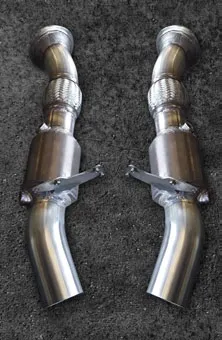
Down pipes CAT 200 cell Mansory for Ferrari 296 GTB


Down Pipes CAT 200 Cell Mansory for Ferrari 296 GTB
The down pipes — the sections of exhaust pipe that connect the turbocharger turbine outlets to the catalytic converter assembly — are the single most flow-critical component in the 296 GTB's exhaust system. Positioned immediately downstream of the twin-turbo outlets, the down pipes carry the highest-temperature, highest-velocity exhaust gas in the system; any restriction at this point acts as back-pressure directly on the turbine wheel, reducing turbine efficiency, increasing turbo lag, and limiting the maximum mass-flow rate the turbocharger can process. The Mansory Down Pipes with 200-Cell Catalysts replace the OEM down pipes and primary catalysts with a set that uses 200-cell-per-square-inch high-flow catalysts — less restrictive than OEM primary cats, which typically use 400-cell-per-square-inch substrates — while retaining catalytic function for emissions compliance in markets where catalytic-equipped down pipes are required. As part of the Mansory Carbon Fiber Body kit set for Ferrari 296 GTB, these down pipes address the highest-leverage point in the exhaust system's flow path, unlocking turbocharger efficiency gains that manifest as reduced lag, stronger mid-range pull, and an enriched exhaust note from the F163 twin-turbo V6's 663 hp combustion output across the rev range. Note: these down pipes retain catalyst function; the catless variant is available separately.
Construction & Materials
The Mansory 200-cell down pipes are fabricated from mandrel-bent grade 321 stainless steel — a titanium-stabilised austenitic alloy that maintains its strength and corrosion resistance at the sustained high temperatures (600–900 °C) experienced at the turbocharger outlet, where grade 304 would begin to sensitise at the weld heat-affected zones over extended use. The primary tube is 63.5 mm OD at 1.5 mm wall for the section between the turbine outlet and the catalyst housing; the catalyst housing expands to 100 mm OD to accommodate the 200-cell substrate, which is a 93 mm diameter metallic-substrate catalyst element rated to 900 °C continuous gas temperature. The metallic substrate — as opposed to the OEM ceramic substrate — provides the same catalytic surface area at 200-cell density while offering lower thermal mass (faster light-off after cold start) and higher structural resilience to vibration and thermal cycling than the ceramic equivalent. Post-catalyst tube returns to 63.5 mm OD and connects to the mid-pipe at the OEM secondary cat flange position. All welds are TIG, full-penetration aerospace standard.
- Material: mandrel-bent grade 321 stainless steel (titanium-stabilised) — superior high-temperature performance vs. 304
- Primary tube: 63.5 mm OD, 1.5 mm wall, turbine outlet to catalyst housing
- Catalyst housing: 100 mm OD, 200-cell metallic substrate, 93 mm diameter, rated 900 °C continuous
- Cell density: 200 cpsi vs. OEM primary 400 cpsi — approximately 40 % lower flow restriction at equivalent catalyst volume
- Metallic vs. OEM ceramic substrate: faster cold-start light-off, higher vibration resistance, longer thermal cycle fatigue life
- Post-catalyst tube: 63.5 mm OD to OEM secondary cat flange
- Welds: TIG full-penetration, aerospace quality
- Pair weight: ≈ 2.8 kg (saving ≈ 1.6 kg vs. OEM primary cat assembly)
Design & Visual Function
The down pipes are invisible in the finished car — they occupy the hot zone immediately beneath the engine bay at the turbocharger outlet, accessed only from below when the undertray is removed. Their design impact is entirely functional: reduced back-pressure at the turbine outlet lowers the pressure ratio the turbine wheel must work against, allowing the compressor wheel to spin up faster from a given exhaust energy input. This reduces turbocharger lag — the delay between throttle application and boost pressure build — which is particularly relevant for a PHEV system where the electric motor fills the low-RPM torque void but the combustion V6's hybrid mode engages progressively across the RPM range. With the 200-cell down pipes installed, the V6's boost response becomes more immediate above the electric motor's primary operating band, sharpening the transition between electric-only torque and full hybrid torque delivery.
The 200-cell catalyst density is a balance between flow efficiency and catalytic conversion rate. At 200 cells per square inch, the substrate provides approximately 60 % of the geometric surface area of a 400-cell equivalent of the same physical dimensions, but the 40 % reduction in cell count produces a proportionate reduction in flow restriction. For a turbocharged engine where exhaust velocity at the primary catalyst is high — the hot-vee architecture concentrates both turbo outlets into a compact junction — the additional cell-wall obstruction of a 400-cell substrate is a measurable flow inhibitor. The Mansory 200-cell design represents the practical optimum for a road-registered car: sufficient catalytic surface area for emissions compliance in most markets, with the maximum flow benefit achievable within a catalytic-equipped system. The metallic substrate's faster cold-start light-off also reduces emissions during the initial warm-up phase, partially offsetting the reduced steady-state surface area.
The grade 321 stainless steel's titanium carbide stabilisation prevents intergranular sensitisation at the weld heat-affected zones that grade 304 would develop at sustained temperatures above 425 °C. In the turbocharger outlet zone of the 296 GTB's hot-vee layout, sustained full-load exhaust temperatures regularly exceed this threshold; specifying 321 SS for this application is an engineering choice that extends the service life of the system beyond what 304 SS can reliably deliver in this thermal environment. The full-penetration TIG welds — inspected against a weld-quality visual standard before despatch — ensure that the seams carry the full hoop stress of the exhaust gas pressure pulse without risk of cracking at the heat-affected zone boundary.
Compatibility & Fitment
The Mansory 200-cell down pipes fit the Ferrari 296 GTB coupé (2022+), 296 GTS spider (2023+), and 296 Assetto Fiorano, connecting at the OEM turbine outlet flange and at the OEM secondary catalyst inlet flange. Lambda sensor bosses are pre-welded at the OEM sensor positions; OEM lambda sensors transfer directly. The 296 GTB's OEM secondary catalytic converter is retained downstream. No ECU modification is required for the 200-cell primary cat variant; the lambda management system operates within its normal adaptive range. LHD and RHD configurations use the same system. Assetto Fiorano cars with carbon underbody panels have the same turbo-outlet and primary cat flange positions as standard specification.
Installation & Reversibility
Down pipe replacement requires access from below with the undertray removed — a two-post lift, undertray removal, and disconnection of the OEM turbine outlet and secondary cat flanges. A qualified exhaust specialist or Ferrari dealer service workshop is recommended for this work. Time estimate approximately 3–4 hours for the first installation; subsequent refits are faster once the fastener positions are known. The OEM down pipes and primary cat assembly are unmodified on removal and can be refitted to OEM specification at any time. All gaskets, flange hardware, and sensor adapters are supplied in the fitting kit.
Pairing within the Mansory 296 GTB programme
The 200-cell down pipes deliver the greatest benefit when paired with the Exhaust Mansory for Ferrari 296 GTB — the down pipe reduces primary restriction at the turbocharger outlet while the exhaust system reduces cat-back restriction downstream, creating a coherent low-restriction path from turbine to tailpipe. Owners who require the maximum possible flow and acoustic output — for dedicated track use only — should consider the Down Pipes Mansory for Ferrari 296 GTB (catless variant), which eliminates catalyst restriction entirely but is for track/off-road use only and requires checking of applicable regulations. The Exhaust Tip for OEM Exhaust Mansory for Ferrari 296 GTB can be fitted to the OEM cat-back system if the down pipes are upgraded without the full exhaust system.
Maintenance & Durability
Grade 321 stainless steel in this application requires no active maintenance beyond visual inspection at each service interval. Inspect the TIG weld seams at the turbine outlet flanges and at the catalyst housing tube junctions annually for any thermal fatigue cracking or surface rust at exposed raw-metal areas. The metallic catalyst substrate should be inspected for delamination — a failure mode more common in ceramic substrates but possible in metal substrates under extreme thermal shock events such as cold-water induction during a heavy rain shower. Lambda sensor threads should be inspected for condition at each service; corroded sensor threads in the stainless boss can make future lambda sensor replacement difficult without damaging the boss. The flange gaskets at both ends of the down pipe should be replaced with new OEM-specification equivalents whenever the down pipes are removed and refitted.
Lead Time & Warranty
Down pipes with 200-cell catalysts carry a lead time of 4–5 weeks from order confirmation — catalyst substrate procurement and integration into the pipe assembly adds lead time versus a catalyst-free design. The 12-month warranty covers TIG weld integrity, catalyst substrate retention, and flange dimensional accuracy. Catalyst performance (conversion efficiency) is not warranted against degradation from misfueling or engine oil contamination events. Contact Hodoor with order reference and workshop photographs for warranty claims.
FAQ
Q: Are the 200-cell down pipes compliant with OBD2 catalyst monitoring?
A: The 296 GTB's OBD2 system monitors catalyst efficiency via the upstream and downstream lambda sensors. The 200-cell metallic substrate provides sufficient catalytic conversion to maintain lambda-derived efficiency readings within the OBD2 system's fault threshold under normal road use conditions. Individual vehicle calibration can vary; if a persistent P0420/P0430 code appears after installation, an ECU service update from a Ferrari dealer may resolve the monitoring threshold tolerance.
Q: What is the performance gain from the 200-cell down pipes compared to OEM?
A: Precise dyno figures depend on the specific vehicle, ambient conditions, and whether the ECU has been optimised for the new back-pressure profile. As a reference, 200-cell primary down pipes on comparable turbocharged V6 applications typically produce 15–25 hp and 15–20 Nm at peak, with more significant gains in mid-range torque response and reduced turbo lag perception.
Q: Do these down pipes require an ECU remap to realise their performance benefit?
A: The 296 GTB ECU's adaptive lambda management will accommodate the changed exhaust condition without a mandatory remap. However, an ECU optimisation calibrated for the new back-pressure profile will recover the full performance potential of the down pipes; without recalibration, the ECU's safety margins may partially constrain the boost advantage the pipes make possible.
To order the 200-cell down pipes or discuss the complete drivetrain exhaust programme for your 296 GTB, contact us via WhatsApp +44 7488 818 747 or [email protected].