
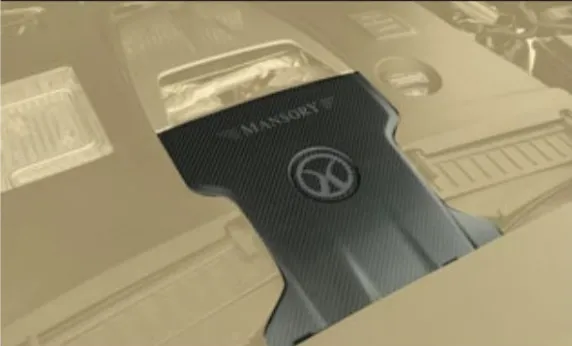
Engine cover for G63 AMG Mansory Carbon for Mercedes G-class G500 / AMG G63 W463A


Engine cover for G63 AMG Mansory Carbon for Mercedes G-class G500 / AMG G63 W463A
This is the centrepiece carbon shroud that drops over the M177 4.0-litre V8 BiTurbo plenum on AMG G63 examples of the W463A G-class — a part that exists for one reason: when the bonnet swings open at the valet, the show has to be as composed as the rest of the car. It belongs to the wider Mansory Carbon Body Kit for Mercedes G-class W463A G500/G63 programme, where every visible surface, from front mask to spare-wheel cover, has been re-skinned in autoclave-cured composite. The cover replaces the soft-touch plastic factory shroud with a one-piece carbon panel whose weave runs deliberately along the V-angle of the engine, framing the AMG twin-turbo silhouette and giving the bay the same architectural treatment as the exterior. It is a pure show piece — nothing about it adds horsepower — and that is exactly the point.
Construction & Materials
The shell is laid up from pre-impregnated 3K twill fabric over a CNC-milled positive that mirrors the OEM AMG plenum cover almost exactly, then cured under autoclave pressure to keep the resin matrix dense and void-free. Because this part lives in a hot-zone — ambient bay temperatures climb sharply on a turbocharged motor — the matrix and surface lacquer are spec’d for sustained thermal exposure, not the cooler conditions a body panel sees. The factory M177 cover’s rubber-isolated mounting pegs are retained, so the carbon shell snaps onto the stock posts without drilling, modification, or adhesives.
- Weave: 3K twill 2x2, oriented along the V8 plenum centreline so the diagonal runs converge above the throttle body
- Cure: autoclave at controlled ramp; resin Tg comfortably above sustained under-bonnet temperatures on a hard-driven AMG
- Wall thickness: ~2.0–2.4 mm depending on rib geometry; reinforced under the AMG badge plinth
- Weight: approximately 1.05–1.25 kg, roughly 35–45% lighter than the soft-touch OEM shroud
- Mounting: factory rubber-grommeted pegs — no clips, no VHB, no fasteners required
- Finish: heat-resistant 2K clear lacquer cured beyond 180°C, UV-stable, designed not to yellow when the bonnet is closed onto a heat-soaked V8
- Branding: Mansory’s signature — matte logo on a glossy field, subtly inset; the original AMG script stays beneath, hidden by the new shell, so the cover deletes AMG branding visually rather than relocating it
- Edge treatment: full wrap to the underside, no exposed laminate edges, no fibre fray
Design & Visual Function
Open the bonnet on a stock G63 and the bay reads as a slab of textured black plastic with an embossed AMG word-mark dead-centre. Open the bonnet on a Mansory-equipped car and the same volume reads as a single, anodised-feeling carbon prism with a deliberate diagonal weave. The geometry is unchanged — the cover sits at the same height and footprint as the OEM piece — but the optics are completely different: light no longer absorbs into matte ABS, it travels along the lacquer and bounces off the resin-rich peaks of the twill, throwing the V8’s outline into hard relief.
Mansory’s house aesthetic on this piece is restraint relative to the exterior. The exterior body kit is loud; the engine bay is quiet. There is one logo, machined and matte, set onto a flat field rather than raised into a bulge. The deletion of AMG branding is intentional — the bay belongs to the tuner, not the OEM, and visitors are meant to read “Mansory G63” before they read “AMG”. Owners who want the AMG mark preserved should look at standard carbon-overlay treatments instead; this is a re-shell, not a re-trim.
Functionally, the cover has the same job as the original: it hides cabling, isolates plastic intake noise, and gives the eye a finished surface to land on. The carbon adds no thermal benefit over the polymer it replaces — if anything it conducts a touch more heat outward at the surface — but it does not impair airflow either, because the M177’s induction draws from front-mounted intakes well clear of the cover’s footprint.
Compatibility & Fitment
This part is built around the AMG G63 M177 4.0 V8 BiTurbo plenum specifically, on the W463A 4th-generation G-class platform (2018+, the “new G” with independent front suspension and the wider track). It is not a G500 part: the G500’s M176 V8 has different cover geometry, and the OM656 inline-six diesel found in G350d / G400d markets uses a completely different plenum shape that this shell will not clear. Pre-2018 W463 (the old “boxy” G with the OM642/M157 powertrains) is not compatible — different engine, different cover, different mounting points. W464/W465 Gronos cars run separate engine-bay treatments. Steering side is irrelevant to the cover itself, since the M177 plenum sits central. AMG-package badging on the exterior does not change fitment; what matters is the engine code on the build sheet — if it’s 177.980, this fits.
Installation & Reversibility
This is a 5–10 minute job and a strong candidate for owner installation. The OEM shroud lifts off its rubber grommets with a firm, even, vertical pull at four points — no tools required — and the carbon replacement seats the same way, locating onto the same posts. Care is taken not to flex the carbon shell during seating; pressure should be applied directly above each grommet, not in the unsupported centre. Refitting during service (oil changes, ignition coil access, plenum work) is identical to OEM — the AMG cover is the first thing a technician removes when working on the V8, and the carbon piece comes off just as quickly. There is no drilling, no adhesive, no cutting, and no electrical interface, so reversibility is total: the original AMG cover slips back onto the stock pegs in seconds. Owners who plan to track or rally the car often keep both covers and swap to the carbon one only for shows.
Pairing within the Mansory G-class W463A G500/G63 programme
The cover is rarely specified on its own. The natural completion is the matching engine cover side parts for G63 AMG, which re-skin the inboard fender liners and complete the bay into a single carbon volume rather than a carbon island floating in plastic. Owners who want the show to start before the bonnet opens specify an engine bonnet IV — the most aggressive of the four bonnet variants — and add the air outtake for the engine bonnet, the functional vent that pulls heat out of the bay above the cover. Together, those four parts define the upper engine compartment top to bottom — bonnet skin, vent, central cover, side covers — and they are the way most owners brief the build.
Maintenance & Durability
An engine bay carbon part lives a different life from a body panel. It does not see road salt, stone chips, or wash-bay shampoo, but it does see cyclical thermal load, oil mist, and the occasional drip from a coolant top-up done by someone in a hurry. Cleaning is therefore mostly dust-and-fingerprint maintenance: a damp microfibre with isopropyl-alcohol-and-water (50/50) lifts handprints and the fine oily film that condenses out of bay air. Avoid solvents like acetone, lacquer thinners, brake cleaner, and ammonia-based glass cleaners — all four attack 2K clear coats. Carnauba waxes are unnecessary on a part that lives indoors at the engine bay; a single application of a temperature-rated ceramic coating during installation gives years of easy wipe-down. Coolant or oil spills should be wiped within minutes — both are mildly hygroscopic and will leave watermarks if they are allowed to dry. Expected service life under normal conditions is well past a decade, with the lacquer being the wear element rather than the laminate.
Lead Time & Warranty
Lead time on the engine cover runs typically 2–3 weeks once the order is confirmed and the engine code is verified, since each piece is post-cured and lacquered to order rather than pulled from a shelf. The 12-month warranty covers manufacturing defects — delamination, voids visible through the clear coat, mis-cures, fitment failure on a confirmed M177 plenum — and excludes thermal damage caused by aftermarket performance work that raises bay temperatures beyond the OEM envelope. Owners running stage-two or higher tunes with relocated intercoolers should mention it at quote stage so the lacquer spec can be matched.
FAQ
Q: Will this fit my G500 or G350d as well, since it’s the “same” W463A?
A: No. The cover is shaped to the M177 V8 plenum — AMG G63 only. G500 (M176) and OM656 diesels have different plenum geometry that the shell will not clear. The W463A platform is shared, the engines are not.
Q: Does it actually do anything thermally, or is it just for looks?
A: It is for looks. The OEM cover already isolates noise and hides cabling; this replaces that role with the same effectiveness in carbon. There is no measured intake-air-temperature change. Owners specify it because the bay reads as one piece when the bonnet opens, not because it adds power.
Q: Will the lacquer yellow or craze from heat-soak?
A: No, provided the car runs OEM-spec or close-to-OEM thermal loading. The clear coat is a 2K heat-rated lacquer cured above 180°C and is dimensionally stable through the temperature window an M177 generates at the cover’s position. UV exposure is minimal because the bonnet is shut most of its life.
Q: Is the AMG logo preserved?
A: No — that is by design. The carbon shell sits over the OEM cover’s position and the AMG word-mark is hidden beneath. The visible branding becomes the inset matte Mansory logo. Owners who want AMG to remain visible should look at carbon-overlay films, not at this re-shell.
Q: Can I take it off for service and put it back on without damaging anything?
A: Yes — that is its strongest fitment trait. Same four rubber-grommet pegs as the OEM cover, vertical pull-off, vertical press-on, no fasteners. A technician working on coils or plenum gaskets removes and refits it without thinking about it.
If you are speccing the upper bay end-to-end, brief us on the bonnet variant and side covers in the same conversation so the weave runs match across all four parts. Talk to us on WhatsApp +44 7488 818 747 or write to [email protected].