
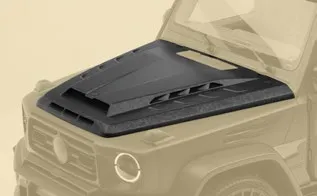
Engine bonnet IV Mansory Carbon for Mercedes G-class G500 / AMG G63 W463A


Engine bonnet IV Mansory Carbon for Mercedes G-class G500 / AMG G63 W463A
The Bonnet IV is the latest entry in a four-step evolution of Mansory carbon hoods for the Mercedes-Benz G-class W463A — and the only one in the catalogue that treats the engine bay as a thermal problem rather than a styling one. Sitting on the parent Mansory Carbon Body Kit for Mercedes G-class W463A G500/G63, this hood replaces the painted steel OEM panel with an autoclave-cured pre-preg shell, then carves out the largest extraction area of the family. Owners who specify it almost always pair it with the Performance grill mask: high-pressure air enters at the front, transits the radiator, and now actually has somewhere to go. On a slab-sided W463A that lives in stop-go traffic, on dune crawl, or behind a brake-heavy off-road rig, that exit path matters.
Why a Fourth Variant (the design problem solved)
Bonnets I and II were styling exercises — surface relief, raised power-bulge, decorative louvre detail with a mostly-closed underside. They looked the part but did not move much air. Bonnet III opened up real cutouts behind the leading edge, with a single transverse vent set; it works on the move but stalls under the hood at idle. Bonnet IV was drawn around a different brief: keep the M177 V8's turbo plenum and the M256's exhaust manifold below their thermal soak threshold even when the truck is not moving. The answer was a multi-zone vent layout — a forward NACA-style intake to feed cool air across the cam covers, plus two staggered rear extraction slots positioned over the hottest zones of the engine bay, where convective rise carries heat upward through the cutouts rather than recirculating it back toward the firewall.
Visually the IV reads as the most purposeful of the four — the vents are not decorative, the carbon weave runs continuously across the central spine, and the leading edge keeps the OEM shut-line so the front clip still sits flush with the wide front mask. It is the bonnet you fit when you want the truck to look serious and to actually behave that way.
Vent Geometry & Thermal Extraction
Total open extraction area on the IV measures in the order of 380–430 cm² across all cutouts combined, depending on whether the underside mesh inserts are specified or omitted. For comparison, Bonnet III sits closer to 220 cm² and Bonnet II is essentially closed (decorative relief only). The forward NACA-profile intake, sized roughly 14 × 6 cm at its mouth, sits ahead of the throttle bodies and feeds a cooler air mass over the intake plenum before that air migrates rearward. Heat rejection happens via two paired rear slots, asymmetrically biased — on the G63 with the M177, the right-hand slot sits directly over the turbocharger heatshield region, where exhaust manifold radiation is most aggressive; on the G500 with the inline-six M256, the bias shifts subtly because the manifold sits on the opposite side of the head.
The cutout shapes are not random rectangles. Each slot has a raised leading lip — about 8–10 mm proud of the surrounding bonnet plane — so that at any forward speed above walking pace, a low-pressure zone forms immediately downstream of the lip and actively pulls hot air out of the bay. At standstill the same lip geometry does not interfere with simple buoyancy-driven extraction. The result is a vent that works in two regimes rather than only one.
Lay-Up: Sandwich Carbon Schedule
A bonnet of this footprint — roughly 1450 mm wide by 1300 mm front-to-back on the W463A — needs torsional stiffness across two axes simultaneously: it has to resist twist between the hinges at the rear and the latch at the front, and it has to resist localised flex around every cutout edge. Mansory's solution is a directional sandwich. The visible outer skin is laid as 0/90 pre-preg twill so the weave reads cleanly to the eye and the surface stays optically flat. Beneath that sits a ±45° biaxial layer that resists in-plane shear — this is what stops the bonnet flexing diagonally when you push down on one corner. A foam or honeycomb core fills the central span, and the inner skin mirrors the outer schedule in reverse to balance thermal expansion across the sandwich. Cure is autoclave under approximately 6 bar at 120 °C for the standard schedule, which gives a void content well under 2 % and consistent fibre-to-resin ratio across the panel.
- Outer skin: 3K twill pre-preg, 0/90 orientation, two plies for surface optics
- Core: PMI structural foam (~8 mm) under the central span; reverts to solid laminate at the cutout edges
- Inner skin: 3K twill, 0/90 mirrored, with ±45 reinforcement around vent perimeters
- Wall thickness: 2.4–2.8 mm at solid laminate zones, 11–13 mm including core in the central panel
- Weight: roughly 9.5–10.5 kg complete with hinges and underside heat-shield insert (vs ~17 kg OEM steel)
- Cure: autoclave, 120 °C, ~6 bar, ramped schedule
- Mounting: OEM hinge points retained, original gas struts re-used or upgraded to higher-rate items (panel is lighter, so spring rate is matched)
- Finish: gloss clear lacquer over visible carbon; matte 2K lacquer or full body-colour paint available on request
Compatibility & Fitment (G500 vs. G63)
The Bonnet IV fits the W463A platform — Mercedes' fourth-generation G-wagen, in production from 2018 onward. That covers G500, G550 (US-spec equivalent), G400d, G350d and AMG G63. The shell, the OEM hinge geometry and the latch position are common across these variants, so the same carbon hood drops onto all of them. What differs is the underside heat-shield configuration: G63 cars with the M177 4.0 V8 BT generate noticeably more turbo radiation, so the IV ships by default with a thicker aluminised heat-shield over the inner skin in the rear two-thirds of the panel. On G500/G400d/G350d the standard insert is sufficient. The pre-2018 W463 (the original boxy 1979–2018 platform) is NOT compatible — the older car uses different hinge points, a different latch position, and does not share the W463A's cutline. Likewise, Mansory Gronos kits on W463A and any W465 successor use distinct bonnet geometry and are not cross-compatible.
Installation, Hinge & Strut Considerations
Fit time is typically 2.5 to 4 hours for a competent body shop. The bonnet drops onto the OEM hinges using factory bolts; no drilling and no irreversible modification to the chassis. The first practical question is gas-strut rate: the carbon panel weighs nearly 7 kg less than the steel original, which means OEM struts can over-extend it on opening and the bonnet will float past its detent. Mansory supplies — and we recommend specifying — a matched-rate strut pair calibrated to the new weight; this restores the OEM closing dampening and stops the panel from slamming on close. Latch alignment is set with the original striker; expect 10–20 minutes of shimming across the four hinge bolts to dial out any cosmetic gap variance. The forward NACA intake routes engine-bay air upward, so a small foam dam is usually fitted around the air-filter housing to prevent water-ingress concerns at the airbox in heavy rain — Mansory ships this dam with the kit.
The hood release cable, washer-jet lines and any bonnet-up courtesy lighting all transfer across without modification. Reversibility is total: the OEM steel bonnet bolts straight back on if an owner ever decides to revert.
Pairing within the Mansory G-class W463A programme
The Bonnet IV is rarely specified in isolation — its design intent only fully resolves when the whole front-end air path is built around it. The most common pairings:
- Air outtake for engine bonnet — adds a third extraction zone behind the rear vents for cars that see sustained high-load running, doubling the thermal bandwidth of the IV alone.
- Engine cover for G63 AMG — once you open up the bonnet vents, what sits beneath them is on permanent display; the carbon engine cover keeps that view in keeping with the rest of the car.
- Logo emblem badge for engine bonnet — the small carbon-and-metal Mansory plaque that sits on the leading edge of the IV; tiny detail, but it ties the panel to the rest of the kit.
Owners stepping up from a fully-painted OEM bonnet often combine the IV with the wide front mask + Performance grill so the air entry side matches the new exit side; running one without the other leaves either a cooling deficit or a styling mismatch.
Maintenance, Wax & Stone-Chip Repair
Lacquered visible-weave carbon on a horizontal surface lives a harder life than a vertical panel. The hood sees direct overhead UV, hot-engine convection from below, and the occasional kicked-up stone from a leading vehicle. Maintenance is straightforward but specific. Use a pH-neutral shampoo at every wash — kitchen detergents and ammonia-based glass cleaners will cloud the lacquer over time. A carnauba paste wax is acceptable for short-term gloss; a properly applied 9H ceramic coating is the better long-term answer because it resists thermal cycling and gives stone-chips a sacrificial top layer. Avoid abrasive sponges entirely; a clay bar followed by a fine polish handles bonded contamination without micro-marring.
Stone chips through the lacquer are repairable. A small chip is filled with a UV-cure clear, levelled with a 2000-grit pad and a polishing compound — a competent detailer handles it in 30 minutes. A chip that has gone through into the carbon plies is a more serious job and should be sent to a composite repair shop rather than a paint shop, because re-lacquering over a damaged weave without first stabilising the fibres will telegraph through within months.
Lead Time & Warranty
Standard lead time on the Bonnet IV in gloss-clear lacquered visible carbon is 4 to 6 weeks from order confirmation. Matte clear and full body-colour finishes add roughly one week for the additional paint cycle. Each panel is serial-numbered on the underside next to the hinge boss and ships with a 12-month warranty against manufacturing defects — delamination, voids, fitment-related cosmetic issues. The warranty does not cover impact damage, stone-chip propagation or finishes degraded by improper cleaning chemistry; those are detailed and resolved on a case-by-case basis at fair labour rates.
FAQ
Q: How much extra extraction area does Bonnet IV give over Bonnet III?
A: Roughly 1.7–2× — around 380–430 cm² of total open vent area against the III's ~220 cm². The forward NACA intake is new on the IV; the III does not have a forward feed.
Q: Can I retrofit Bonnet IV onto a car running Bonnet I, II or III?
A: Yes, directly. All four variants share the OEM W463A hinge points, latch position and cutline. We recommend re-specifying gas struts at the same time.
Q: Lacquered visible carbon, or painted body colour?
A: Visible carbon is the standard and roughly 80 % of owners pick it — shows the weave continuity. Body-colour is the right answer if the rest of the car is monochrome.
Q: How much weight does it actually save?
A: About 6.5–7.5 kg over OEM steel, depending on heat-shield spec. The real benefit is reducing mass high and forward, which marginally improves turn-in.
Q: Does it slam on closing because the panel is so light?
A: It would if you reused OEM struts calibrated to a 17 kg steel hood. Specify the matched-rate strut pair (shipped with the kit) and closing feel mirrors OEM dampening.
Pair the Bonnet IV with the front-mask and grill set, the air outtake and the carbon engine cover for a fully resolved front-end. Talk it through with us: WhatsApp +44 7488 818 747 or [email protected].