
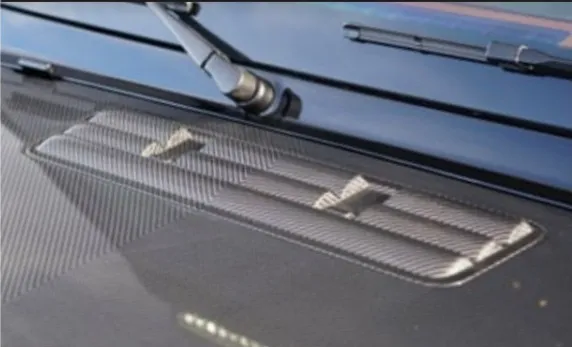
Air outtake for engine boonet Mansory Carbon for Mercedes G-class G500 / AMG G63 W463A


Air outtake for engine bonnet Mansory Carbon for Mercedes G-class G500 / AMG G63 W463A
The Mansory Carbon air outtake is the smallest discrete piece of the W463A bonnet programme — and one of the most useful pieces an owner can fit without pulling the whole panel. It is a louvred CFRP vent insert that drops onto the OEM steel bonnet or onto an existing Mansory carbon bonnet that does not yet carry an aggressive aperture, giving the bay a real exit path for hot air rolling off the M177 4.0 V8 biturbo or the M256 inline-six. Within the wider Mansory Carbon Body Kit for Mercedes G-class W463A G500/G63 it sharpens the bonnet visually and, more importantly, keeps under-bonnet temperatures manageable in slow crawl, queue traffic and at sustained motorway pace.
The Bolt-On Heat Extraction Upgrade
Owners arrive at this part by one of two routes. Route one: the truck is on its OEM steel bonnet, the bay runs hot in summer, the underside heat-shield is starting to discolour, and the owner wants an upgrade that does not require panel paint, fender realignment or insurance disclosure. Route two: the truck already wears an early Mansory carbon bonnet — typically variant I or II — whose surface is mostly closed and which therefore looks the part but flows almost no air. In either case the standalone outtake is the answer: a finished, lacquered CFRP insert with a NACA-style scooped louvre cluster, dimensioned to fit a precision cut in the host panel and sealed top and bottom with EPDM gasket so rain water exits at the rear lip rather than dropping onto the intake plenum. The reason this works on the W463A is geometrical: the fourth-gen G is taller and squarer than its predecessor, the bonnet is long, and there is genuine vertical clearance between the underside of the panel and the top of the airbox. That clearance is dead air on a stock car, and dead air is exactly what a bonnet vent monetises.
NACA Geometry & Extraction Math
The louvre profile is not arbitrary. A flat slot cut into a bonnet creates a high-pressure zone on its leading edge that fights extraction; at low road speed it can even reverse and pull hot air back into the bay. The Mansory outtake uses a NACA-derived submerged duct geometry with a gently swept ramp and a divergent throat so that the static pressure above the louvres sits just below the static pressure inside the engine bay across the operating envelope. Indicative numbers: at hot idle with the bonnet closed and a typical bay pressure rise of 30–60 Pa above ambient, the outtake will pass on the order of 35–55 CFM of buoyant hot air. At a steady 80 km/h the dynamic component dominates: the cluster sees roughly 250–320 CFM of through-flow, climbing past 400 CFM at 120 km/h. Compared with a flat slot of the same surface area a NACA-style cut typically delivers 25–40% more extracted mass flow because it preserves a clean boundary layer along the ramp instead of tripping it at the leading edge.
UV / Heat Soak Resin Selection
An air outtake is not a structural panel, but it lives in the worst thermal neighbourhood on the car. The underside is bathed in radiant and convective heat from the manifolds and turbos; the top side bakes in direct sun and takes the brunt of summer rain. A standard low-temp epoxy will yellow, soften at the bondline, and let the lacquer micro-crack along the louvre fences. Mansory therefore specs the outtake on a UV-stabilised, post-cured high-Tg matrix — glass transition above 150 °C — laid into 3K twill skins with a non-woven scrim core where the louvres turn through their tightest radii. The clear lacquer is a 2K aerospace-grade urethane with HALS UV inhibitors to keep the weave from going amber, and the same resin choice handles thermal cycling from -10 °C cold-soak to +110 °C bonnet-skin without movement.
OEM Bonnet vs. Mansory Bonnet Mounting
Two host scenarios, both fit. On the OEM steel bonnet the installer cuts a template-marked aperture through the outer skin, deburrs and primes the cut edges to stop corrosion at the pinch line, and bonds the carbon outtake on with structural urethane plus a perimeter EPDM gasket; the inner stiffening rib is preserved and the cut sits between the ribs. On a Mansory carbon bonnet (engine bonnet I in particular ships closed-face) the cut is cleaner because the host panel is a single CFRP shell, and the bonding system shifts to a CFRP-to-CFRP epoxy plus mechanical clips so the outtake can be removed for service. Either way the part arrives finished, painted and lacquered. Engine bonnet IV already integrates its own vent geometry and rarely needs the standalone outtake on top.
Installation, Sealing & Drainage
Budget six to eight hours at a body shop that has cut composite panels before. Steps: protect wings and grill, mask the bonnet, scribe the supplied template, drill the four pilot corners, jigsaw the aperture with a fine fibreglass blade, file to the line, prime the cut, dry-fit the outtake, mark the gasket line, apply structural urethane on the bond face and EPDM on the perimeter, set the part, clamp with weighted bridges for the cure, refit the underside heat shield. The drainage detail is critical: the rear lip is profiled so that water tracking down the bonnet at speed exits aft of the louvres and falls onto the cowl, never onto the airbox. Hose-test before delivery.
Pairing within the Mansory G-class W463A programme
The outtake is rarely a standalone purchase. The natural pairings are engine bonnet I for owners who want the closed-face Mansory bonnet first and add the vent later; engine cover for G63 AMG so the M177 looks finished when the bonnet is opened and the venting reads from below; and engine bonnet IV for owners who skip the standalone outtake entirely and go straight to the most aggressive integrated-vent variant. Pick one path or the other — fitting the standalone outtake on top of bonnet IV is double-counting and looks busy.
Care, Cleaning Around Louvres
The louvre fences trap water spots, road film, and — if the truck lives near pine trees — sap. A weekly detail-brush rinse with pH-neutral shampoo keeps the lacquer optically clean. Do not run a high-pressure lance straight down into the louvres at less than 30 cm: that drives water past the gasket and onto the airbox. Wax with a synthetic sealant or a ceramic spray topper rather than a heavy carnauba — carnauba softens at bay temperature and will haze. After a long motorway run, let the bonnet cool fully before opening; thermal-shocking the outtake with a cold rinse on a hot panel is the single most common cause of edge crazing.
Lead Time, Warranty & Replacement
Lead time is two to three weeks from confirmed order — the outtake is one of the faster-moving parts in the W463A catalogue because the tooling is shared across all bonnet variants. Twelve-month warranty against manufacturing defects: delamination, voids, fitment errors, lacquer failure under normal use. Replacement after damage is straightforward because the part is a discrete bonded insert: a body shop can debond the old unit with controlled heat, clean the host panel, and bond the new unit in one working day. Crash damage, chemical attack and DIY install errors are not covered.
Construction & Materials
Built as a single CFRP moulding with integrally formed louvre ribs, finished to show-surface tolerance.
- Outer skin: 3K twill 2/2, 200 gsm, weave-aligned along the ramp axis
- Inner ply stack: 2K plain at the louvre roots for tear resistance
- Cure: autoclave, post-cured high-Tg epoxy (Tg > 150 °C)
- Wall thickness: 1.6–2.2 mm at the skin, 3.0 mm at the louvre fences
- Weight: ~0.65 kg complete with gasket and clips
- Mounting: structural urethane + EPDM gasket on steel; CFRP-to-CFRP epoxy + clips on carbon hosts
- Finish: 2K UV-stable urethane lacquer, glossy as standard, satin or matte on request
Compatibility & Fitment
Designed for the Mercedes-Benz G-class W463A generation (2018+ 4th-gen platform, Mercedes internal model code). Fits G500, G550, G400d, G350d and AMG G63 with the M177 4.0 V8 biturbo. Pre-2018 W463 ("boxy" G) is not compatible — different bonnet skin, ribs and curvature. W464/W465 Gronos use a separate venting solution. LHD/RHD installs are identical (centreline part). Fits with or without the AMG package and clears the washer jets, bonnet release and sound-deadening.
FAQ
Q: Can I retrofit this to a stock OEM steel bonnet without replacing the bonnet?
A: Yes — that is the primary use case. A body shop cuts the OEM panel to the supplied template, primes the cut edges, and bonds the outtake with structural urethane plus EPDM gasket. The OEM bonnet stays on the car, no fender realignment, no full repaint, six to eight hours.
Q: If I sell the car, can the next owner remove this and go back to a closed bonnet?
A: On an OEM steel host the cut is permanent, so going back to fully stock means a replacement bonnet. On a Mansory carbon host the outtake is bonded to that specific bonnet and reversibility lives at the bonnet-swap level. Most resale buyers in the W463A market view the outtake as value-add.
Q: Will rain water get into the engine bay through the louvres?
A: No, by design. The rear lip is profiled so water tracking down the bonnet exits aft of the louvre cluster and falls onto the cowl drain, not the airbox; the perimeter EPDM gasket keeps water out at the bond line.
Q: Does it whistle at speed?
A: A correctly installed outtake is acoustically quiet up to motorway speeds. Whistles come from poorly trimmed apertures or gaps left between the gasket and the panel cut — installer faults, not part faults.
Q: Can I have it painted body colour instead of visible carbon?
A: Yes — Mansory will ship the part in primer for body-colour paint at the same body shop doing the install. The CFRP substrate accepts standard automotive primer / base / clear without issue.
Pair with engine bonnet I and finish the view with the engine cover for G63 AMG. To work out whether a standalone outtake or a full bonnet IV swap is the right call, message the team on WhatsApp +44 7488 818 747 or [email protected].