
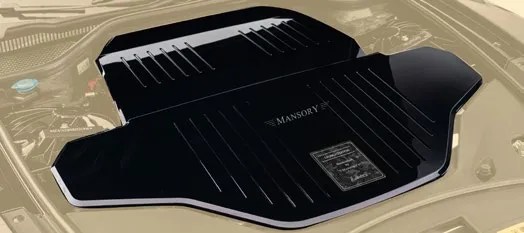
Engine carbon cover with emblem Mansory for Rolls-Royce Spectre


Engine Carbon Cover with Emblem Mansory for Rolls-Royce Spectre
The engine carbon cover with embedded emblem is the bespoke Mansory finishing panel for the area under the Spectre’s front bonnet — a region that, on this all-electric coach-door coupe, has nothing to do with combustion. It sits over the front-motor and inverter housing, replacing the OEM moulded-plastic shroud with an autoclaved carbon plane carrying an inset silver Mansory marque. Within the wider Mansory Carbon Fiber Body kit set for Rolls-Royce Spectre programme this is the one part most owners never see while driving and yet specify first, because every time the bonnet is lifted — at a concours, at a hotel valet stand, at a boutique unveiling — the front compartment becomes the frame around the brand statement. The cover transforms a service area into a presentation surface without disturbing the silent drivetrain or thermal envelope beneath.
Construction & Materials
The cover is laid up by Mansory’s carbon division in Brand from prepreg 3K twill skinned onto a closed-cell aramid honeycomb core. The complete laminate is autoclave-cured at 120°C and 6 bar to consolidate the plies and remove voids that would otherwise telegraph through the lacquer as a hazy grain. The emblem is not stuck on top: the carbon plane is pre-formed with a milled recess into which a CNC-machined aluminium emblem (with engraved silver Mansory bird marque on a brushed background) is bonded with a structural acrylic before the final clearcoat is flowed. The result is a single optical surface where the weave runs uninterrupted around the emblem, the silver insert sitting flush rather than proud.
- Weave: 2×2 3K twill, mirror-axis aligned across the central plane so that the chevron meets exactly under the emblem
- Cure: autoclave prepreg, 120°C / 6 bar, post-cure stress relief at 80°C for 4 hours to flatten any residual spring-back
- Wall thickness: 2.4–2.8 mm carbon skin over a 4 mm aramid honeycomb core in the central pan; solid laminate at clip and edge zones
- Total panel mass: 1.6–1.9 kg complete with hardware, replacing the ~2.4 kg OEM acoustic foam-backed plastic shroud
- Emblem: CNC 6082-T6 aluminium with PVD silver finish on the engraved Mansory bird, brushed backing field, bonded into milled recess before clearcoat
- Mounting: OEM clip locations retained (eight modified-acrylic VHB pads on the underside reference the original locating pins), no body-frame drilling
- Finish: clear UV-stable polyurethane lacquer, gloss as standard; matte and silk satin as options; anti-yellowing UV inhibitor compounded into the topcoat
- Underside: black flock coating to absorb diffuse light bounce and to damp any incidental tick from the front-motor management plenum
Design & Visual Function
Open the bonnet of a stock Spectre and you see a thoughtfully styled but ultimately industrial scene — a black plastic shroud with cast-in fluting, the 12V auxiliary battery box, the brake-fluid reservoir, and the dark glass hatch over the high-voltage service disconnect. The Mansory cover unifies the central plane of that scene. The geometry is a long, slightly bowed lozenge that follows the contour of the front-motor housing beneath, with raised plinths around the four primary fixing points so the surface reads as a single sculpted volume rather than a flat lid. The emblem is set inboard of centre, biased toward the windscreen so it catches the reading angle of someone standing at the front of the car looking down.
Light handling is where the part earns its keep. The 3K twill is fine enough to read as a luxury textile rather than a motorsport panel; under direct sun the chevron pattern shimmers in two-tone, the high points catching gloss while the low points hold a soft graphite shadow. The inset silver Mansory bird is engraved rather than painted, so the highlights move as the bonnet angle changes — a property the OEM badge cannot replicate. Two-tone owners often colour-key the emblem ground field to the upper paint shade, a service Mansory’s atelier offers as part of the bespoke programme.
Visual integration with the wider front compartment is deliberate. The cover’s perimeter mirrors the trim line of the OEM washer-fluid lid, and the rear fold steps down toward the windscreen scuttle so the eye is led from the bonnet bar through the carbon plane to the wiper park position — a coherent material story from the exposed exterior bar through to the inner compartment.
Compatibility & Fitment
The cover is cut for the Rolls-Royce Spectre (MY2024+, all-electric, two-door coach-door coupe) on the Architecture of Luxury aluminium spaceframe. Both LHD and RHD compartments are catered for in the same panel — the front-motor and inverter assembly is laterally symmetrical and the cover spans the central pan; only the cable-management cut-outs are mirrored between markets. Fitment respects all OEM service-access points: the 12V auxiliary battery housing is reachable through a hinged sub-flap on the cover; the brake-fluid reservoir and washer cap have dedicated finger-cut release notches so a technician does not need to remove the full panel for routine service. The high-voltage service disconnect, which sits below the cover under its own shielded sub-cover, remains compliant with Rolls-Royce’s technical service bulletin for HV access — the carbon cover does not bond or lock over that area.
Installation & Reversibility
Installation is a 35–55 minute task at a clean bench. Open the bonnet, support it on the strut, and remove the OEM acoustic shroud by releasing its eight integral plastic clips with a trim tool. Inspect the underlying housing for clip-pin damage, replace any pins from Mansory’s supplied service kit, then dry-fit the cover and verify all eight clip alignments. Apply the modified-acrylic VHB activator to the contact pads, peel the liners, and seat the cover from the windscreen edge forward, pressing each clip home for full engagement. Cure time before bonnet closure is 30 minutes at workshop temperature. The panel is fully reversible — a careful trim-tool lift from the rear edge releases all eight clips and the VHB cleanly, with no drilling and no permanent modification to the OEM substrate. Mansory recommend an authorised installer for the activator step because over-application can wick under the lacquer at the panel edge. Spectre’s aluminium spaceframe means modified-acrylic VHB is the correct chemistry here.
Pairing within the Mansory Spectre programme
The natural companion is the standalone emblem for engine cover with engraved silver logo, sold separately for owners who want to refresh or replace the badge later without re-doing the full carbon panel. Visually the cover continues the carbon language begun by the Mansory front bonnet and the exposed carbon bar across the front bonnet — open the bonnet on a car wearing all three and the eye reads a single material story from the exterior trim through to the front compartment. Many owners also specify the individualised emblems for front fender at the same time, so the silver-logo motif appears on three distinct planes of the car and the bespoke commission reads as a deliberate set rather than a one-off touch.
Maintenance & Durability
Care rules differ from exterior carbon. The cover sees no UV when the bonnet is closed, so lacquer yellowing is not a concern, but it does collect ambient pollen, fine front-axle brake residue, and the silica film that drifts from cabin vents over time. Wipe it cool — the inverter can reach 80–100°C under sustained highway load and the cover’s face tracks ambient for several minutes after a drive. Use a pH-neutral carbon-safe shampoo on a plush microfibre, never an alkaline degreaser; alkalines and ammonia lift the topcoat from the weave within months. Avoid silicone dressings — they migrate and leave a tacky residue that traps dust. Once a year, refresh with a hand polish and a sealant designed for clear-coated CFRP. Skip ceramic coating here: it is formulated for rain-shedding the panel does not need and the curing chemistry can flash unevenly in the warm, low-airflow space under the bonnet.
The silver emblem cleans with a damp microfibre and warm water — never metal polish, because the engraved highlights are PVD silver and abrasive polish burnishes the engraved peaks unevenly. Chip repair on the carbon plane is a carbon-shop job; deep penetration into the weave is a panel replacement.
Lead Time & Warranty
Lead time is 4–7 weeks from order confirmation. Standard gloss clearcoat ships fastest; matte, silk satin and colour-keyed emblem grounds take longer because they share oven slots with the bespoke interior programme. Mansory provide a 12-month warranty against manufacturing defects — delamination, voids in the laminate, lacquer haze, fitment of clip locations, and emblem bond failure are all covered. Stone strikes and operator damage are not covered, but Mansory’s service network can re-skin or repair on a chargeable basis.
FAQ
Q: Does the carbon cover affect the front-motor or inverter cooling?
A: No. The OEM thermal plenum sits below the cover and draws conditioned air from the front intake; the carbon panel sits above that plenum without obstructing flow. The black flock underside actually damps secondary heat radiation back into the panel, and the autoclave laminate is rated for continuous service at the local ambient temperatures (~80–100°C) the front compartment reaches.
Q: Can a technician still reach the 12V auxiliary battery and brake-fluid reservoir?
A: Yes. The cover incorporates a hinged sub-flap over the 12V battery and finger-cut release notches at the brake-fluid and washer caps. Routine service does not require removing the full panel.
Q: Is the silver emblem replaceable later?
A: It is. Mansory ship a standalone emblem in the same engraved-silver specification, sized to the same recess; a service-trained installer can cut the original bond, lift the old emblem, and re-bond the replacement without touching the surrounding clearcoat.
Q: Can I order the carbon plane in matte rather than gloss?
A: Yes. Matte, silk satin and a Mansory-signature soft-gloss finish are all available; lead time is slightly longer for non-standard finishes because the lacquer oven schedule is shared with the wider bespoke programme.
Q: Does it fit both LHD and RHD Spectres?
A: Yes. The front-motor and inverter assembly is laterally symmetrical; the cover panel is a single SKU with mirrored cable-management cut-outs depending on market.
Q: Will the cover create rattles given the Spectre’s near-silent drivetrain?
A: No, when correctly installed. The eight VHB pads sit on rigid clip stations, the panel cannot oscillate, and the flock-coated underside isolates any incidental high-frequency noise from the inverter management hardware. Mansory specifically tune their bonded carbon panels for NVH-sensitive cabins because Rolls-Royce’s pre-collection silence is the brand promise the kit must protect.
Pair the cover with the standalone silver emblem and the carbon bar across the front bonnet to complete a coherent material story under the bonnet. Specification, finish and emblem-ground colour: WhatsApp +44 7488 818 747 or [email protected].