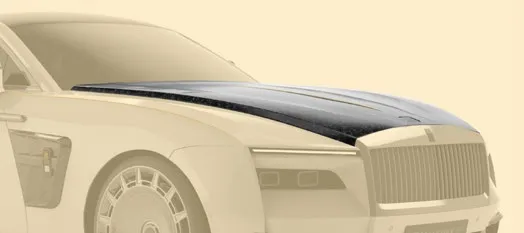
Front bonnet Mansory for Rolls-Royce Spectre


Front Bonnet Mansory for Rolls-Royce Spectre
The front bonnet is the longest single body panel on the Rolls-Royce Spectre, and Mansory's carbon replacement treats it with the reverence that long, uninterrupted plane deserves. Sitting upstream of the Pantheon Grille and capping the high-voltage compartment that houses the front motor and inverter, the bonnet is the first surface the eye reads as the car approaches. Mansory's piece is part of the wider Mansory Carbon Fiber Body kit set for Rolls-Royce Spectre, and within that programme it is the keystone front-end element — the panel that takes the OEM silhouette and reissues it in autoclave carbon without breaking a single proportion line. Owners specify it for the weight saving over the front axle, for the way unbroken twill catches grazing light along the central crease, and for the silent confidence carbon brings to a 2.97-tonne electric coupe.
Construction & Materials
The bonnet is built as a multi-layer pre-preg lay-up over a male tool taken directly from the Spectre's body data. The outer skin is 3K twill — Mansory's signature visual weave — laid so the diagonal grain runs symmetrically about the central spine of the bonnet, with the chevrons opening toward the windscreen. Beneath the cosmetic layer sit unidirectional carbon plies oriented at 0/45/90/-45 degrees for stiffness, then a closed-cell foam core in the centre fields to keep the panel acoustically dead under wind load at autobahn speed. The whole stack cures in an autoclave at controlled pressure and temperature so the resin fraction stays consistent — that is what gives the lacquered finish its glassy depth and what keeps the panel from oil-canning over a long highway plane.
Hardware is OEM-matched. The bonnet uses the original Spectre hinges, the original gas struts, the original safety-catch geometry and the original front-edge latch. No drilling, no relocating, no shimming the cowl. Underside ribbing replicates the OEM stiffening pattern so closing feel and pedestrian-impact crush behaviour stay within the band the spaceframe was engineered around.
- Outer weave: 3K twill, autoclave-cured pre-preg, optional 2K plain or forged-look variants on request
- Sub-structure: unidirectional carbon plies in a 0/45/90/-45 quasi-isotropic lay-up over a closed-cell foam core in the central plateau
- Wall thickness: 1.6–2.2 mm at the skin, ribbed to 6–8 mm at the underside reinforcement frame
- Finished weight: 6.0–8.0 kg complete with hardware, against an OEM aluminium hood weight of roughly 14–16 kg
- Mounting: OEM Spectre hinges, OEM gas struts, OEM front latch, OEM safety hook — bolt-for-bolt swap, no machining
- Finish: high-build clear lacquer with UV inhibitors as standard; matte 2K, satin and raw-weave brutalist options to order
- Edges: hand-flatted and clear-coated separately so the weave does not feather under the bonnet shut-line
- Sealing: original Spectre cowl seal, A-pillar seals and front-edge weatherstrip retained without modification
Design & Visual Function
The Spectre's front bonnet is a slow, deliberate plane. It rises from the Pantheon Grille header, runs flat for most of its length, then breaks gently into the cowl shut-line in front of the windscreen. Mansory's job is not to redraw that plane — it is to reissue it. Every crease the OEM panel carries is preserved: the long central spine that splits the bonnet into mirrored fields, the soft shoulder lines that flow into the front fenders, the radius that meets the Pantheon Grille header at the leading edge. What changes is what the surface is made of. Where OEM aluminium reads as a single tone under a single colour of paint, the carbon skin reads as woven texture under lacquer — a second layer of detail that only resolves once the eye is close enough to count threads.
Weave alignment is the discipline that separates a Mansory bonnet from a generic carbon hood. The 3K twill chevrons are mirrored about the central crease, so when you stand at the Spirit of Ecstasy and look down the bonnet toward the windscreen, both halves of the weave open toward you symmetrically. That symmetry holds across the shoulder break and into the corners, which means the panel reads as one object rather than two pre-preg sheets butted together. On a car as long-bonneted as the Spectre — a coupe that uses bonnet length as part of its proportional argument — that consistency matters at every angle, not only head-on.
Lacquer choice changes the personality. The standard high-build clear gives a deep, wet lustre that catches sky and architecture and reflects them across the bonnet plane the way a still pond does — appropriate to a Rolls-Royce. A matte 2K finish reads as graphite, swallowing reflection and leaving only the woven texture on display, closer in spirit to Mansory's wider tuner heritage. For owners who want the most unapologetic statement, a raw-weave option pairs especially well with the bar-exposed-for-front-bonnet variant — together they make the central bonnet relief the strongest single visual gesture on the front of the car.
Compatibility & Fitment
Designed for the Rolls-Royce Spectre, MY2024+ — the all-electric two-door super-coupe built on the Architecture of Luxury aluminium spaceframe. Both LHD and RHD cars are covered without separate part numbers; the bonnet is symmetrical about its centreline and uses the same hinge geometry on either side. The panel mates to OEM hinges, OEM gas struts, OEM front latch and OEM cowl seal, so no spaceframe geometry is altered during install. The underside reinforcement frame is shaped around the Spectre's front-motor and inverter packaging so service access — opening the bonnet to the same angle as OEM, and reaching the same maintenance points — is preserved fully. The carbon panel does not interfere with the high-voltage service disconnect location or with the front crash-management points.
Installation & Reversibility
Allow four to six hours for a clean swap with one experienced body-shop technician plus a helper for lifting. The OEM bonnet comes off in the standard way: support it on stands, disconnect the gas struts, mark the hinge positions with painter's tape so alignment carries across, unbolt the hinges and lift it clear with the helper. The carbon bonnet bolts back to the same hinge holes, the gas struts are reattached, the latch is checked for engagement at the safety hook and the primary catch, and the shut-lines are walked around with a feeler gauge to confirm symmetric gaps to the front fenders, the headlight cassettes and the cowl. If a colour-matched paint is being applied rather than clear lacquer over the weave, schedule another full day for prep, base, clear and bake. The swap is fully reversible — keep the OEM bonnet on a padded rack and the original look can be restored in the same window.
Adhesives are not part of this install — every fixing is mechanical and OEM-matched. The Spectre's spaceframe uses modified-acrylic VHB chemistry on its bonded body components elsewhere on the car, but the front bonnet is a hinged panel and stays fully bolt-on. Recommended installer: certified body shop with experience on aluminium luxury bodies. DIY is not advised given the panel size, the cost of a mis-set hinge, and the closing-pressure calibration required at the latch.
Pairing within the Mansory Spectre programme
Sensible companions on the front of the car. The carbon front bonnet pairs naturally with the bar exposed for front bonnet — that piece sits in the central relief and reads as raw weave against the lacquered field of the bonnet, giving the front end a sharper, more brutalist accent without disturbing the OEM line. Below the grille, the front lip closes the carbon argument at the chin, finishing the shut-line that the bonnet opens at the top. For owners who want the front fenders to carry the same weave story as the bonnet, the front fender panel brings the diagonal twill across the wheel arch and into the side profile so the entire forward third of the car is unified in carbon.
Maintenance & Durability
Lacquered carbon is a clear-coat surface and lives or dies by how that clear coat is treated. Wash with pH-neutral shampoo and a clean lambswool mitt; never go near the bonnet with a stiff sponge, an alkaline wheel cleaner or any product with ammonia, dishwasher detergent or harsh solvent. Those chemistries cloud the lacquer and in the worst case lift the gel coat at the edges. A ceramic coating on cured lacquer is sensible long-term protection — insect acid stops etching, and water releases more cleanly during a rinse.
UV exposure is the slow killer of any clear-coat carbon panel. Park in shade where you can and consider a soft cover for long static periods. With reasonable care the lacquer remains optically perfect for many years; chips from stone strikes can be touched in by a paintwork specialist, and deeper damage is repairable by a carbon body shop without replacing the panel. Keep pressure-washer wands at distance — they strip wax and over years open micro-fractures around the shut-lines.
Lead Time & Warranty
Lead time is four to eight weeks from order — Mansory produces the bonnet to order in autoclave, and individual finish requests (matte 2K, raw weave, painted-over-carbon, special lacquer tints) extend that window further. The piece carries a 12-month manufacturing warranty against delamination, voids in the lay-up, hinge-bracket fitment errors and lacquer defects. Damage from impact, road debris, chemical attack or improper care is excluded — those are repair cases rather than warranty cases, and any qualified carbon shop can handle them.
FAQ
Q: How much weight does the carbon bonnet save versus the OEM aluminium one?
A: Roughly 6 to 10 kg, depending on the finish specification. A standard 3K twill with high-build lacquer typically lands around 7 kg for the bonnet plus its underside frame, against the OEM aluminium hood at 14–16 kg fully trimmed.
Q: Will it affect the warranty on the high-voltage front compartment or my dealer service relationship?
A: The bonnet is a cosmetic panel and does not interface with high-voltage hardware. Service points under the bonnet open and close exactly as OEM, the bonnet position sensor and front-edge latch are retained, and dealer routine inspections are unaffected. Many owners run Mansory carbon bodywork alongside an active dealer relationship without issue.
Q: Can I have the bonnet painted in body colour rather than left as visible weave?
A: Yes. The panel is supplied in primer-ready surface on request and can be sprayed in any factory or bespoke Rolls-Royce colour, including two-tone treatments split along the central spine to align with a coach-line on the lower body. Painted carbon retains the weight saving but loses the woven texture as a visual element.
Q: Does the carbon bonnet still close softly the way the OEM hood does?
A: Yes. The OEM gas struts, latches and stops are all retained, and the underside frame is engineered to give the same closing pressure and rebound as the aluminium original. Closing feel — that gentle, damped settle — is part of how a Rolls-Royce identifies itself and is preserved.
Q: Is the bonnet supplied with the bar-exposed-for-front-bonnet centre relief?
A: No, that is a separate part. The bonnet is supplied as one complete carbon panel ready to fit. The bar-exposed variant is ordered alongside it and installed into the centre relief once the bonnet is on the car — most owners specify both together for the strongest visual effect.
Configure your Spectre's front-end carbon programme — bonnet, lip, fender panels, exposed bar — with our team. Reach us on WhatsApp +44 7488 818 747 or by email at [email protected].