
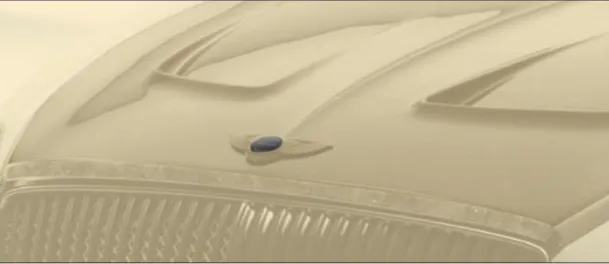
Logo for front bonnet Mansory Carbon for Bentley Continental GT GTC V8


Logo for front bonnet Mansory Carbon for Bentley Continental GT GTC V8
This is the small, hand-finished Mansory carbon plate that sits on the front bonnet of a Mansory-converted Continental GT — a discreet maker's mark rather than a structural component. The plate is laser-trimmed from a flat carbon laminate, profile-machined, edge-polished, and bonded to the bonnet at a precise centreline location specified in the Mansory build documentation. Within the broader Mansory Body Kit for Bentley Continental GT 2nd-Gen (D2A), the logo is the part most often photographed and the part that signs the car as a Mansory build at first glance from the front. Small parts get scrutinised closely at car shows and in detailing photographs, so the bar for finish quality is in some ways higher than on a bumper or fender — there is nowhere on a 12-gram piece for a flaw to hide.
Construction & Materials
The blank is laid up as a flat panel, autoclave-cured for tonal consistency, then the logo profile is cut on a five-axis carbon-edge router. Edge-machining matters here because any chip, fray, or fibre pull on the perimeter is visible at arm's length under any inspection. After cut, the perimeter is hand-dressed and the face is lacquered. The flat-panel approach to substrate matters: trying to mould a logo plate as a complex three-dimensional part introduces resin-pooling and weave-distortion failure modes that small parts cannot recover from. A flat blank with profile-cut perimeter avoids those failure modes entirely.
The cross-ply structure under the visible weave deserves a closer look. A single-ply trim plate would warp under thermal cycling — sit a single ply of cured carbon in a hot car-bonnet thermal cycle for a season and the plate develops a pronounced bow as the resin matrix relaxes asymmetrically. Multiple cross-plied plies, oriented at deliberate angles to each other, balance the matrix-relaxation forces and keep the plate dimensionally flat across the bonnet's slight crown radius. This is why a properly engineered logo plate stays bonded for years where a cheap one peels in eighteen months.
- Substrate: 3K 2x2 twill prepreg, 200 gsm, multiple cross-plies for flatness
- Cure: autoclave-cured flat panel, controlled cool-down to lock dimensional stability
- Plate thickness: approximately 1.8 mm
- Profile cut: five-axis router with diamond-tipped tooling, edge-dressed by hand
- Mass: approximately 12–15 g
- Adhesion: high-strength automotive double-sided foam tape, OEM-grade chemistry
- Finish: 2K UV-inhibited clear over the carbon face, polished to gloss; matte option available
- Backside features locating ribs that key into the bonnet's natural centreline
Design & Visual Function
Trim parts live or die on edge quality and weave registration. On a small carbon plate, every visual flaw is concentrated. The logo blank is therefore laid up with the weave aligned to the long axis of the plate so that the diagonal pattern reads as a clean continuous lattice across the face — not a fragmented partial weave. The cross-plies underneath keep the panel dimensionally flat after cure, eliminating the slight bow that single-ply trim plates typically take on under thermal cycling.
Visual function is integration. On a Mansory-converted car, the logo plate is supposed to look as if it left the factory that way: lacquer depth matching the surrounding carbon parts, weave alignment honouring the bonnet's centreline, edge profile crisp enough to throw a clean shadow under direct light. The plate's thickness is held just under 2 mm so that it raises slightly off the bonnet — enough to read as a discrete component, not a sticker, but thin enough that it does not catch a wash mitt or behave as a wind-noise generator. The proud thickness also creates the small drop-shadow line that the eye uses to register the plate as a real component, which is what separates this part from a printed decal at any viewing distance.
Light behaviour is straightforward at this scale: the polished clear gives a wet-look reflection, and the matte option diffuses to a soft sheen. Matte is the more popular choice when the bonnet itself is in matte carbon, simply for tonal consistency. Mixing finishes is possible — gloss plate on matte bonnet — but it makes the plate read as deliberately graphic, which is occasionally what an owner wants but more often is not.
The five-axis edge-machining sets the visual quality benchmark. A laser-cut perimeter on carbon leaves a faint heat-affected zone along the cut edge that resists lacquering cleanly; a router with diamond tooling running in 5-axis follows the contour without that heat damage and yields an edge that flat-sands and clears with no transition mark. The difference is visible at arm's length under direct light, and on a part this small that matters.
Compatibility & Fitment
Profile and centring are referenced to Bentley Continental GT 2nd-generation (D2A) bonnet geometry, V8 and W12, model years 2011 through 2017 facelift, both coupé and GTC. The plate fits cleanly on either OEM bonnet or on a Mansory carbon bonnet — though pairing it with the carbon bonnet is the visually correct combination. Earlier 1st-gen Continental GT bonnets have a different crown radius and the locating ribs do not align on that platform. Bentley Flying Spur and Bentayga have entirely different bonnet geometries; this plate is not designed for either.
Installation & Reversibility
Fitting is a 10–15 minute job. The bonnet centreline is cleaned with isopropyl alcohol, the plate is positioned dry against an alignment template, then the foam-tape backing is exposed and the plate is firmly hand-pressed for 30 seconds. The adhesive reaches full bond strength after about 24 hours; the car is wash-safe immediately but should not be high-pressure-washed at the plate edge for a day. Removal is possible with heat — a heat gun on low warms the adhesive enough to lift the plate cleanly, though residue will need to be cleaned off the bonnet with adhesive remover before any subsequent fitting. The bonnet paint underneath the plate is generally untouched after removal, which makes the part fully reversible if a future owner reverts the car to factory specification.
Pairing within the Mansory Continental GT programme
The logo plate naturally completes a build that already runs the Engine bonnet or Engine bonnet II, and many owners spec it together with the 31 Lamels chromed grill so that the front-end identity is unambiguous from twenty paces. Owners running an OEM bonnet still occasionally fit the plate as a discreet maker's mark, but the visual logic is strongest with the carbon bonnet underneath.
Maintenance & Durability
The lacquer is the only wear surface. Treat it as you would any other carbon panel: pH-neutral shampoo, microfibre, no abrasive sponges, and a ceramic coating or high-grade synthetic wax to keep the clear's depth alive. The foam-tape adhesive is rated for the full thermal envelope of a road car bonnet — including hot panel surface temperatures during summer parking — and will not creep under load. If the plate is removed for any reason, the adhesive backing should be replaced rather than re-used. Avoid tar-removers on the plate face; the solvent chemistry is harsher than the lacquer needs and can leave a haze that requires re-polishing to recover.
Lead Time & Warranty
Lead time is 2 weeks for standard gloss; matte adds approximately 3 days for the satin top-coat schedule. Twelve-month warranty covers laminate, lacquer adhesion, and edge-machining quality. Damage from removal attempts, abrasion, or third-party detailing chemistry is excluded. Replacement plates can be supplied at the same SKU on request — useful if a plate is damaged and a clean replacement is preferable to a lacquer touch-up.
FAQ
Q: Will the adhesive damage my bonnet paint?
A: No. The foam tape is OEM-grade automotive emblem chemistry, the same class used by manufacturers for original badge attachment. Removal with heat is clean and the underlying paint is generally undisturbed.
Q: Is this just a sticker?
A: No. It is a machined carbon plate with measurable thickness, weave, and lacquer depth. A sticker would not throw the same shadow line or wear correctly under washing. The plate is a proper component, not a graphic.
Q: Can I fit it on an OEM-painted bonnet?
A: Yes, the profile and locating ribs reference the bonnet geometry, not the bonnet finish. It looks more cohesive on a carbon bonnet but is mechanically valid on either. Some owners specifically use it to tease a future carbon-bonnet upgrade.
Q: Can the plate be re-finished if scratched?
A: A carbon specialist can flat-sand and re-clear the plate face, though replacement is usually more economical given the part size and lead time.
Q: Will high-pressure car wash dislodge it?
A: After full adhesive cure, no. We recommend avoiding direct lance-on-edge pressure for the first 24 hours; after that, normal automated and high-pressure washing is fine.
Sign the build with the Mansory carbon logo plate alongside the bonnet and grille that earned it. WhatsApp +44 7488 818 747 or [email protected].