
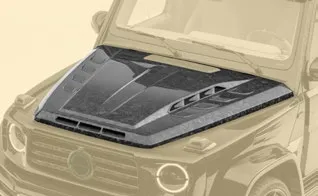
Engine bonnet III for Mercedes G-class W463A Gronos


Engine Bonnet III for Mercedes G-Class W463A Gronos
Within the tiered bonnet range of the Mansory Body Kit for Mercedes G-Class W463A Gronos, the Engine Bonnet III represents the thoughtfully balanced choice for W463A owners who want measurable thermal improvement above the engine bay without the fully louvred visual statement of the top-tier panel. This is not a compromise — it is a deliberate design point that prioritises weave-surface coherence on the G-Wagon's defining flat bonnet face, while still allowing enough managed airflow to address heat soak above the M177 twin-turbocharger installation during extended urban use or in hot ambient conditions. The G63 AMG and G500/G550 W463A platforms are both accommodated; the Bonnet III's mounting geometry and hinge pattern are identical across the two donor variants.
Construction & Materials
The Engine Bonnet III is formed on a dedicated mould that captures the W463A's distinctive flat bonnet profile — a nearly horizontal panel with a subtle forward rise at the leading edge and a precise fit at the hinge-line and bonnet-to-wing seal. The laminate schedule uses a symmetrical 0°/±45° prepreg stack that balances in-plane stiffness with torsional resistance: torsional stiffness on a W463A bonnet is important because the panel is wide relative to its length and sits on just two hinge points, meaning any laminate asymmetry causes a diagonal twist under aerodynamic load that manifests as a door-gap inconsistency at motorway speed.
The outward-facing ply is 3K twill prepreg with the weave direction set to run fore-and-aft on the bonnet centreline. This orientation — parallel to the G-Wagon's direction of travel — creates a linear shimmer effect when the vehicle is viewed from the side, emphasising the bonnet's horizontal length rather than the diagonal movement produced by a 45° weave offset. The inner surface of the panel receives a light structural gelcoat layer that provides moisture barrier continuity across the entire underside, protecting the structural plies from humidity that accumulates in the W463A's factory-sealed bonnet cavity.
- Visible weave: 3K twill carbon, fore-aft orientation on centreline — creates a longitudinal light-line that extends the visual length of the G-Wagon's flat bonnet face
- Structural lay-up: 0°/±45° prepreg stack for balanced stiffness and anti-twist geometry across the wide W463A bonnet span
- Inner surface: light gelcoat moisture-barrier layer over structural plies — seals the underside against humidity accumulation in the bonnet cavity
- Cure: autoclave 120 °C / 4 bar — necessary for void-free consolidation across the wide panel geometry
- Wall thickness: 1.8–2.2 mm across the main panel field; 2.8–3.2 mm at hinge reinforcement zones
- Weight: approximately 6.5–8.0 kg — approximately 40–50% lighter than the OEM steel bonnet
- Mounting hardware: OEM hinge bolt pattern; bonnet stay bracket and washer-jet plumbing transfer directly from the OEM bonnet
- Finish: gloss clearcoat standard at 35–45 µm DFT; satin/matte available on request; visible-weave raw carbon option available for specialist builds
Design & Visual Function
The Engine Bonnet III's visual character is defined by restraint. Where the Bonnet IV announces its purpose through louvre geometry that creates strong shadow lines across the bonnet face, the Bonnet III presents a clean carbon surface with the vent treatment integrated at a lower visual weight. The result is a bonnet that reads as a precision material upgrade — the weave-texture and surface reflectivity of 3K twill visible carbon, scaled across the G-Wagon's notably wide flat bonnet field — without the motorsport-aggressive language of the fully louvred tier. This suits W463A owners whose specification targets are refinement-led: the Gronos programme applied with visual discipline rather than visual maximalism.
The G-Wagon's bonnet is one of the few surfaces on a modern performance vehicle that is routinely viewed from above — particularly from upper-floor vantage points in urban settings where the W463A is most commonly operated. The Bonnet III's fore-aft weave alignment creates a consistent parallel light-line pattern when viewed directly from above, which pairs particularly well with the W463A's rectangular roofline and its precision-squared bonnet-to-wing gap margins. Any bonnet panel on the G-Wagon is also heavily scrutinised from the interior driving position, because the driver's forward sightline passes directly along the bonnet crown to the leading edge — the Bonnet III's clean carbon field, free of heavy louvre recesses, gives a cleaner driver forward view across the bonnet face.
Compatibility & Fitment
Engine Bonnet III fits the Mercedes-Benz G-Class W463A across all model years from 2018 to present. This covers G63 AMG (M177 4.0 L V8 biturbo, 585 hp / 850 Nm, 9G-TRONIC AMG) and G500/G550 (M176 V8 biturbo, 422 hp / 610 Nm, standard 9G-TRONIC). The bonnet hinge geometry and stay attachment point are identical across LHD and RHD W463A body configurations — the Bonnet III is a single-mould panel compatible with both. Owners with factory AMG optional bonnet insulation matting should check whether the OEM mat's profile requires trimming in the vent section — Mansory can advise on this at order stage. The 2024 cosmetic facelift W463A models retain unchanged bonnet geometry; Bonnet III is fully compatible. Pre-2018 W463 owners: this panel is NOT compatible — body shell geometry differs materially from the W463A refresh platform.
Installation & Reversibility
Bonnet III installation follows the same procedure as any W463A bonnet panel swap. The vehicle is raised on a ramp or four-post lift, the OEM bonnet hinge bolts are accessed from above (through the engine bay with the bonnet propped), the washer-jet supply hose is disconnected from the OEM bonnet-underside jet nozzle, and the bonnet stay is released. Two technicians are required for bonnet removal and fitting — the W463A's wide bonnet panel is unwieldy for a single installer and diagonal twist during handling risks chipping the carbon leading edge against the front wings. After fitting, gap alignment between the Bonnet III and the wings is checked at three points per side and adjusted at the hinge elongated-hole adjustment before final torque. Time estimate: 2–3 hours including gap alignment and bonnet stay re-attachment. Fully reversible — the OEM bonnet is stored and re-installs without modification.
Pairing within the Mansory Gronos programme
The Bonnet III pairs naturally with components that share its clean-surface visual discipline. The Engine Bonnet IV represents the next step up in the same programme hierarchy — worth reviewing if thermal extraction goals evolve after initial specification. For under-bonnet visual coherence when the panel is raised, the Engine Cover for G63 AMG Side Parts extends Gronos carbon into the visible engine bay flanks. For headlight-zone material continuity at the bonnet corners, the Carbon Headlight Covers complete the front-end carbon register in the same clean-surface visual language as the Bonnet III.
Maintenance & Durability
The fore-aft weave orientation on the Bonnet III makes horizontal swirl marks from incorrect washing technique particularly visible under raking light, because the parallel weave threads run exactly perpendicular to a horizontal-swirl polishing arc. Always wash the bonnet surface with a top-to-bottom or front-to-back motion following the weave direction rather than circular or cross-panel strokes. Use a dedicated carbon-safe pH-neutral shampoo — alkaline car shampoos above pH 8 can leave a thin white residue in the weave recesses of the 3K twill under certain water conditions, which is difficult to remove without light polish.
Apply carnauba or SiO2 ceramic protection every 6–10 weeks. The G-Wagon bonnet is exposed to stone chip more than a conventional sports car's lower-profile nose because the W463A's squared leading edge creates a recirculating pressure zone that throws debris upward onto the bonnet face from the front tyres. Fit a clear paint-protection film to the bonnet leading edge and the first 100 mm of the bonnet face — this is highly recommended for W463A builds used at motorway speeds on unsealed-surface adjacent roads. Expected clearcoat lifespan without PPF: 8–12 years under normal use.
Lead Time & Warranty
Lead time for the Engine Bonnet III is 3–4 weeks from order confirmation. The panel carries a 12-month warranty against manufacturing defects — delamination, structural void formation, hinge-geometry dimensional errors, and clearcoat adhesion failures at the panel edges. Warranty is not applicable to stone-chip damage, incorrect installation resulting in gap misalignment, or chemical damage from paint-shop materials applied to adjacent panels.
FAQ
Q: What is the practical difference between Bonnet III and Bonnet IV for a daily-driven G63 AMG?
A: Bonnet III provides moderate heat extraction with a clean visible-carbon surface. Bonnet IV provides maximum heat extraction with pronounced louvre geometry. For a daily-driven G63 in mixed urban/motorway use, Bonnet III's thermal performance is adequate for normal operating conditions; Bonnet IV becomes more relevant for track use or extended low-speed running in sustained high-ambient-temperature environments.
Q: Does the fore-aft weave direction on Bonnet III look different from the diagonal weave on Bonnet IV?
A: Yes, and the difference is noticeable. Bonnet III's fore-aft 3K twill creates parallel light-lines running front-to-rear when viewed from above or from the driving position. Bonnet IV's 45° diagonal weave creates a V-pattern that fans out from the bonnet apex. Both are attractive — the choice depends on visual preference rather than structural performance.
Q: Is there a weight difference between Bonnet III and the OEM steel bonnet significant enough to affect steering feel?
A: The Bonnet III is approximately 40–50% lighter than the OEM steel bonnet — a saving of 7–9 kg at the front of the vehicle. On a G-Wagon with the W463A's ladder-frame construction and 2,560 kg+ kerb weight this reduction is not felt in steering effort, but it does move the nose weight slightly rearward and contributes to a fractionally improved front-to-rear balance.
Q: Can I install Bonnet III myself, or does it require a body shop?
A: Two-person installation is strongly recommended due to the W463A's wide bonnet panel. A competent home mechanic with ramp access can complete the swap. Gap alignment at the hinge-line requires patience — the elongated adjustment slots on the W463A hinges provide enough range, but rushing the alignment step risks binding the bonnet at the leading edge against the front wing seal.
Q: What happens if the Bonnet III clearcoat chips at the leading edge? Is it repairable?
A: Yes. Small clearcoat chips at the leading edge are repaired with a precision clear touch-up pen matched to the finish (gloss or satin). Larger areas exposing the weave surface require a local re-lacquer by a carbon specialist using solvent-compatible clearcoat. Attempting to use standard bodyshop clearcoat over bare carbon without a carbon-compatible adhesion primer typically results in adhesion failure within 12 months.
Specify your Engine Bonnet III finish and confirm W463A build year with the Hodoor Mansory team: WhatsApp +44 7488 818 747 or [email protected].