
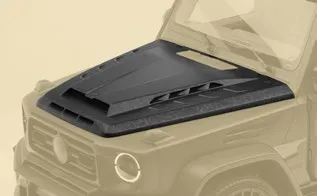
Engine bonnet IV for Mercedes G-class W463A Gronos


Engine Bonnet IV for Mercedes G-Class W463A Gronos
Fitted to the topmost specification of the Mansory Body Kit for Mercedes G-Class W463A Gronos, the Engine Bonnet IV is the heat-management centrepiece of the Gronos exterior programme. The W463A G63 AMG's M177 4.0 L twin-turbo V8 — producing 585 hp and 850 Nm at the crankshaft — generates a substantial thermal column above the engine bay. The M177's twin turbochargers are mounted in the hot-vee position between the cylinder banks, concentrating heat at the highest point of the engine bay directly below the bonnet panel. In standard OEM specification the bonnet traps this heat during low-speed urban running and in queue traffic. The Bonnet IV addresses this with a purpose-designed extraction geometry developed through CFD analysis on the W463A body scan, allowing heated air to evacuate through louvred openings in the carbon panel before it migrates rearward into the cabin ventilation zone.
Construction & Materials
The Engine Bonnet IV is produced as a one-piece structural carbon-fibre assembly on a precision mould derived from the W463A OEM bonnet geometry. Mansory specifies full autoclave cure at 120 °C under sustained 4 bar consolidation pressure, eliminating void formation in the laminate even through the complex louvre-recess geometry. The prepreg lay-up uses alternating 0°/90° structural plies beneath the visible surface weave, providing the torsional stiffness required to match the OEM hinge-to-stay geometry under aerodynamic load at motorway speeds without panel flutter.
The outward-facing surface carries 3K twill prepreg in a single-ply visible layer bonded above the structural laminate, with all weave runs terminated and mitre-joined at the louvre aperture edges. This edge treatment prevents delamination initiation at the most stress-concentrated zones on the panel. The finished carbon surface receives two coats of UV-stable clearcoat at 35–45 µm DFT, with extra clearcoat build applied inside the louvre recesses to protect the raw-fibre edges from moisture ingress.
- Visible weave: 3K twill carbon (2×2 diagonal braid) — centreline-aligned with a 45° offset at the bonnet apex to produce a V-pattern that mirrors the M177's hot-vee turbo layout as seen from above
- Structural laminate: alternating 0°/90° unidirectional carbon plies under the visible weave layer — provides torsional stiffness to match OEM hinge geometry without flutter
- Cure process: autoclave at 120 °C / 4 bar — mandatory for the louvre-recess geometry where void-free consolidation is critical
- Wall thickness: 2.0–2.4 mm on the main bonnet field; 3.0–3.5 mm at hinge attachment reinforcement zones
- Panel weight: approximately 5.8–7.2 kg depending on finish options — versus OEM steel bonnet approximately 14–17 kg
- Louvre apertures: louvre-edge clearcoat build at 50–60 µm DFT to seal raw-fibre cut edges against moisture and stone chip
- Mounting: OEM hinge bolt pattern with torque specification per Mercedes-Benz W463A bonnet installation procedure; bonnet stay transfer from OEM panel
- Finish options: high-gloss clearcoat standard; satin/matte clearcoat on order; raw-weave visible carbon without topcoat on request (specialist care required)
Design & Visual Function
The IV designation places this bonnet at the apex of Mansory's Gronos bonnet hierarchy in terms of thermal and visual presence. Where lower-tier bonnet options provide a surface-level carbon transformation, the Bonnet IV introduces louvred extraction geometry that is visible from outside the vehicle and signals purpose to any observer familiar with motorsport heat-management engineering. The louvre openings are positioned at the rearmost third of the bonnet — immediately above the M177's turbocharger hot-vee — where heat concentration is highest during low-speed running and where extractable pressure differential between the high-pressure engine bay and the lower-pressure zone behind the raised bonnet lip is greatest. At motorway speeds this differential increases significantly, making the Bonnet IV thermally effective under the full speed range of the G63 AMG's operating envelope.
The G-Wagon's nearly flat bonnet presents a design challenge that the Bonnet IV resolves through proportion rather than aggressive sculpting. The louvre geometry is recessed into the carbon field rather than raised above it, maintaining the bonnet's characteristic flat-crown profile when viewed from the side while creating dramatic shadow-play in the louvre recesses when lit from above. This restraint is intentional — the W463A's architectural identity depends on its flat horizontal surfaces being unbroken from above, and the Bonnet IV's recessed louvres respect this geometry while adding functional depth. From a three-quarter front angle the louvres read as a precision-cut matrix in the carbon field, reinforcing the Gronos programme's engineering character.
Compatibility & Fitment
The Engine Bonnet IV fits the Mercedes-Benz G-Class W463A platform, model years 2018 to present, across both G63 AMG (M177 twin-turbo V8, 585 hp / 850 Nm) and G500/G550 (M176 V8, 422 hp / 610 Nm) variants. The bonnet mounts to the standard W463A hinge points using the OEM bolt pattern; no drilling or modification to the body shell is required. Both left-hand-drive and right-hand-drive configurations use the same hinge geometry on the W463A, so the Bonnet IV is a single-mould part compatible with both steering-side configurations. The louvre extraction geometry is calibrated to the M177's hot-vee turbocharger layout; it is equally functional on the M176 in G500/G550 specification. The post-2024 W463A cosmetic facelift did not change the bonnet hinge point geometry, headlight surround aperture, or bonnet-to-wing gap — Bonnet IV fits all W463A production years.
Installation & Reversibility
Bonnet IV installation is a 2–4 hour job for a qualified technician. The procedure begins with raising the vehicle or positioning on ramps for safe front-end access, then disconnecting the bonnet washer-jet plumbing and releasing the OEM bonnet stay. The OEM hinges are unbolted and the original bonnet is removed and stored. The Mansory Bonnet IV is positioned on the hinge brackets, torqued to the W463A specification, and the bonnet stay and washer-jet feed are transferred. Gap alignment between the Bonnet IV and the front wings should be checked and adjusted at the hinge before final torque — the bonnet-to-wing gap tolerance is 3–4 mm on the W463A and carbon thermal expansion is slightly lower than the OEM steel, which reduces gap growth under engine heat. Reversibility is full — the OEM bonnet and all hardware can be reinstalled without modification to the body shell.
Pairing within the Mansory Gronos programme
The Engine Bonnet IV functions at its best when the front-end thermal and visual system is completed. The Fully Carbon Front Mask with Performance Grill ties the Bonnet IV's upper-face presence to the nose aperture, creating a coherent front-end geometry from the bonnet apex to the lower chin. The Engine Cover for G63 AMG continues the Gronos carbon language beneath the open bonnet — visible when the bonnet is raised and photographically consistent for a fully specified G63. The Carbon Headlight Covers with Air Intake integrate the front-corner heat management with the Bonnet IV's extraction strategy, managing the thermal column at the outboard edges of the engine bay.
Maintenance & Durability
The Bonnet IV's louvre recesses require particular attention during washing because they trap road film, soap, and mineral deposits that are not removed by a standard over-hand pass. After washing the main bonnet surface, direct a gentle water rinse down into the louvre channels from the front edge to flush accumulated grit; never pressure-wash directly into the louvre recesses at close range as the stream can lift the clearcoat from the raw-fibre cut edges inside the recess. Dry the louvre channels with a compressed-air blow-out or an extension-nozzle detail blower before applying wax or sealant to the main bonnet field.
The clearcoat on the main bonnet face should be protected with a carnauba wax or SiO2 ceramic sealant on a 6–8 week cycle — the bonnet is the highest UV-exposure panel on the W463A. Avoid ammonia-based chemicals near the bonnet edge seams. If the louvre-edge clearcoat shows micro-chipping from stone strikes, address it with a clearcoat touch-up within 48 hours of discovery to prevent moisture from reaching the carbon fibre edge — moisture ingress along cut fibre edges is the primary cause of premature delamination in louvred carbon bonnets. Expected panel lifespan under correct maintenance is 10–15 years before clearcoat rejuvenation.
Lead Time & Warranty
Lead time for the Engine Bonnet IV is 3–5 weeks from order confirmation, reflecting the autoclave cure schedule and precision louvre-machining step after demoulding. The panel carries a 12-month warranty against manufacturing defects including delamination, void formation, louvre-edge clearcoat adhesion failures, and dimensional fitment errors at the hinge and stay attachment points. Warranty does not cover damage from off-road stone strikes to the louvre recesses, incorrect pressure-washing, or chemical exposure during adjacent panel refinishing.
FAQ
Q: How much cooler does the engine bay run with the Bonnet IV versus the OEM steel bonnet?
A: Mansory's on-road testing with a G63 AMG donor vehicle measured a peak bonnet underside temperature reduction of 18–24 °C at idle and low-speed conditions in high ambient temperatures. At sustained motorway speeds the pressure differential across the louvres increases further, enhancing extraction effectiveness.
Q: Can the Bonnet IV be fitted to a standard G500 rather than a G63 AMG?
A: Yes. The W463A bonnet hinge geometry is identical across G500 and G63 AMG variants. The louvre positioning above the M177 hot-vee is equally beneficial for the M176-powered G500/G550, which also concentrates turbine heat in the upper engine bay, albeit at lower intensity than the 585 hp G63 AMG.
Q: Will the louvred openings allow rainwater into the engine bay?
A: No. The louvre geometry is designed with a downward-exit angle that prevents direct water ingress under normal precipitation. The openings are positioned at the trailing section of the bonnet where airflow exits rearward under motion; standing water drains through the louvre channel geometry rather than into the engine bay. OEM rain-deflection baffles remain in place below the bonnet panel.
Q: Is the Bonnet IV heavier or lighter than the Bonnet III?
A: The Bonnet IV is marginally heavier than Bonnet III — approximately 0.3–0.5 kg more — due to the additional clearcoat build inside the louvre recesses and reinforcement plies at the louvre-edge stress zones. Both are substantially lighter than the OEM steel bonnet.
Q: My W463A has the 22-inch AMG wheel and tyre package — does this affect bonnet fitment?
A: Wheel and tyre size does not affect bonnet fitment. The bonnet panel is entirely above the wheel-arch line; no clearance relationship exists between bonnet geometry and wheel/tyre combination on the W463A.
Discuss Bonnet IV specification and finish options with the Hodoor Mansory team: WhatsApp +44 7488 818 747 or [email protected].