Engine bonnet II Mansory Carbon for Mercedes G-class G500 / AMG G63 W463A


Engine bonnet II Mansory Carbon for Mercedes G-class G500 / AMG G63 W463A
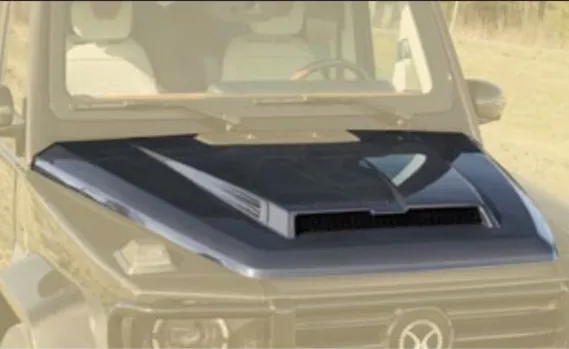
Inside the Mansory carbon programme for the Mercedes G-class W463A G500/G63 there are four bonnet styles, and the second one — the part listed here as Engine Bonnet II — is the deliberately quiet member of the family. It keeps the OEM silhouette of the box-shaped G hood, drops the muscular nostrils and bulged ridges of variants III and IV, and answers a question Mansory clients keep asking: how do I keep the carbon programme but stop the bonnet from being the loudest panel on the truck. The piece is part of the broader Mansory Carbon Body Kit for Mercedes G-class W463A G500/G63, fits LHD and RHD W463A platform (2018+ fourth-generation chassis), and speaks to a buyer who picked Obsidian Black, Magnetite Black or Designo Manufaktur G manufaktur Pewter Magno on purpose.
Restraint as a Carbon Statement
Most carbon bonnets in the aftermarket world are loud by reflex — domes, ridges, gloss-black NACA scoops, exposed weave from edge to edge. Mansory's Bonnet II is the opposite reflex. It is shaped almost exactly like the OEM steel hood, with the same shoulder line stepping down to the wing crease and the same flat centre plateau the factory G uses, but it is laid up in autoclave-cured carbon and carries one — exactly one — visible design cue: a slim lacquered centreline strip running from the windshield wipers up to the front grille. That is the entire styling signature. No vents, no power dome, no bulges. The rest of the panel is painted body-colour and matched into the wing line.
Owners who select Bonnet II are usually the second-time Mansory buyer — the one who already lived with the louder III or IV on a previous car and decided next time the bonnet will whisper. It is also the choice of the client who specified full widebody fenders, a wide front mask and a roof wing — at that point the bonnet has nothing left to prove, and a quiet panel keeps the proportion legal.
Visible-Weave Centreline & Lacquer Chemistry
The single styling cue on Bonnet II is the visible-weave centreline strip, and the engineering behind that strip is more interesting than it looks. The bonnet is laid up in 3K twill prepreg, autoclave cured at 120 °C / 6 bar in a one-piece tool. The whole skin is structurally identical, but the lacquer protocol changes mid-panel: the central strip — roughly 90 mm wide — is masked, lacquered with a UV-stabilised 2K clear, then unmasked and the surrounding surface is sprayed in body-colour basecoat plus its own clear. The two clear systems are chemically compatible (same isocyanate hardener family) so the boundary cures as one continuous film instead of a glued seam. That is why the gloss line stays flush with the painted surrounds — there is no step you can feel with a fingernail and no edge for water to creep under.
The cure room is dust-controlled (ISO 8 spray, ISO 7 cure), and the panel sits on a horizontal cradle so the lacquer self-levels under gravity instead of running. Mansory uses a six-step build for the visible strip: tack-coat, fill-coat, two flow-coats, sand at 1500 grit, final clear, then machine polish with 3M Trizact and a finishing wax.
- Weave: 3K twill prepreg, single-layup tool
- Cure: autoclave, 120 °C / 6 bar
- Wall thickness: 1.6–1.9 mm depending on zone
- Weight: ~8.4 kg painted (vs ~22 kg OEM steel)
- Mounting: OEM hinges, OEM front latch, optional hood pins
- Centreline strip: ~90 mm wide, UV-stabilised 2K clear
- Surround finish: 2K basecoat / clearcoat to factory paint code
Mass Reduction on a Sprung Panel
The OEM steel bonnet of the W463A weighs roughly 22 kg painted. The Mansory Bonnet II in autoclave carbon comes in at around 8.4 kg painted with full lacquer system — that is a saving of about 13.5 kg sitting on the sprung end of the front axle, ahead of the strut towers. On a 2.5-tonne truck that number is small in the absolute, but it is in exactly the right place: the further forward of the front axle and the higher above the suspension travel a mass sits, the more it loads the dampers in compression and the more it works against the front anti-roll bar. Removing 13 kg from there is not horsepower, but you can feel it in the first 50 metres after going over a speed bump — the front rebounds quicker, the nose settles faster, and the ride takes one less cycle to calm down.
Compatibility with W463A G500 / G350d / G400d / G63
Bonnet II fits the full W463A engine line: G350d (OM656 inline-six diesel), G400d (same family, higher tune), G500 (M176 4.0 V8 BT), and AMG G63 (M177 4.0 V8 BT). Mounting points are identical across the range — the W463A uses one bonnet pressing across all engines, and the front hinges and bonnet release latch are common parts. LHD and RHD are both fine; the bonnet is symmetrical along the long axis so the wiper cut-outs and washer nozzle holes mirror cleanly. Pre-2018 W463 ("old box" 1979–2018) is NOT compatible — different bonnet size, hinge geometry and latch height. W463A Gronos uses a separate kit, and W465 (next-gen G) is a different chassis entirely.
Installation, Hood Strut & Pin Considerations
Install time is 3 to 4 hours for a competent body shop, including hinge transfer and gas-strut swap. The carbon panel uses the original two hinges at the rear and the original latch at the front. Because the panel is roughly 13 kg lighter than the steel original, the OEM gas struts overshoot and the bonnet bottoms out the strut at full extension. Mansory ships the bonnet with two replacement gas struts rated for the lower mass — a direct-fit swap on the OEM ball studs. Skipping that step is the most common reason a Bonnet II install feels wrong.
Hood-pin modification is optional. The OEM single front latch is rated for the carbon panel; some owners want a second mechanical retention point as a backup. Mansory offers a hood-pin kit that drills two small holes through the front lip with carbon-reinforced backing plates underneath. If you take the hood-pin route the install is no longer fully reversible — most clients skip the pins.
Pairing within the Mansory G-class W463A programme
Bonnet II is designed to live next to other restrained pieces from the same kit. The natural neighbours are the Engine bonnet III as the obvious step-up if you ever change your mind, the Wide front mask with performance grill which mirrors the same painted-with-carbon-detail logic on the lower face, and the Carbon mirror housing which carries the same lacquered visible-weave detail at eye level. Together those three parts form a "quiet carbon" specification that returning Mansory buyers often request by name.
Long-Term Care: UV, Yellowing, Repolishing
The biggest long-term enemy of a lacquered carbon panel is ultraviolet light, and the second is the wrong polish compound. The UV-stabilised 2K clear Mansory uses on the centreline strip is rated for around five years of full daylight before any visible amber tint creeps in; a ceramic coating layered over the top extends that comfortably to seven or eight years. Stick to a pH-neutral car shampoo, never use cabin or kitchen detergents on the carbon strip (the surfactants attack the clear), and keep ammonia-based glass cleaners away from the panel. If the gloss ever goes flat, machine repolish with a finishing-grade compound (3M Perfect-It or Menzerna 3500 family) at 1500–1800 RPM and re-seal with carnauba or a silica-based ceramic. Avoid abrasive sponges and keep the bonnet out of automatic brush car-washes.
Lead Time, Warranty & Refinish
Lead time is 4 to 6 weeks from order confirmation. The bonnet is built to order — Mansory does not warehouse painted panels because each car gets a paint code match sprayed on the same panel that goes out to the client. The first 2 weeks are layup and cure, week 3 is body-colour paint and the lacquered carbon strip, weeks 4–6 cover quality control, polish and crating. Warranty is 12 months against manufacturing defects — delamination, voids, fitment, lacquer failure not caused by impact. A small chip on the body-colour area is a 200–400 EUR spot repair. A scratch through the centreline strip is more delicate — budget 600–900 EUR at a Mansory-trained shop.
FAQ
Q: Will the visible-carbon centreline strip yellow over time?
A: The clear is UV-stabilised 2K and rated for around five years of full sun before any amber tint appears. Ceramic coating extends that to seven or eight years. If yellowing ever does start, the strip can be cut back and re-clear-coated without disturbing the surrounding paint.
Q: Will the body-colour paint match my car perfectly?
A: Mansory paints to the exact factory colour code (Obsidian Black 197, Magnetite Black 183, Manufaktur Pewter Magno, etc.) using the same DuPont/Glasurit system the factory uses. On metallics, ask your shop to blend the painted area into the wings — a hard edge between two metallic panels can show under low side-light even when the code is identical.
Q: Do I need to change the hood gas struts?
A: Yes. The OEM struts are calibrated for the 22 kg steel bonnet; with the 8.4 kg carbon panel they overshoot. Mansory supplies two lower-rated struts in the box — direct fit on the original ball studs, 10 minutes per side.
Q: Do I have to fit hood pins?
A: No. Hood pins are optional. The original single-latch retention is rated for the carbon panel and most road clients skip pins entirely. If you fit them, the panel is no longer fully reversible because two small holes are drilled through the front lip.
Q: Will the bonnet's weight class change for shipping or insurance?
A: For carrier billing, yes — the crated panel is around 14 kg with packaging vs around 28 kg for the OEM, usually one rate band lower. For insurance, the bonnet is declared as a Mansory carbon body-part with replacement value of 4500–5500 EUR — normally a line item on the agreed-value sheet rather than a class change.
Q: How much does a refinish cost if the bonnet is scratched?
A: A small body-colour chip is 200–400 EUR at any competent shop. A scratch through the centreline carbon strip is 600–900 EUR at a Mansory-trained shop because the visible-weave lacquer system has to be cut back and re-built. A full bonnet refinish runs 1800–2500 EUR but is rare in practice.
Pair Bonnet II with the carbon mirror housings and the wide front mask with performance grill and the W463A reads as a coordinated, restrained Mansory build. To configure: WhatsApp +44 7488 818 747 or [email protected].