
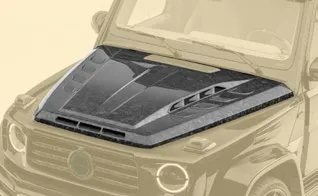
Engine bonnet III Mansory Carbon for Mercedes G-class G500 / AMG G63 W463A


Engine bonnet III Mansory Carbon for Mercedes G-class G500 / AMG G63 W463A
The Engine bonnet III sits in the middle of the four-step Mansory bonnet ladder for the W463A widebody and is, by some margin, the variant most often seen on customer cars specced early or mid-program. It is the practical sweet-spot piece — visually committed enough to mark the car out from a stock G500 or AMG G63, but without the theatrical NACA-style cutouts of the bonnet IV. As part of the wider Mansory Carbon Body Kit for Mercedes G-class W463A G500/G63 programme, the III is the role owners ask for when they want vents that actually move air at idle, yet still want the bonnet to read as a refined sculpture. It bolts to the OEM hinge geometry and accepts the original gas struts.
The Pragmatic Middle Variant
Across the bonnet line, the design language steps up in aggression: the bonnet I is the gentle entry, the II adds a subtle raise, the III introduces a real cooling pattern, and the IV is the full performance treatment. Owners who pick the III are typically running a G500 or AMG G63 daily and want the bonnet to look like it earns its keep without committing to the IV's louder geometry. It is the classic "I want vents but I don't want the car to scream" choice — which is why it appears so often in delivered builds.
The mature design balances styling with cabin temperature. The raised central scoop directs warm air up and over the screen, while the lateral gills relieve pressure pockets that build in the front bay during low-speed crawling. On a hot day with the M177 or M256 idling at a junction, that pressure relief is the difference between heat soaking back through the bulkhead or being dumped clear of the bonnet skin.
Vent Pattern: Centre Scoop + Side Gills
Read from a three-quarter angle, the bonnet III shows three distinct features: one centerline raised section that lifts 18–22 mm above the surrounding skin and tapers rearward, plus a paired set of lateral gills set further outboard and slightly aft. The geometry is intentionally asymmetric in emphasis — the centre is the dominant element, the side gills frame it. From the driver's seat you see the leading edge of the central scoop rising into peripheral vision, a constant reminder that this is no longer a stock skin.
The centre scoop is forward-fed: cool ambient air enters the leading face, accelerates over the top, and the lower-pressure region behind the lip pulls warm bay air up through the underlying mesh. The side gills work as relief vents — they do not feed cold air in, they let hot air out laterally at low speed.
Hot-Idle Behaviour & Engine-Bay Cabin Heat
This is where the bonnet III genuinely outperforms the bonnet I. With the smaller vent pattern of the I, hot bay air stratifies against the underside of the skin, conducts through the panel, and slowly bleeds into the bulkhead. On a 38°C summer day with the V8 idling at a red light, that conducted heat is what owners feel as a warm dashboard and a struggling A/C compressor. The III's larger central opening and side gill area allows convective venting — heat plumes rise out under their own buoyancy without needing forward speed. Real-world owner reports place under-bonnet temperatures 8–14°C lower at idle versus the closed OEM bonnet, and 4–7°C lower than the bonnet I after twenty minutes of stop-start traffic.
On the move, the centre scoop's leading-edge ramp creates a small but useful cool-air slug into the upper bay between 40 and 90 km/h. Above that speed the dominant flow is over the bonnet rather than into it, and the gills shift to neutral — they do not significantly increase drag because they sit in the boundary-layer shadow of the centre scoop.
Carbon Lay-Up & Surface Finish Options
The bonnet III is laid up in pre-preg carbon over a closed-cell aero core, autoclave-cured at controlled temperature and pressure. The outer skin is 3K twill 2x2 weave as standard, with the option of plain 2K weave for a tighter surface or a forged-look composite finish for owners who want the marbled chip aesthetic. Wall thickness of the visible skin runs 1.6–1.9 mm, with localised reinforcement to 3.0 mm at the hinge points and the latch face. Total panel weight, complete with bonded inner liner and stainless mesh inserts, is 9.4 kg — versus an OEM steel bonnet at roughly 18 kg, that is an 8.6 kg saving on the front of the chassis.
- Outer weave: 3K twill 2x2 standard, 2K plain or forged-composite optional
- Cure: pre-preg autoclave at 6 bar, 120°C dwell, controlled cool-down
- Wall thickness: 1.6–1.9 mm skin, 3.0 mm at hinge and latch reinforcement
- Weight: 9.4 kg complete with inner liner and vent mesh
- Mounting hardware: OEM hinge bolts (M8x20), OEM latch hook, original gas struts re-used
- Vent mesh: stainless 304, 5 mm diamond aperture, powder-coated satin black
- Finish: clear UV lacquer (high gloss), satin clear, or matte clear
- Surface preparation: ready for Mercedes paint code matching if an owner wants a body-coloured bonnet with carbon vents only
Fitment Across G500 / G350d / G400d / G63
Mercedes-Benz G-class W463A generation, 2018 onwards, fourth-generation platform — Mercedes' internal model code. The bonnet III fits the G500 (M176/M256), G550 NA-spec, G400d and G350d (OM656 diesel), and the AMG G63 with the M177 4.0 V8 biturbo. Pre-2018 W463 cars (1979–2018, the boxy classic) are NOT compatible — different bonnet geometry, hinge geometry, latch hook, and headlight cut. W464 / W465 Gronos use a separate bonnet not interchangeable with the III. LHD and RHD chassis share the same panel; only the windscreen-wash routing differs. The bonnet is cleared for both with-AMG-package and base trims; the AMG hood badge bracket can be retained or deleted.
Installation Time, Hinge Rebalance & Painted vs. Visible
Allow 3.5–5 hours at a competent body shop. The bonnet ships ready to bolt to the OEM hinges using the original M8 fasteners. The gas struts may need to be retained or, on a couple of chassis, swapped to slightly stiffer items because the carbon panel is lighter than steel — a strut rebalance prevents over-travel at the open stop. Latch alignment is set on the original hook with shim washers, and the wash-jet feed is re-routed through pre-moulded grommets in the inner skin. If the owner wants the bonnet painted to a Mercedes paint code (designo Mauritius Blue, obsidian black, hyacinth red etc.) the panel arrives primer-ready; the carbon-visible route is finished with three coats of clear and a wet-sanded flat-out final layer.
Pairing within the Mansory G-class W463A programme
The bonnet III is most often specced alongside other front-end pieces that complete the visual story without escalating to the full IV-spec aggression. Owners considering a more theatrical front profile sometimes upgrade to engine bonnet IV instead — the IV is louder, deeper-vented, and reads as a track-day piece. Owners who want a cleaner, less vented surface usually stay with the engine bonnet I. To finish the front mask without committing to a full carbon mask swap, the bonnet III pairs cleanly with the logo for grill mask — a small carbon Mansory logo that bridges the bonnet and grille line and locks the front-end branding together at a glance.
Care, Wax Cycles & Long-Term Lacquer
The clear-lacquered carbon surface behaves like any high-end clearcoat: a regular two-bucket wash with neutral-pH shampoo, a soft microfibre mitt, and a plush drying towel. Avoid dishwasher detergent, ammonia-based glass cleaners on the bonnet itself, and abrasive sponges — these accelerate haze and matte the gloss. A carnauba-based wax every six to eight weeks works well on the gloss-clear finish; a ceramic coating (9H-grade) extends protection to 12–18 months and gives a deeper wet-look gloss across the weave. Rain ingress through the vents is controlled by the stainless mesh and inner liner channelling — water that enters drains through the same factory points as the OEM bonnet. Expected lacquer lifespan is 6–8 years before any rejuvenation polish is needed.
Lead Time & Warranty
Lead time on the bonnet III is 3–5 weeks from order confirmation, depending on weave selection and finish. Forged-look surfaces and matte clear finishes sit at the longer end of that window. Every panel ships with a 12-month warranty against manufacturing defects: delamination, voids, fitment outside spec tolerance, and lacquer defects beyond cosmetic norm. Fitment is verified before crating against a master jig; the bonnet ships with latch and hinge hardware in a separate parts bag.
FAQ
Q: How does the bonnet III differ from the IV in everyday use?
A: The III is quieter visually — fewer, smaller vents, no NACA-style scoops, cleaner reflection across the central panel. The IV is the full track aesthetic with deeper functional ducts. The III gives the vent benefit without drawing constant attention.
Q: Is the original hood-strut hardware compatible?
A: Yes. The original gas struts and OEM hinges are retained. On a small subset of chassis we recommend slightly stiffer struts because the carbon panel is lighter than steel and over-travels at the open stop; that is a 30-minute swap and a body shop will confirm during fitment.
Q: Has the thermal benefit been measured?
A: Owner-side data places under-bonnet temperature reductions at 8–14°C at idle versus the closed OEM bonnet, and 4–7°C versus the bonnet I, after twenty minutes of stop-start traffic on a hot day. Cabin-felt heat-soak through the bulkhead is reduced correspondingly — most owners notice it within the first week.
Q: What about rain or weather ingress through the vents?
A: Stainless mesh under each vent and the contoured inner liner channel water along factory drain paths. Wet-weather behaviour is the same as the OEM bonnet — the air filter is unaffected and there is no condensation issue under the lacquer.
Q: Can it be repainted to a specific Mercedes paint code?
A: Yes — the panel ships either in carbon-visible clear-lacquered finish or primer-ready. Body-coloured paint to designo, MANUFAKTUR or any standard Mercedes code is straightforward; a popular spec is body-colour with the central scoop and side gills left carbon-visible, highlighting the geometry against the painted skin.
Common companion pieces are the wide front mask with performance grill, mirror housings, and side carbon trim bars — together they finish the front and side profile cohesively. To order or request weave samples, contact WhatsApp +44 7488 818 747 or [email protected].