
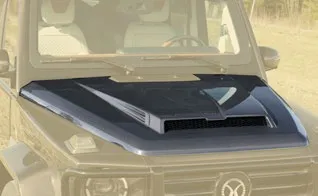
Engine bonnet II for Mercedes G-class W463A Gronos


Engine Bonnet II for Mercedes G-Class W463A Gronos
The Engine Bonnet II occupies a precise position in the Mansory Body Kit for Mercedes G-Class W463A Gronos programme: it is the entry point to the Gronos bonnet hierarchy, and the right choice for owners whose primary goal is the visual transformation of the W463A's most prominent horizontal surface — the wide, flat bonnet that defines the G-Wagon's character from both outside and inside the vehicle. The Bonnet II achieves this transformation through the substitution of the OEM steel panel with an autoclave-cured visible-carbon assembly whose surface texture and reflectivity are categorically different from factory paint. It does this without the prominent vent geometry of the upper-tier bonnets, presenting a clean, uninterrupted carbon field across the full bonnet face — an approach that suits the W463A's architectural proportions particularly well.
Construction & Materials
The Engine Bonnet II is manufactured as a full-face carbon replacement for the W463A's OEM steel bonnet panel. The laminate is constructed from 3K twill prepreg carbon in a balanced 0°/±45° lay-up, autoclave-cured at 120 °C under 4 bar, which delivers the consolidation density required to eliminate micro-voids across the panel's 1,250 mm width. The bonnet's structural task — spanning two hinge points under aerodynamic load and providing enough resistance to bonnet-flutter at motorway speed — is handled by the central structural plies, leaving the outer visible-weave layer free to present the cleanest possible surface without structural interruption.
The underside of the Bonnet II carries a structural gelcoat skin that seals the inner-laminate surface against moisture and provides the mould-side surface quality needed for the OEM bonnet insulation mat to re-seat correctly after the swap. This is a detail that distinguishes a properly engineered carbon bonnet replacement from a cosmetic wrap — the gelcoat underside maintains the factory-set thermal and acoustic properties of the bonnet cavity, which on the W463A includes a factory-fitted noise-reduction matting secured to bonnet under-studs.
- Visible surface weave: 3K twill carbon prepreg — diagonal 45° offset on centreline for a V-spread pattern that draws the eye to the bonnet apex from three-quarter front angles
- Structural laminate: balanced 0°/±45° prepreg stack under visible weave — sized to match OEM W463A bonnet torsional stiffness specification
- Inner surface: structural gelcoat skin — re-seats factory noise-reduction matting and maintains bonnet cavity thermal properties
- Cure process: autoclave 120 °C / 4 bar — void-free consolidation across the full 1,250 mm bonnet width
- Wall thickness: 1.8–2.0 mm on panel field; 2.6–3.0 mm at hinge attachment zones with local reinforcement plies
- Weight: approximately 6.0–7.5 kg — versus OEM steel bonnet approximately 14–16 kg; approximately 8–9 kg saving at the front of the vehicle
- Mounting: OEM W463A hinge bolt pattern; bonnet stay bracket transfers directly from OEM panel; washer-jet underside nozzle transfers to matching boss on the Bonnet II underside
- Surface finish: high-gloss dual-layer UV-stable clearcoat at 35–45 µm DFT; satin/matte clearcoat on request
Design & Visual Function
The clean carbon field of the Bonnet II is, in visual terms, one of the most commanding modifications available to the W463A. The G-Wagon's bonnet is unlike almost any other performance-vehicle panel — it is nearly horizontal, approximately 1,250 mm wide, and lies at near-eye level for observers at kerb height. The OEM paint finish on this surface, however premium the colour specification, is a uniform reflector. The Bonnet II replaces that uniform surface with a 3K twill carbon field whose weave structure creates a three-dimensional depth that changes character with viewing angle, ambient light intensity, and time of day. Under direct overhead sun the diagonal weave pattern produces a symmetrical V-shape spreading from the bonnet centreline; under low-angle morning or evening light the shadow filling the weave recesses creates a grid-shadow that makes the surface appear textured even at distance.
This visual quality is amplified by the W463A's specific geometry in a way that would not apply on most other vehicles. The G-Wagon's forward A-pillars are nearly vertical and the driver's sightline from the seat passes directly along the bonnet crown to the leading edge — effectively making the bonnet interior a design element that is always in the driver's peripheral field. The Bonnet II's clean, uninterrupted weave field performs well in this role: there are no louvre recesses or vent structures to interrupt the horizontal surface when viewed from the driving position, and the weave alignment at the bonnet centreline gives a continuous forward visual reference from the seat.
From an aerodynamic standpoint, the Bonnet II is a panel-for-panel substitution with no change to the W463A's underbonnet air management. The OEM bonnet sealing at the front wings, scuttle, and leading edge is replicated in the Mansory panel — air management in the engine bay remains as Mercedes-Benz designed it. This makes the Bonnet II particularly suited to W463A owners who want a decisive visual transformation without altering the engineered thermal balance of the M177 or M176 engine bay as delivered from the factory.
Compatibility & Fitment
Engine Bonnet II is designed for the Mercedes-Benz G-Class W463A 2018 to present. Donor vehicles include G63 AMG (M177 4.0 L twin-turbo V8, 585 hp / 850 Nm) and G500/G550 (M176 V8 biturbo, 422 hp / 610 Nm). LHD and RHD body configurations share the same bonnet hinge geometry on the W463A; the Bonnet II is a single-mould panel compatible with both. Factory AMG bonnet insulation matting transfers directly to the Bonnet II underside at the OEM stud positions. The 2024 facelift W463A retained the same bonnet aperture geometry — Bonnet II is compatible with all production runs from 2018 onwards. Owners of the pre-2018 W463 platform should not order this part; the W463 bonnet geometry is incompatible with the W463A Gronos panel family.
Installation & Reversibility
Installation of the Bonnet II requires two technicians, a ramp or four-post lift, and a metric bolt set. The procedure mirrors a standard OEM bonnet swap: bonnet opened to the full-stay position, hinge bolts accessed through the engine bay, washer-jet supply hose disconnected at the underside nozzle fitting, bonnet stay released and retained, bonnet removed with two-person lift. The Mansory panel is positioned on the hinges and finger-tightened before gap alignment is set — allow 3–4 mm uniform gap at both wings, checked at leading edge, mid-panel, and hinge-line. Torque hinge bolts to W463A specification. Transfer the bonnet stay, washer-jet nozzle, and insulation matting. Total time: 2–3 hours for two experienced technicians. The modification is fully reversible — the OEM steel bonnet re-installs using the same hardware.
Pairing within the Mansory Gronos programme
The Bonnet II's clean visual register pairs best with front-end components that share its surface-level refinement approach. The High Front Protective Frame adds structural Gronos character to the front face without disrupting the clean bonnet presentation — the brushbar-style frame geometry reads as a deliberate additive element against the carbon bonnet field above it. For headlight-corner carbon continuity, the Carbon Headlight Covers with Air Intake extend the Bonnet II's carbon register from the bonnet face down into the headlight-surround zone. To complete the front-face visual system, the Engine Bonnet IV is available as a future upgrade path if thermal extraction requirements increase.
Maintenance & Durability
The Bonnet II's clean panel surface demands the same care protocol as any lacquered carbon bonnet. Begin every wash cycle with a pH-neutral pre-rinse to loosen surface dust before any contact wash tool touches the panel — on the G-Wagon's horizontal bonnet any dry grit dragged across the surface by a wash mitt creates semi-circular swirl marks that are particularly visible in the 3K twill's diagonal weave under raking light. Use a two-bucket wash method: one bucket for fresh shampoo solution, one for rinsing the wash mitt between panel passes. Never drag the mitt back and forth across the full bonnet width in a single stroke — work in overlapping fore-to-aft passes to minimise swirl risk.
After washing, dry the bonnet surface with a dedicated microfibre drying towel and a leaf blower or forced-air dryer to clear water from the bonnet-to-wing seam gaps before mineral spotting sets. Apply carnauba or ceramic sealant every 6–8 weeks. Inspect the bonnet leading edge — the highest stone-chip risk zone on the W463A — after any motorway run on road surfaces with loose stone margins. Stone chips exposing the carbon surface below the clearcoat should be addressed promptly with a clearcoat pen or local re-lacquer to prevent moisture ingress at the chip site.
Lead Time & Warranty
Lead time for the Engine Bonnet II is 2–4 weeks from order. The panel is warranted for 12 months against manufacturing defects — delamination, void formation, dimensional fitment errors, and clearcoat adhesion failure. Damage from stone strikes, incorrect pressure-washing technique, or adjacent-panel chemical exposure during refinishing work is not covered under the manufacturing warranty.
FAQ
Q: Why would I choose Bonnet II over Bonnet III or IV?
A: If your priority is the visual material upgrade — replacing OEM paint with visible carbon across the G-Wagon's most prominent flat panel — without adding vent geometry or louvre structures to the bonnet face, Bonnet II delivers that result with the cleanest, most architecturally coherent presentation. Bonnets III and IV add progressively more heat-extraction geometry; choose those if underbonnet thermal management is also a goal.
Q: Does Bonnet II maintain the factory bonnet insulation layer?
A: Yes. The OEM noise-reduction insulation mat is transferred from the factory steel bonnet to the Bonnet II underside at the original stud positions. The Bonnet II's gelcoat inner skin provides the correct surface hardness for the mat stud attachment clips to seat without loosening under vibration.
Q: Is the Bonnet II available for both pre- and post-2024 W463A models?
A: Yes. The 2024 cosmetic facelift did not change the bonnet hinge geometry, wing aperture relationship, or bonnet-to-scuttle sealing geometry. Bonnet II fits all W463A production years from 2018 to present.
Q: Can a single technician install this bonnet, or is two-person assistance required?
A: Two people are required. The W463A bonnet panel is 1,250 mm wide and weighs approximately 6–7.5 kg — wide enough that a single installer attempting to manage the panel over the front wings while simultaneously aligning the hinge bolts risks contact damage between the carbon leading edge and the painted front wing.
Q: How does the Bonnet II weave finish compare to factory G-Manufaktur carbon trim?
A: The G-Manufaktur factory carbon programme uses a finer 1K or 1.5K plain-weave carbon on interior and mirror elements, finished with a deep-gloss resin coating. The Bonnet II uses 3K twill prepreg which has a coarser, more three-dimensional weave texture appropriate for a large exterior panel — the factory G-Manufaktur weave specification would look undersized on a 1,250 mm bonnet face.
Discuss Bonnet II specification and delivery timing with the Hodoor Mansory team: WhatsApp +44 7488 818 747 or [email protected].