
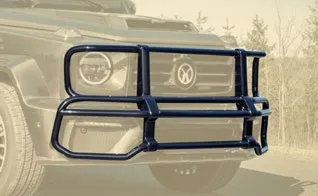
High front protective frame for Mercedes G-class W463A Gronos


High Front Protective Frame for Mercedes G-Class W463A Gronos
The W463A G-Wagon's front face presents a large, vertically flat surface to the road ahead — a profile that, while architecturally compelling, offers no geometric deflection protection against obstacles at bumper and lower-front-panel height. In off-road use, this flat front absorbs vegetation contact, gate impacts, and terrain approaches that would damage the lower front bodywork without protection. In urban and semi-urban use, the same surface zone collects low-speed parking contact damage from kerb edges and obstruction corners. The High Front Protective Frame from the Mansory Body Kit for Mercedes G-Class W463A Gronos adds a structural front brush bar at the upper front face zone — a high-profile frame that extends above the bumper centre line to provide impact interception at a vertical range that a standard low brush bar cannot cover. The Gronos specification produces this frame in visible carbon fibre, integrating protection with the programme's material language at the vehicle's forward-facing primary contact zone.
Construction & Materials
The High Front Protective Frame is a structural carbon-fibre and stainless-steel composite assembly. The primary structural tubes are 50 mm diameter 304-grade stainless-steel bar stock — providing the structural stiffness and impact energy absorption that carbon alone cannot match at the bumper impact zone. The outer surface of each structural tube is carbon-fibre sleeve-wrapped in 3K twill weave, providing the Gronos programme's visual material language over the structural steel substrate. Mounting points are through the lower front cross-member at the W463A's tow point positions, using M14 stainless-steel hardware. The frame height extends to approximately 550–650 mm above the W463A's front wheel centreline, placing the upper bar at the lower windscreen zone — the high profile that distinguishes this frame from the low variant.
- Primary tubes: 50 mm 304-grade stainless steel, carbon 3K twill sleeve-wrapped outer surface
- Frame height: 550–650 mm above front wheel centreline — upper bar at lower windscreen zone
- Mounting: M14 stainless at OEM tow-point cross-member positions — no chassis modification
- Horizontal bars: upper and lower, connected by two vertical uprights — four-bar high-profile frame
- Clearcoat on carbon sleeve: dual-layer UV-stable gloss lacquer; exposed stainless brushed or polished finish
- Weight: approximately 18–24 kg — adds to front axle weight over OEM bumper specification
- W463A front sonar sensor compatibility: sensor apertures or accommodated at lower horizontal bar
Design & Visual Function
A high-profile front brush bar on the W463A fundamentally transforms the vehicle's frontal presence. Where the standard W463A presents a flat, unbroken surface at the front face, the high frame adds a three-dimensional structural overlay that breaks the flat profile into a defined structural form — tubes, horizontal bars, and vertical uprights that project the vehicle's front geometry forward and upward. The carbon sleeve on the structural tubes integrates the frame into the Gronos programme's visual language: the 3K twill weave on the tube surfaces is visible at close inspection distance and identifies the frame as a Mansory Gronos specification element rather than a generic utility brush bar. The frame's presence sends an immediate signal about the vehicle's intended use — a W463A with a high front protective frame communicates readiness for demanding environments without compromising the Gronos exterior programme's material precision.
From the pedestrian perspective the high frame also creates a material depth cue at the W463A's front face. A flat front panel — even a carbon one — presents no forward projection at the bonnet-to-bumper transition zone. The high frame's tubes project 120–150 mm forward of the front bumper surface, which adds a shadow geometry at the leading face that changes throughout the day as the sun angle changes. At direct-frontal illumination the tubes cast a thin shadow line onto the bumper below; at low-angle illumination the tubes project a long shadow across the front face. This shadow geometry is a visual dynamic that a flat panel cannot produce, and it is apparent from the approach angles typical of urban driving where the W463A is seen from distances of 5–30 m as it approaches junctions and intersections.
The high profile carries the visual statement above the bumper line to the lower windscreen zone, which makes the frame visible in the vehicle's frontal silhouette from any approach angle — not just from low angles where a low frame would dominate. This means the frame's design contribution is apparent at the urban and motorway observation angles where the W463A is most frequently viewed, not only at the off-road and close-proximity angles where a low frame reads best.
Compatibility & Fitment
High Front Protective Frame fits Mercedes-Benz G-Class W463A 2018 to present, G63 AMG and G500/G550. The mounting positions at the OEM front cross-member tow points are identical across variants. LHD and RHD compatible. Post-2024 facelift W463A compatible with front sonar sensor accommodation. Not compatible with pre-2018 W463 cross-member geometry. Confirm front sonar sensor configuration with Mansory before ordering.
Installation & Reversibility
Installation time is 90–120 minutes with a two-person crew. The frame is heavy (18–24 kg) and requires two people to position correctly at the front cross-member mounting positions before the M14 bolts are engaged. Torque the M14 mounting bolts to 80 Nm. Verify front sonar sensor positions are not obstructed after fitment. The OEM front bumper remains in place under the frame. Fully reversible — the frame unbolts at the cross-member mounting points without modification to the W463A's front structure.
Pairing within the Mansory Gronos programme
The High Front Protective Frame pairs with the lower front zone programme elements. The Low Front Protective Frame is the bumper-height alternative for builds requiring front protection without the high-profile visual statement. For the front face behind the frame, the Fully Carbon Front Mask with Performance Grill carries the Gronos carbon programme at the central nose that the frame brackets from the outside. The Front Flasher Protection Cover frames the LED flasher units at the lower front wing zone that the protective frame's uprights flank.
Maintenance & Durability
The stainless-steel structural tubes resist corrosion under normal use but the interface between the stainless substrate and the carbon sleeve at the tube surface requires annual inspection. Road salt and moisture can penetrate the sleeve at the tube end-cap junctions during winter use, causing galvanic micro-corrosion at the stainless-to-resin interface. Apply a penetrating corrosion inhibitor at the end-cap junctions annually and ensure the end-cap sealant beads remain intact. The carbon sleeve's clearcoat on the tube-outer surface receives significant stone-chip exposure from the road surface — treat chips immediately with a touch-up pen, as the sleeve's inner face is bonded to the stainless substrate and moisture wicking at chip locations can cause the sleeve to lift from the tube surface over time.
After any impact event — whether at low-speed parking contact or off-road approach — inspect the frame's mounting hardware for any loosening or deformation at the cross-member mounting points. An impact that the frame intercepts will transmit load into the mounting hardware, which can cause thread galling or bolt stretch at the M14 positions. Replace any bolt that has been loaded by an impact event with a new M14 grade-8.8 stainless fastener before the next off-road or exposure event to maintain the frame's structural integrity at its mounting interface.
Lead Time & Warranty
Lead time for the High Front Protective Frame is 3–4 weeks from order. 12-month warranty against sleeve delamination, clearcoat adhesion failures, and mounting hardware failures under normal use. Impact damage to structural elements is not covered under warranty.
FAQ
Q: Does the high frame require any modification to the W463A's front sonar sensors?
A: The frame is designed with accommodation for the W463A's OEM front sonar sensors. Confirm your specific W463A's sonar configuration (number of sensors and positions) with Mansory at order to ensure correct aperture provision in the delivered frame.
Q: Can the High Frame be fitted alongside a front winch?
A: This frame mounts at the OEM tow-point cross-member positions. A winch requires a separate mounting plate at the same cross-member — confirm compatibility with Mansory before specifying both together.
Q: Does the high frame affect the W463A's approach angle in off-road use?
A: The frame's lower horizontal bar is at bumper height, matching the OEM bumper's approach angle limit. The frame does not reduce approach angle below the standard W463A specification.
Specify sensor configuration and finish preference with the Hodoor Mansory team: Contact us via WhatsApp +44 7488 818 747 or [email protected].