
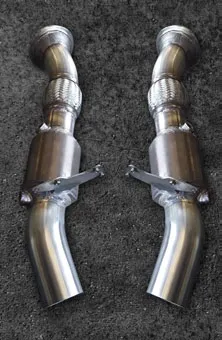
Down pipes Mansory for Ferrari 296 GTB


Down Pipes Mansory for Ferrari 296 GTB
The Mansory Down Pipes (catless) for the Ferrari 296 GTB represent the unrestricted endpoint of the exhaust programme — a set of straight-through primary pipes that eliminate the catalytic converter housings entirely from the turbocharger outlet section, removing the single largest remaining flow restriction in the exhaust path and producing the highest-performance acoustic and flow characteristics available in the Mansory exhaust programme. Without the catalyst substrate's cell matrix in the exhaust stream, the back-pressure at the turbocharger turbine outlet drops to the minimum achievable by the pipe geometry alone; turbocharger response sharpens accordingly, and exhaust gas velocity at the turbine exit increases, improving the scavenging pulse that drives the compressor wheel. These down pipes are intended for track-day and off-road use only; emissions certification requirements mandate a catalytic converter in the exhaust path for road registration in most markets — before fitting these pipes to a road-registered 296 GTB, check applicable local regulations. They are part of the Mansory Carbon Fiber Body kit set for Ferrari 296 GTB and represent the maximum performance configuration of the 296 GTB's F163 twin-turbo V6 drivetrain in the exhaust domain.
Construction & Materials
The catless down pipes are fabricated from mandrel-bent grade 321 titanium-stabilised stainless steel — the same alloy specification as the 200-cell catalyst variant — at the same 63.5 mm OD, 1.5 mm wall tube dimension throughout the full length from turbine outlet flange to secondary cat junction. Without the 100 mm OD catalyst housing expansion section, the straight 63.5 mm tube maintains constant bore area along the full primary pipe run, eliminating the minor diffusion and convergence losses that the catalyst housing introduces in the catalytic variant. Pre-welded lambda sensor bosses at the OEM positions are retained on the catless pipes, enabling the lambda sensor wiring to remain connected — if an emissions-passing strategy requires the sensors to remain fitted during road use alongside a secondary catalyst bypass, the boss positions are present. TIG welding is full-penetration aerospace standard throughout. Pair weight of the catless set is approximately 1.9 kg — approximately 0.9 kg lighter than the 200-cell set, which carries the additional mass of the metallic substrate housings.
- Material: mandrel-bent grade 321 stainless steel, titanium-stabilised, high-temperature alloy
- Tube: constant 63.5 mm OD, 1.5 mm wall, turbine outlet to secondary cat junction — no housing expansion
- No catalyst: fully open bore, minimum back-pressure achievable by pipe geometry
- Lambda sensor bosses: pre-welded at OEM positions, sensors remain connectable
- Welds: TIG full-penetration, aerospace standard
- Pair weight: ≈ 1.9 kg (saving ≈ 0.9 kg vs. 200-cell variant; saving ≈ 2.5 kg vs. OEM)
- Use: track-only / off-road use; check applicable regulations before fitting to road-registered vehicle
- Performance potential: maximum turbo-spool sharpness and exhaust flow in the Mansory programme
Design & Visual Function
The catless configuration's design logic is purely aerodynamic and thermal: without a catalyst in the flow path, exhaust pulse energy from the combustion events reaches the turbine wheel in a higher-fidelity form, with minimal attenuation from cell-wall friction and flow diversion. The turbine's response to each exhaust pulse is sharper; the compressor's pressure delivery to the intake manifold follows with reduced latency. For a driver exploiting the 296 GTB's 830 hp total output at a circuit, this improved transient response means that on-throttle boost pressure is available more immediately after turn-in — the transition from corner apex to straight-line acceleration feels more responsive, with the V6's mid-range torque arriving with less hesitation across the PHEV's sequential electric-to-combustion power blend.
Acoustically, the catless configuration produces the most open, full-range exhaust note possible from the 296 GTB's V6. The catalyst cell matrix acts as a distributed acoustic absorber, attenuating specific frequency bands in the exhaust note — particularly mid-frequency content in the 800–2000 Hz range where the V6's firing order harmonics are most prominent. Without this attenuation, the exhaust note from the turbine outlet propagates freely to the tailpipe, producing a richer, more complex harmonic stack with audibly stronger turbo-whistle and wastegate signatures. On a circuit where sound limits are enforced in terms of dBASPL at distance, note that catless exhaust systems on turbocharged cars typically produce higher noise outputs than catalytic systems — confirm the circuit's noise threshold with the measured output of the Mansory catless configuration before arriving for a track day.
The constant 63.5 mm bore throughout the catless pipe run minimises the pressure-wave reflection events that occur at diameter transitions — transitions that, in some exhaust configurations, generate destructive interference at specific engine speeds and create resonance troughs in the torque curve. The straight-bore catless design eliminates these transitions entirely, producing a flatter back-pressure characteristic across the RPM range than the catalyst housing expansion-and-contraction introduces. The result is more linear torque delivery from the turbocharged V6 — a characteristic that complements the linear electric motor torque of the PHEV system and produces a combined torque curve without the local troughs that complicate maximum-traction driving at the circuit.
Compatibility & Fitment
The catless down pipes fit the Ferrari 296 GTB coupé (2022+), 296 GTS spider (2023+), and 296 Assetto Fiorano, at the OEM turbine outlet and secondary catalyst inlet flanges. Lambda sensor transfer from OEM bosses. LHD and RHD configurations use the same system. These pipes are for track-only / off-road use. Check applicable regulations before fitting to any road-registered vehicle — emissions laws in most markets prohibit removal of primary catalytic converters from road-use vehicles. Mansory and Hodoor accept no liability for regulatory non-compliance resulting from fitting these pipes to a road-registered vehicle.
Installation & Reversibility
Installation procedure identical to the 200-cell variant: two-post lift, undertray removal, 3–4 hours at a qualified exhaust workshop. OEM down pipes unmodified and storable for refitment when road use requires the original configuration. The catless pipes are frequently swapped for a road-legal configuration (OEM or 200-cell) between track use and road use by owners who maintain both sets.
Pairing within the Mansory 296 GTB programme
The catless down pipes represent the maximum-performance exhaust programme configuration; pair with the Exhaust Mansory for Ferrari 296 GTB for a complete low-restriction path from turbine to tailpipe. The Down Pipes with 200-Cell Catalysts Mansory for Ferrari 296 GTB is the road-use alternative within the same pipe geometry family, allowing owners to switch between track and road configurations. The Rear Wing Mansory for Ferrari 296 GTB and catless exhaust together define a track-focused 296 GTB specification that uses the platform's full aerodynamic and drivetrain potential.
Maintenance & Durability
Grade 321 stainless catless pipes in the turbocharger outlet zone operate at the highest sustained temperatures in the exhaust system — sustained gas temperatures of 700–900 °C under full turbo load on circuit. Inspect TIG weld seams at the turbine outlet flanges after each sustained track session in the first 5,000 km of use; thermal break-in cycling can reveal any pre-existing weld stress concentrations that stabilise after normalisation. After this break-in period, annual inspection intervals are appropriate. Lambda sensor thread integrity is critical — corrosion at the boss thread on a catless system that sees track temperatures regularly requires more frequent anti-seize application to the sensor threads. Replace the flange gaskets at both ends whenever the pipes are removed for storage or workshop access.
Lead Time & Warranty
Catless down pipes are simpler to fabricate than the catalytic variant and carry a lead time of 3–4 weeks from order confirmation. The 12-month warranty covers TIG weld integrity, flange dimensional accuracy, and lambda sensor boss thread quality. Performance claims are not warranted as they depend on the complete exhaust system configuration, ECU calibration, and driving conditions. Contact Hodoor with order reference and photographs for warranty claims.
FAQ
Q: Are these down pipes legal for road use?
A: These pipes are for track-only / off-road use. They eliminate the primary catalytic converters required for road use under emissions legislation in most markets. Check applicable regulations before fitting to any road-registered vehicle. For road-registered 296 GTB exhaust upgrades, specify the 200-cell catalytic down pipe variant.
Q: Can I swap between catless and OEM (or 200-cell) down pipes for road versus track use?
A: Yes — this is the standard use case for catless performance down pipes. The turbine outlet and secondary cat flanges are bolted connections; swapping between two sets of down pipes is a 3–4 hour workshop operation. Many owners maintain a full road-legal exhaust configuration (OEM or 200-cell) alongside the catless track set and swap before each track day.
Q: Does removing the primary cats trigger OBD2 fault codes?
A: Yes — the downstream lambda sensors will detect the absence of catalytic conversion activity and trigger P0420/P0430 catalyst efficiency fault codes. On a track-only car this is irrelevant; on a car used on public roads these codes will illuminate the engine warning lamp and cause MoT/emissions test failure. The lambda sensor bosses are pre-welded to allow sensor connection, but the absence of the catalyst substrate means the sensors will always detect inefficiency.
Q: What is the acoustic difference between the catless and 200-cell down pipes with the Mansory exhaust system?
A: The catless variant produces a noticeably louder, more open acoustic character — the mid-frequency content attenuated by the 200-cell catalyst substrate is fully recovered, producing a richer harmonic stack at 3000–6000 rpm. The difference is most apparent at wide-open-throttle on a circuit; at cruise and urban driving speeds the difference is less dramatic. Track operators with sound-limit enforcement should verify compliance with the measured output of the complete catless configuration before attending.
To order catless down pipes or discuss the complete track exhaust programme for your 296 GTB, contact us via WhatsApp +44 7488 818 747 or [email protected].