Carbon windshield panel Mansory for Lamborghini Aventador Competition


Mansory Carbon Windshield Panel for Lamborghini Aventador Competition
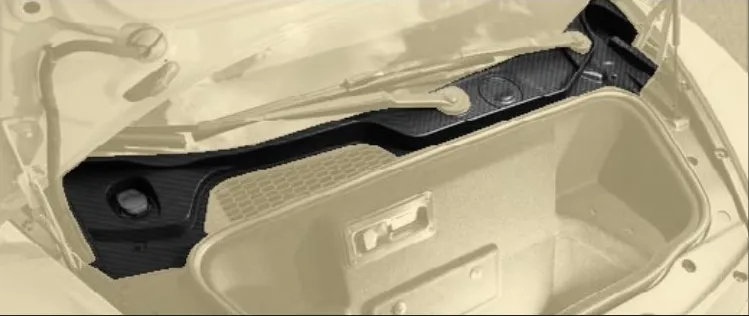
The carbon windshield panel sits at the most photographed seam of the Aventador silhouette — the band of bodywork that wraps the lower edge of the windscreen, ties into the cowl, and runs outward until it meets the foot of each A-pillar. Within the Mansory Carbon Body Kit for Lamborghini Aventador Competition it functions as the connective tissue between the front clamshell and the greenhouse: a single, uninterrupted carbon plane that resolves the glass-to-cowl interface and cleans up the optical step that would otherwise interrupt the eye on the way from the front bonnet to the roof. Owners specify it because the Aventador's V12 NA architecture, scissor-door geometry and aluminium-CFRP monocoque deserve a transition piece that is itself a structural-grade laminate rather than a painted plastic surround.
Construction & Materials
The panel is laid up as a continuous skin so the weave never breaks across the windshield base. Plies are oriented to follow the curvature of the cowl, with bias-cut overlaps placed under the wiper sweep arc and along the A-pillar feet so that under raking sunlight the twill grid reads as one fabric, not two. Mansory's atelier presses the part with a male and female tool to control both visible and bond-side surfaces; this matters because the lower edge tucks under the windshield gasket and any fibre print-through there would telegraph through the urethane bead.
- Reinforcement: aerospace-grade T700 3K twill prepreg, 200 g/m² primary skin with localised 245 g/m² doublers at A-pillar foot transitions
- Cure cycle: full autoclave at 6 bar / 125 °C, with a post-cure dwell to stabilise the lacquer carrier before topcoat
- Wall section: nominal 1.6–1.9 mm with a tapered 1.2 mm featheredge where the panel meets the windshield gasket lip
- Mass: approximately 0.7 kg per panel including bonded studs — a ~1.0 kg net delta versus the OEM cowl trim assembly it replaces
- Mounting: factory M5 cowl studs reused, plus four bonded aluminium inserts for the A-pillar foot tabs; a butyl bead seals the windscreen interface
- Finish menu: gloss UV-stable lacquer, satin matte, or raw-weave open-pore with hydrophobic sealer
- Edge treatment: hand-stoned, sealed and clear-coated so the laminate cross-section reads as a clean dark line, not a fibre stub
- Quality control: gloss-meter check across the central span, Barcol hardness on the doubler region, white-light scan against the master tool
Design & Visual Function
This is a larger-scope piece than the small wipers cover and a different geometry than the A-pillar cover; it sits between them and visually subsumes both into a single carbon band. Where the wipers cover is a compact lid concerned only with concealing the wiper park and pivot bosses, the windshield panel runs the full transverse width of the cowl, picks up the curvature of the windscreen rubber, and continues outward until it merges into the A-pillar transition. The result is one continuous surface from one A-pillar foot to the other rather than three discrete trim islands.
On the Aventador's dramatic, cut-glass surfacing the panel does real work. The factory cowl plane on a Roadster or coupé tends to reflect sky in a single bright sheet that competes with the front bonnet's vents; once the area is finished in twill the reflection is broken into thousands of micro-facets and the eye is led naturally up the windscreen and into the roofline. On SVJ trim, where the bonnet vent and ALA intake mouths already speak a strong graphic language, the carbon panel acts as a low-noise base that lets those features carry the composition. The A-pillar transition, in particular, becomes a deliberate seam rather than an accidental one — the weave continues into the optional A-pillar cover so the scissor-door cut reads as a clean carbon arch from cowl to roof header.
Surface continuity versus paint is the real selling point. A painted cowl trim eventually shows micro-scratches from windscreen wiper towel work and from the constant cleaning that a stone-magnet supercar receives at this exact spot. A lacquered carbon panel is far more forgiving: the weave hides hairline marring optically, the lacquer system is harder than acrylic body paint, and any deeper damage can be re-flatted and re-cleared without colour-matching to the rest of the body.
Compatibility & Fitment
Engineered for the Lamborghini Aventador across LP700-4, LP750-4 SV, S, SVJ and Ultimae, in both coupé and Roadster body styles. The windshield aperture and cowl geometry are essentially shared across the range, so the panel itself is a single SKU; what differs between cars is the specification of the surrounding parts. On Roadster cars, the panel is fully compatible with the targa-style soft-top stowage flow and does not interfere with the roof-cover-cabrio panels behind the cabin. The OEM rain sensor housing, windscreen washer jets, wiper pivot bosses and A-pillar drip channels are all retained — the panel cuts around them rather than blanking them off, which preserves regulatory glass clearance and washer spray angles.
Installation & Reversibility
This is a bolt-and-bond panel rather than an adhesive-only body section, which keeps it firmly inside the DIY-friendly group together with mirror caps, A-pillar cover and the small wipers cover. Plan on roughly 60 to 90 minutes for a careful first-time install, plus drying time for the sealing bead. The wipers and the cowl plenum trim come off first, the OEM rubber gasket is freed at the lower edge, and the original trim assembly lifts away to expose the cowl studs. The carbon panel drops onto those studs, the A-pillar foot tabs are wet-set with a low-modulus structural adhesive compatible with the Aventador's CFRP monocoque (methacrylate-class, manufacturer-specified), and a continuous butyl or polyurethane bead reseals the windscreen interface. Reinstall the wipers, recalibrate park position with the diagnostic tool if needed, and the job is done. Reversibility is full: the studs are factory, the adhesive line is on a sacrificial substrate region, and a clean removal returns the car to OEM. For body shops handling a complete kit, allocate 30–60 minutes for this panel as a sub-task within the larger 12–20 hour kit fit.
Pairing within the Mansory Aventador Competition programme
The windshield panel almost always travels with two stablemates. The first is the small Mansory carbon windshield wipers cover, which sits inside the panel's footprint and is the lid over the wiper park; pairing the two yields a single carbon expanse from glass edge to bonnet shut-line with no painted island in between. The second is the A-pillar cover, which continues the weave from the panel's outer ends up the windshield posts to the roof header — the two parts are explicitly designed to alignment-match at the foot of the A-pillar so the twill grid reads as one continuous fabric across that corner. Owners specifying a maximalist front graphic also tend to add the front bonnet, which puts carbon on the upstream side of the windshield so the entire forward hemisphere — bonnet, cowl panel, A-pillar covers, roof header — speaks the same material language.
Maintenance & Durability
The cowl region collects pollen, tree sap, dead insects and the residue of every windscreen washer cycle, so this panel sees more chemistry than most body parts. Wash with pH-neutral shampoo and a soft microfibre, never with alkaline degreaser or ammonia-based glass cleaner — the latter creep onto the lacquer at the gasket edge and can dull the clear over time. A two-layer ceramic coating is the default protection: it shrugs off water-spot etch from the washer jets and gives the wiper towel a slick path to glide on. Avoid abrasive sponges and never use clay on a fresh lacquer cure. Stone chips at the leading edge of the panel — rare, since the bonnet shields it — are repairable by spot-flatting and re-clearing without disturbing the surrounding body paint, which is one of the ownership advantages over a painted OEM cowl. Service life with reasonable care exceeds a decade; UV-stable lacquer is essential for cars stored outdoors so the resin does not amber.
Lead Time & Warranty
Production is bespoke through Mansory's atelier; lead time is typically 4 to 8 weeks from order confirmation to ship-ready, longer if a non-standard finish such as a tinted lacquer or a coloured-fibre hybrid weave is requested. Each panel is covered by a 12-month warranty against manufacturing defects (delamination, gel-coat porosity, fitment outside tolerance). Wear items — lacquer micro-marring, install-induced cosmetic damage — are excluded.
FAQ
Q: How is this different from the smaller windshield wipers cover?
A: The wipers cover is a compact lid that hides the wiper park and pivots only. The windshield panel is the larger surrounding piece — it bridges the entire glass-to-cowl interface and runs outward until it meets the A-pillar feet. They are different parts and they nest together: the wipers cover sits inside the windshield panel's footprint.
Q: And how is it different from the A-pillar cover?
A: The A-pillar cover wraps the windshield posts vertically. The windshield panel is horizontal — the cowl-line band. They meet at the foot of the A-pillar and are designed to alignment-match the twill grid at that junction.
Q: Is the part the same on coupé and Roadster?
A: Yes. The windshield aperture and cowl geometry are shared across LP, S, SV, SVJ, Ultimae, coupé and Roadster, so it is a single SKU.
Q: Can I install it myself?
A: It is one of the more approachable carbon parts in the kit — closer to mirror caps than to a front bumper. Most owners with workshop experience handle it in an afternoon. The only specialist step is resealing the windscreen interface bead.
Q: Does it interfere with the rain sensor or the heated wiper park?
A: No. The OEM sensor housing, washer jets, wiper pivot bosses and any heated park elements are retained; the panel is cut around them.
Q: Lacquered gloss versus raw matte — which holds up better at this location?
A: Both are durable, but lacquered gloss is easier to maintain in the cowl area because that surface is wiped constantly. Raw matte looks superb but reveals fingerprints and washer-fluid splash sooner; ceramic-coat it on day one if you go matte.
Pair this panel with the wipers cover and the A-pillar cover for a single uninterrupted carbon band from one windshield post to the other. To order or to spec a finish, message WhatsApp +44 7488 818 747 or email [email protected].