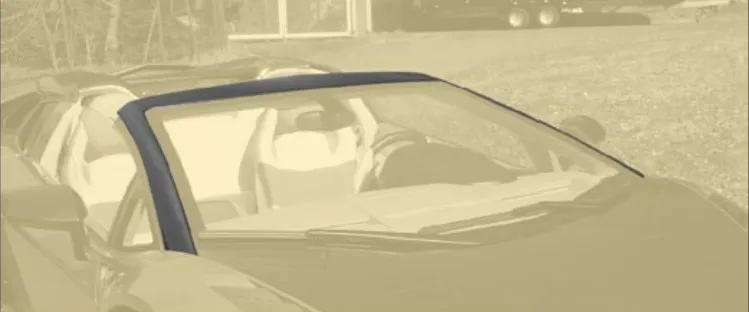
A-pillar cover Mansory Carbon for Lamborghini Aventador Competition


Mansory A-Pillar Cover Carbon for Lamborghini Aventador Competition
The A-pillars are the slender posts that frame the windshield, climbing from the cowl up to the roof header. On a Lamborghini Aventador they are doing more than holding glass: they sit at the visual hinge between the long aluminium-CFRP nose, the carbon roof and the upward sweep of the scissor-door cut. The Mansory A-Pillar Cover Carbon pair belongs to the wider Mansory Carbon Body Kit for Lamborghini Aventador Competition programme, the SVJ-derived high-spec build that wraps the LP, S, SVJ and Ultimae cars in autoclave twill. Owners specify it because a body-coloured A-pillar breaks the carbon-on-carbon roofline; the Mansory shell rebuilds that continuity, turning the windshield surround into a single dark ribbon. The OEM substrate stays in place under the cover, so head-impact behaviour, airbag deployment paths and rain-channel geometry are untouched. The pair fits coupe and Roadster, and behind the visual it is a quietly engineered piece — a slender post is the hardest place on a car to lay weave that still looks straight at every angle.
Construction & Materials
Each A-pillar shell is a thin autoclave laminate built around the OEM trim profile. Mansory works the weave bias deliberately: a slender, curving post will telegraph any weave run-out, so the bias is set so warp threads track the upward sweep and weft threads run roughly parallel to the door cut. From the side the pillar reads as a clean diagonal of carbon; from inside the windshield, looking out, the surface stays calm rather than busy.
The pair is shipped finished and ready to mount. Lacquered weave is the standard hand-off; a satin matte clear is offered for owners running a stealth roof and B-pillar treatment. Hardware is supplied with the kit.
- 3K twill prepreg carbon, 2x2 weave, bias aligned to pillar sweep
- Autoclave cure, 6 bar, 125 C dwell, post-cure for dimensional stability on a slender section
- Wall thickness 1.4–1.7 mm — deliberately thin to keep added height over OEM trim under 2 mm
- Pair (left + right) weight approximately 0.32–0.42 kg combined
- Mounting: high-bond acrylic foam tape pre-applied to the inner face, plus two locator clips that engage the OEM trim's existing fixing rebates
- UV-stable two-pack clear lacquer; satin matte option on request
- Edges hand-radiused so the cover blends into the OEM rain channel without a visible step
- Inner face flocked black to kill any reflection into the windshield from below
Design & Visual Function
The A-pillar is a difficult canvas. It is narrow, it curves in two planes, and it sits in direct view of both the driver and anyone looking at the car from a three-quarter angle. The Mansory cover treats it as a deliberate graphic element rather than a leftover surface. The weave is laid so the diagonal of the twill picks up the diagonal of the post itself; the eye reads the pillar as faster, more raked, more part of the windshield than it does in body colour.
The continuity argument is the main one owners cite. An Aventador with the carbon roof panel, carbon B-pillar treatment and carbon mirror caps, but body-coloured A-pillars, has a visible interruption at the top corner of the windshield. With the Mansory shell in place the line runs unbroken: header rail, A-pillar, roof, B-pillar, scissor-door cut, all in twill. The car stops looking like it has carbon accents and starts looking like it has a carbon greenhouse — a different and more expensive impression.
The cover also changes how the post behaves under light. OEM textured paint scatters reflections, which in bright sun makes the pillar look thicker than it is. Lacquered twill picks up a single, directional highlight along the bias, which makes the post look slimmer and more tense. From the driver's seat the inner edge is flocked, so there is no hot reflection bouncing off the lacquer into the lower windshield — a small but real consideration on a low-set, deeply raked screen.
Compatibility & Fitment
The A-pillar cover pair fits the Lamborghini Aventador across LP700-4, LP750-4 SV, S, SVJ and Ultimae trims, and across coupe and Roadster bodies. The A-pillar geometry is shared across the range — the bumper and ALA differ between pre-SVJ and SVJ cars, but the windshield surround is constant — so no variant-specific part number is required. The OEM trim stays in place; the Mansory shell sits on top of it. Rain channels, weatherstrip lips, and the upper edge of the door glass seal are all preserved. Parking sensors, rain sensor and the windshield-mounted camera (where fitted) are unaffected because the cover does not touch any glass-side hardware.
Installation & Reversibility
This is one of the genuinely DIY-friendly pieces in the Mansory Aventador Competition catalogue. Working time is 30–45 minutes for the pair on a clean, warm car. The workflow is: clean the OEM A-pillar trim with isopropyl alcohol, warm both the trim and the inner face of the cover to roughly 25–30 C with a heat gun on low, peel the liner from the high-bond tape, locate the cover using the two clip features, and press from the base of the post upward in one continuous motion to avoid trapping air. Final cure of the acrylic tape is 24–48 h at room temperature; the car can be driven immediately but should not be pressure-washed at the windshield surround for two days.
Reversibility is part of the brief. Because the OEM trim is retained, removing the cover later restores the original look without touching paint, glue residue on body panels, or drilled holes. A soft plastic trim tool slid behind the cover at the base lifts it cleanly; tape residue on the OEM trim wipes off with a citrus-based adhesive remover. No methacrylate bonds to the CFRP monocoque are involved on this part — the bond is OEM-trim-to-cover, not body-to-cover, which keeps the substrate chemistry conversation entirely off the table here.
Pairing within the Mansory Aventador Competition programme
The A-pillar cover is the smallest piece in a three-part windshield-surround upgrade. Run with it: the carbon windshield panel across the cowl, and the carbon windshield wipers cover over the wiper arms. Together those three pieces redraw the entire forward greenhouse in twill — cowl, wipers, posts — without touching aero. Add the Mansory mirror housings and the side view becomes a single carbon diagonal from windshield base to door cut. None of these parts are aero-active; they are visual-continuity work, and they only earn their cost when run as a set.
Maintenance & Durability
A-pillar covers live in the worst microclimate on the car for lacquered carbon. They sit at the top of the cowl, so they catch direct sun for long periods, they get hit by sprinkler overspray and tree sap when parked outdoors, and they are within the wiper-spray arc on the driver's side. Care is straightforward but specific. Use a pH-neutral car shampoo and a dedicated soft microfibre — never the same mitt that has touched the lower body or wheels, because grit picked up there will haze the lacquer instantly on a small, curved part. Avoid alkaline traffic-film removers, ammonia-based glass cleaners that drift onto the post during windshield cleaning, and abrasive sponges of any kind.
A ceramic coating rated for clear-over-carbon is the right protection here, applied at fitment when the lacquer is fresh and uncontaminated. Reapply or top up every 12–18 months. Carnauba wax is acceptable but offers less UV defence on a part this exposed. If a stone chip or wiper-arm scuff breaks the lacquer, address it within weeks, not months — water ingress under clear coat on a slender part lifts a much larger area than the original chip. A specialist can spot-repair a chip on the A-pillar cover for considerably less than a full re-lacquer.
Lead Time & Warranty
Lead time runs 4–8 weeks from order confirmation. Mansory builds the Aventador Competition carbon programme to bespoke order; A-pillar covers are made in matched left-right pairs from a single layup batch so the weave alignment carries across the windshield. Warranty is 12 months against manufacturing defects — delamination, lacquer failure not caused by impact, or misalignment beyond Mansory's tolerance. Damage from impact, chemical attack, or installation outside the documented procedure is not covered.
FAQ
Q: Does this replace the OEM A-pillar trim or sit over it?
A: It sits over it. The OEM trim, the airbag tear-line behind it, and the head-impact substrate all stay exactly as Lamborghini built them. The Mansory cover is a thin shell bonded to the outside of that assembly.
Q: Will it affect the airbag or head-impact compliance?
A: No, because the cover does not modify the OEM substrate. The deployment path of the curtain airbag and the energy-absorbing structure underneath the trim are untouched. This is the central design reason for keeping the cover thin and the bond to the OEM trim, not to the body.
Q: Coupe and Roadster — same part?
A: Yes. The A-pillar geometry on the Aventador is shared between coupe and Roadster; the differences are at the rear roof structure, not the windshield surround. One pair fits both bodies across the entire LP / S / SVJ / Ultimae range.
Q: Can I run lacquered twill on the A-pillars and matte carbon on the roof?
A: It is possible but read carefully in person before committing. The eye is very sensitive to gloss differences across the windshield-roof junction. If the roof is matte and the A-pillars are lacquered, the post can read as a different material rather than a continuation. Most owners specify both surfaces in the same finish.
Q: Is the weave direction the same on left and right?
A: The weave bias is mirrored. Mansory lays the layup so the twill diagonal sweeps inward toward the windshield centreline on both sides, which keeps the pair visually symmetric. A non-mirrored pair would look subtly off, especially head-on.
Q: Will it hold up to automated car washes?
A: Soft-cloth washes are tolerated; brush washes are not recommended for any lacquered carbon part on this car, and the A-pillar is one of the first surfaces a brush head contacts. Hand wash is the safe default.
Specify the pair alongside the windshield panel and wipers cover for a complete carbon greenhouse. Order or ask for finish samples on WhatsApp +44 7488 818 747 or [email protected].