
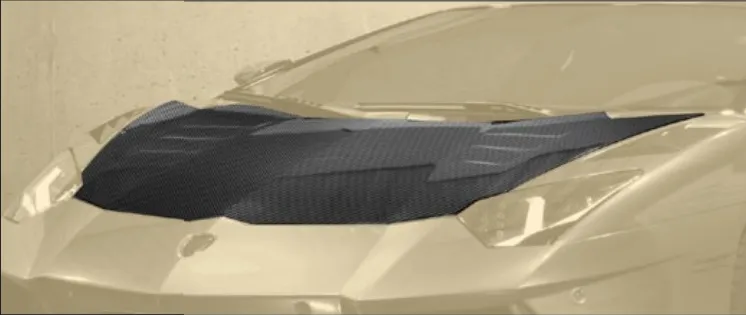
Front bonnet Mansory Carbon for Lamborghini Aventador Competition


Mansory Carbon Front Bonnet for Lamborghini Aventador Competition
The front bonnet is the panel an Aventador owner stares at every time the scissor doors are open and the nose is pointed away from the kerb — so getting it right is a visual and a dynamic decision in equal measure. The Mansory Carbon Front Bonnet for Lamborghini Aventador Competition replaces the OEM aluminium lid that closes off the small front trunk, swapping mass that sits ahead of the front axle for a cured carbon shell with a central duct array. Within the wider Mansory Carbon Body Kit for Lamborghini Aventador Competition programme this is the piece that ties bumper, fenders and windscreen surround into one continuous carbon canopy, while quietly improving steering response and frunk thermal behaviour on the naturally aspirated 6.5-litre V12 platform with its CFRP monocoque, scissor-door geometry and rear-wheel-steering chassis.
Construction & Materials
The bonnet is laid up as a structural sandwich rather than a cosmetic skin. An outer prepreg face carries the visible weave, an aramid honeycomb core gives torsional stiffness across the long span between the headlight cut-outs, and an inner skin closes the box and accepts the OEM hinge captives. The central duct walls are bonded into the inner skin so airflow is guided through a sealed channel rather than spilling under the panel and disturbing frunk seal compression. Lay-up is autoclave cured, post-baked to drive off residual solvent, and inspected with tap and ultrasonic methods at the duct radii where stress concentration is highest.
- Surface ply: 3K twill 2x2, 200 g/m², oriented for chevron continuity across the centreline ridge
- Optional surface ply: 2K plain weave for a tighter, less directional reading under garage halogen
- Forged-pattern variant available across the central crown only, twill on the flanks for a contrast band
- Core: aramid honeycomb 8 mm in flat zones, stepped to 4 mm around hinge captives
- Outer wall thickness 1.6–2.0 mm; inner wall 1.2 mm; bonded duct walls 1.4 mm
- Mass after cure typically 5.6–6.4 kg vs the OEM aluminium lid; net saving 3–4 kg ahead of the front axle
- Hardware: stainless hinge captives moulded to OEM Lamborghini bolt pattern, OEM latch retained
- Finish: 2K UV-stable lacquer, gloss or satin; raw twill on request with hydrophobic seal
Design & Visual Function
The visual job of an Aventador front bonnet is unusual. Because the doors lift vertically, the bonnet is read in plan view far more often than on a conventional supercar — valets, photographers and onlookers see it from above with the doors framing the panel. Mansory’s design therefore privileges a strong central spine and symmetrical strake pair flanking the duct, so the eye runs from the windscreen base forward to the nose without a visual break. The exposed weave is aligned so that the twill chevrons mirror across the centreline; the central crown reads slightly darker than the flanks under raking light, which exaggerates the ridge.
The duct array is not decorative. The Aventador frunk traps a measurable column of hot air from the front brake bay and from the radiator pack ahead of it, and at low speed that air has nowhere to go. Mansory’s central duct opens a vertical exit path through the bonnet skin: at speed the low-pressure zone over the crown of the bonnet pulls warm air upward and out, while at standstill thermal buoyancy alone bleeds the frunk after a hot stop. A pair of NACA-style strakes either side of the central duct catch a small fraction of incoming nose air and route it down to the front brake ducts, supplementing the OEM lower brake intakes. None of this interferes with the SVJ’s ALA 2.0 system, which lives at the rear; the front aero is purely passive.
Visual continuity with the rest of the kit is deliberate. The weave direction lines up with the front bumper splitter blade and with the carbon windshield wipers cover, so when the bonnet is closed and the wipers are parked the eye reads a single carbon plane from the leading edge to the base of the windscreen. With the doors open, the bonnet’s side flanks sit just below the lower scissor-door edge, so the carbon line continues unbroken from nose to A-pillar to door bottom — a deliberate echo of the Aventador’s hexagonal Lambo cues.
Compatibility & Fitment
The bonnet fits Lamborghini Aventador LP700-4, LP750-4 SV, S, SVJ, Ultimae, both coupé and Roadster, with the same shell. OEM hinge points, latch geometry, hood-pin holes (where fitted by the dealer), windscreen-washer jet positions and Lamborghini parking sensor mounts are all preserved. Pre-SVJ cars and SVJ cars share the same front bonnet aperture, so a single moulding covers all variants — this is one of the few panels in the kit that does not require pre-SVJ vs SVJ differentiation. The duct array clears the OEM frunk seal and the windscreen washer reservoir cap, and the strake outlets are positioned so they do not foul the OEM front radiator shroud below.
Installation & Reversibility
Plan on 3–5 hours of bench time for a competent body shop. The OEM bonnet is unbolted from its hinges, the latch and any hood pins are transferred to the new shell along with the rubber seal, and the carbon bonnet is offered up, shimmed and torqued. Hinge alignment is the critical step: a 1 mm error at the hinge becomes 4–5 mm at the leading edge, so the shop should set hinge shim packs first and only then close the latch. Aventador front-end panels use a mix of mechanical fasteners and methacrylate adhesive bonds elsewhere, but the bonnet itself is a bolt-on piece — no adhesive chemistry is involved on this part, which keeps reversibility clean. The original aluminium bonnet stores flat on a padded rack and can be refitted at any point. Because no body adhesive is broken to install this part, residual value on the OEM shell is fully preserved.
Pairing within the Mansory Aventador Competition programme
The front bonnet is the natural anchor for the front carbon set. The closest sibling is the Trunk Carbon Cover, which sits inside the frunk volume and trims the exposed structure once the lid is open — with both pieces installed the frunk reads as a fully finished carbon space rather than a painted aluminium tub. Pair the bonnet with either the Front Bumper I or the more aggressive Front Bumper II to carry the weave from nose to windscreen; Bumper I keeps a closer link to the OEM Aventador face, Bumper II opens up larger lateral intakes for owners who track the car. To complete the front canopy, the Carbon Windshield Wipers Cover closes the panel between bonnet trailing edge and windscreen base, so the carbon plane runs uninterrupted into the A-pillar.
Maintenance & Durability
The bonnet sits high in the airflow and sees the heaviest UV dose of any panel on the car, which is why the lacquer specification matters. Use a pH-neutral shampoo, a soft microfibre mitt, and a separate mitt for the lower-half panels that pick up brake dust. A ceramic coating rated for high heat is sensible because the central duct exit can warm the surrounding lacquer noticeably during a hot summer stop; a carnauba wax is fine cosmetically but will need refreshing more often than ceramic. Avoid alkaline traffic-film removers, ammonia-based glass cleaners drifting onto the lacquer, and any abrasive sponge or clay-bar grade that is too aggressive for clear-on-carbon. Stone chips at the leading edge are inevitable on a low car driven hard; a paint-protection film strip 200–300 mm deep across the nose of the bonnet is the cheapest insurance and is removable. With sensible care, the lacquer will hold its gloss and the weave its colour for many years before any refurbishment is required.
Lead Time & Warranty
Lead time is typically 4–8 weeks from order to dispatch, reflecting Mansory’s bespoke production cadence, lay-up cure cycle and finish queue. Each bonnet ships with a 12-month warranty covering manufacturing defects, delamination and lacquer adhesion failure under normal use. Rush slots are sometimes possible during quieter production windows; ask when placing the order.
FAQ
Q: Will this bonnet fit my LP700-4 as well as a friend’s SVJ?
A: Yes. The front bonnet aperture and hinge geometry are common across LP700-4, SV, S, SVJ and Ultimae, so a single shell covers every variant in the Aventador family.
Q: How much weight comes off the front axle?
A: The OEM aluminium bonnet is around 9–10 kg installed; the carbon shell lands at 5.6–6.4 kg depending on weave and core spec. Net saving is typically 3–4 kg, all of it ahead of the front axle line, which is where mass reduction has the biggest effect on steering response and turn-in.
Q: Does the central duct actually do anything or is it cosmetic?
A: It is functional. The duct opens a vertical exit path for hot air trapped in the frunk and around the front radiator pack, and the flanking strakes feed a small bleed flow toward the front brake ducts. None of this interferes with ALA 2.0, which is a rear-mounted system.
Q: Can I keep my hood pins?
A: Yes. The shell is moulded with hood-pin reinforcement at the OEM dealer pin locations, and the standard OEM latch is retained as primary. Owners who track the car can fit pins for redundancy without any additional drilling beyond the OEM pattern.
Q: Is the bonnet reversible if I sell the car?
A: Fully. It is a bolt-on swap with no adhesive chemistry on the bonnet itself, so the OEM aluminium lid stores on a rack and can be refitted in an afternoon to return the car to factory spec.
Pair this bonnet with the front bumper of your choice, the trunk cover and the wiper cover to close the front carbon canopy. WhatsApp +44 7488 818 747 or email [email protected] to confirm weave, finish and lead-time slot.