
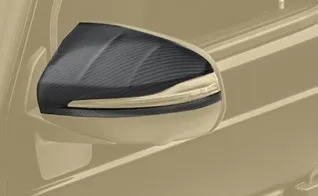
Carbon mirror housing II for Mercedes G-class W463A Gronos


Carbon Mirror Housing II for Mercedes G-Class W463A Gronos
Where the original Mansory carbon mirror housing for the W463A focused on aerodynamic profile refinement at the door shoulder, the Carbon Mirror Housing II from the Mansory Body Kit for Mercedes G-Class W463A Gronos takes a second-generation approach to the same challenge — evolved housing geometry that prioritises visual coherence with the W463A's squared-off body vocabulary alongside the aerodynamic and material benefits that define the Gronos carbon programme. The II designation reflects a revised cross-sectional profile at the housing's widest point, a redesigned upper-face junction where the housing meets the door surface, and a refined weave-layout specification that improves the visual quality of the carbon surface at the angles from which the W463A's mirrors are most frequently viewed. Both housings are live options in the Gronos programme and both retain full OEM actuator, heater, and glass-adjustment compatibility.
Construction & Materials
The Carbon Mirror Housing II uses a revised two-shell architecture compared to the generation I unit. The outer visible-carbon shell on the II retains the same 3K twill prepreg with autoclave cure at 120 °C / 4 bar but uses a higher-camber cross-section at the housing mid-point — the point of maximum width — that improves airflow attachment on the housing's inner-face (door-side) surface. This revision reduces the low-pressure wake behind the housing's inner face, which on the generation I housing at speeds above 100 km/h was identified as a minor contributor to the low-frequency door-mirror buffet noted in high-speed testing.
The upper-face junction — where the housing lid meets the door surface at the shoulder line — has been revised to a tighter, more angular profile that better reflects the W463A's squared-off body language. The generation I housing had a rounded, blended transition at this junction that softened the meeting between housing and door; the II replaces this with a sharper, nearly 90° junction edge that reads as a deliberate angular statement consistent with the G-Wagon's characteristic hard-edged body geometry. This edge carries a locally thickened laminate schedule (3.0 mm versus 1.6 mm on the main housing face) to withstand the higher stress concentration at the sharp transition without micro-cracking the clearcoat at the edge.
- Outer shell: 3K twill prepreg carbon, autoclave 120 °C / 4 bar — higher-camber II-generation cross-section at housing mid-point reduces inner-face wake
- Upper junction geometry: sharp 90° edge at housing-to-door-surface transition — reinforced at 3.0 mm wall thickness to prevent clearcoat micro-cracking at the edge
- Weave layout: 3K twill diagonal on housing body; 2K plain weave at the upper and lower cap sections — two-weave specification provides visual interest at the housing termination faces
- Inner shell: revised GFRP former with improved actuator-motor seating bosses — reduces resonance transmission from motor to outer carbon shell at folding cycle
- Wall thickness: 1.6–2.0 mm on main body; 3.0 mm at upper junction edge; 2.4 mm at door mount attachment zones
- Weight per housing: approximately 0.48–0.63 kg per unit — marginally heavier than I due to reinforced upper edge, still substantially lighter than OEM
- Clearcoat: three-coat UV + structural + surface-protection system, locally built to 55–65 µm DFT at the sharp upper edge to prevent chip initiation
- Supplied: matched pair LH/RH — specify steering side
Design & Visual Function
The sharper upper junction of the Carbon Mirror Housing II introduces a design language that is specifically aligned with the W463A's architectural character. The G-Wagon's body lines are defined by abrupt, hard-edged transitions — the corner where the front wing meets the door, the crease where the sill guard meets the door face, the angular junctions of the rear light cluster to the body panel. The generation I mirror housing's blended upper transition was at odds with this vocabulary; the II's 90° junction resolves this tension by presenting the same angular geometry as the surrounding body panels. At the viewing distance of a parallel vehicle in traffic — approximately 3–5 metres — the II housing's sharp upper edge reads as an intentional design element that aligns the housing with the G-Wagon's wider body character rather than appearing as an organically shaped add-on.
The two-weave specification on the II — 3K twill on the main body, 2K plain at the cap sections — creates a subtle material hierarchy on the housing face. The 2K plain weave's finer grid texture at the upper and lower caps frames the main body's bold 3K diagonal in a way that defines the housing's extent as a panel: the caps read as border elements, the body as the primary surface. This visual organisation of the housing face into a distinct panel structure reinforces the Gronos programme's consistent approach to carbon panel composition, where different weave scales are used to establish visual hierarchy without colour contrast.
Compatibility & Fitment
Carbon Mirror Housing II fits Mercedes-Benz G-Class W463A 2018 to present, on G63 AMG and G500/G550. LHD and RHD configurations covered. Post-2024 facelift compatible. Retains all OEM folding motor, heater, and glass-adjustment wiring without modification. Not compatible with pre-2018 W463 mirror assembly.
Installation & Reversibility
Installation procedure is identical to the generation I housing — 30–60 minutes per side, trim pry tool and T15 Torx. The revised actuator-motor seating bosses in the GFRP inner shell of the II may require a brief torque-test on the motor retention screws during fitting to confirm the revised boss geometry provides correct seating — confirm all motor retention screws are fully engaged before remounting the assembly on the door. Fully reversible.
Pairing within the Mansory Gronos programme
The Carbon Mirror Housing II pairs naturally with components that share its angular vocabulary. The Carbon Mirror Housing (I) is the alternative design for comparison. For door-surface carbon continuity below the mirror, the D-Pillar Cover II brings the same angular carbon language to the rear pillar face. For the body's trim-bar zones above the door sill, the Carbon Trim Bars complete the Gronos surface programme at the lower body register, connecting the mirror-shoulder carbon treatment to the sill-area specification.
Maintenance & Durability
The sharp upper junction edge of the II requires particular attention during washing — the tight radius carries less clearcoat protection at its apex than the main housing face panels. Use a soft foam detailing brush rather than a wash mitt on the upper junction edge: the brush's flexible bristles follow the sharp geometry without the abrasion risk that a flat-face wash mitt creates when pressed against a 90° edge. Apply additional clearcoat protection sealant to the upper edge after washing — a foam applicator pad allows targeted application to this narrow zone without contaminating the adjacent door surface.
The locally thickened clearcoat at the upper edge (55–65 µm DFT versus 35–45 µm on the main body) provides enhanced stone-chip protection at this high-risk zone. Inspect annually for any clearcoat micro-cracking at the edge — the combination of thermal expansion cycling and wind-vibration loading at the sharp junction makes this the first site where clearcoat fatigue manifests if not maintained.
Lead Time & Warranty
Lead time for Carbon Mirror Housing II pair is 2–4 weeks. 12-month warranty against delamination, clearcoat adhesion failures at the upper edge, inner shell boss failures, and fitment dimensional errors.
FAQ
Q: How does the Housing II look different from the Housing I at a glance?
A: The II's most distinguishable feature is its sharp 90° upper junction — the line where the housing top meets the door surface. The I has a rounded, blended transition at this junction. The II also has a slightly wider camber at mid-housing. Both feature 3K twill carbon but the II adds 2K plain weave at the cap sections.
Q: Is one generation better than the other from an aerodynamic perspective?
A: The II's higher-camber mid-point profile provides a marginal improvement in inner-face airflow attachment above 100 km/h, reducing the low-frequency wake behind the housing slightly. For most urban/motorway W463A usage the difference is not perceptible. The choice between I and II is primarily a design preference decision.
Q: Can the 2K plain weave on the cap sections be specified in a different finish from the main body?
A: Both sections receive the same clearcoat finish across the housing. The textural difference between 3K twill and 2K plain reads as a subtle detail difference without colour or finish variation between sections.
Q: Are these mirrors compatible with aftermarket camera-in-mirror systems?
A: The Carbon Mirror Housing II retains the OEM glass-carrier geometry. If an aftermarket camera is integrated into the OEM glass carrier, it will transfer to the Mansory housing's inner shell without modification in most cases. Confirm with the camera system supplier if uncertain.
Q: My G63 AMG has the optional 360° camera system — will this affect installation?
A: The W463A 360° camera uses four body-mounted cameras, not mirror-mounted units. Mirror housing fitment does not interfere with the 360° camera system.
Choose your generation and confirm steering side with the Hodoor Mansory team: Contact us via WhatsApp +44 7488 818 747 or [email protected].