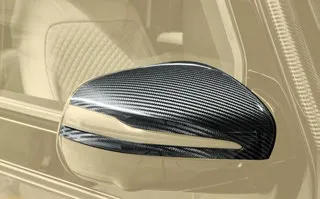
Carbon mirror housing for Mercedes G-class W463A Gronos


Carbon Mirror Housing for Mercedes G-Class W463A Gronos
The door mirrors on the W463A G-Wagon are mounted at the door-top shoulder — a position that places them directly in the 60–80 km/h zone of the vehicle's lateral airstream at cruising speed. The OEM mirror housing geometry on the W463A is sized for the large glass area required by the G-Wagon's tall, wide body, which makes the housing a meaningful aerodynamic drag contributor. The Carbon Mirror Housing from the Mansory Body Kit for Mercedes G-Class W463A Gronos replaces the OEM painted plastic housings with precision-profiled carbon-fibre assemblies that reduce the housing's frontal Cd contribution through sharper leading-edge radius geometry and a reduced cross-sectional area profile while preserving the full glass sweep angle required for the W463A's rearward sightlines. This is a component where the carbon material choice is simultaneously functional — carbon's lower density allows thinner wall sections at the housing edges — and visual, declaring Mansory's Gronos programme treatment at the most visible shoulder point on the vehicle's lateral face.
Construction & Materials
The Carbon Mirror Housing is produced as a two-shell assembly — an outer visible-carbon shell and a structural inner shell — that fits over the W463A's OEM mirror mount and actuator assembly. The outer shell is 3K twill prepreg carbon, autoclave-cured at 120 °C / 4 bar, with a swept-back profile at the leading edge that presents a sharper radius to the lateral airstream than the OEM housing's blunt leading section. The inner shell is a GFRP structural former that maintains the housing geometry under the lateral G-forces imposed by the door-folding mechanism and provides mounting bosses for the actuator motor and glass-carrier assembly retention bolts.
The visible-carbon surface weave is oriented with the 3K twill diagonal running from the housing's leading lower edge to its trailing upper edge — this orientation follows the swept-back geometry of the housing profile and reads as a single diagonal flow across the housing face when viewed from directly behind the vehicle. The clearcoat system uses a three-coat approach: an adhesion primer on the prepreg surface, a structural clearcoat at 35–45 µm, and a surface-protection topcoat resistant to the combined effects of UV from above, lateral airstream impacts, and the concentrated stone-chip zone at the housing leading edge.
- Outer shell: 3K twill prepreg carbon, autoclave 120 °C / 4 bar — swept-back leading-edge profile sharpens frontal radius vs OEM housing
- Inner shell: GFRP structural former with actuator motor and glass-carrier mounting bosses — retains full OEM folding and adjustment mechanism
- Weave orientation: diagonal from lower leading edge to upper trailing edge — follows housing swept profile geometry
- Wall thickness outer shell: 1.4–1.8 mm on body panels; 2.2–2.6 mm at mount attachment zones
- Clearcoat: three-coat UV + structural + surface-protection system — rated for sustained lateral airstream at 140 km/h and stone-chip from the leading-edge impact zone
- Weight per housing: approximately 0.45–0.60 kg — approximately 30–40% lighter than OEM plastic housing including folding motor assembly
- Actuator compatibility: retains OEM electric folding, heating, and lateral adjustment function — no wiring modification required
- Supplied: pair (LH and RH mirror-image housings)
Design & Visual Function
On the W463A's body-on-frame construction the door-shoulder is uniquely prominent — the body sits high on its ladder chassis and the door surface rises steeply from the sill to the mirror shoulder. The mirror housing, mounted at this shoulder junction, occupies a visual zone that is at eye level for pedestrians alongside the vehicle and at the most prominent lateral point in the vehicle's profile view. The Carbon Mirror Housing's visible-carbon surface at this location adds material depth to the shoulder transition — the diagonal weave catches lateral light (from passing windows, street lamps, and oncoming headlights at night) and creates a shimmer that identifies the housing as deliberately different from the painted body surface beside it.
The swept-back profile of the Carbon Mirror Housing also changes the vehicle's lateral silhouette at the shoulder point. The OEM housing projects forward and outward from the door face in a relatively blunt, symmetrical form that is optimised for glass-area visibility. The Mansory housing retains the same rearward glass sweep but sharpens the forward profile, so the housing's shadow on the door surface when lit from the side is narrower and more directional — it reads as a pointed, forward-oriented element rather than a rounded protrusion, reinforcing the impression of lateral speed and purposeful design at the W463A's shoulder.
Wind noise from mirror housings on the W463A is a known characteristic of the vehicle at motorway speeds — the OEM housing generates a vortex at its trailing edge that produces a low-frequency buffet audible to the driver with the window cracked. The Mansory housing's tighter trailing-edge radius reduces the vortex shed frequency, shifting the noise spectrum upward and reducing the perceived boom level. This is not a primary acoustic engineering goal of the housing — it is a byproduct of the aerodynamically improved profile — but owners frequently note the quieter motorway character as a secondary benefit of the carbon housing upgrade.
Compatibility & Fitment
The Carbon Mirror Housing fits Mercedes-Benz G-Class W463A 2018 to present, covering G63 AMG and G500/G550. The housing is produced in matched pairs for LHD and RHD body configurations — specify your steering-side at order. The housing retains the OEM mirror motor, heater, and lateral adjustment wiring without modification. Post-2024 facelift W463A mirrors retain the same mounting interface. Not compatible with the pre-2018 W463 mirror assembly.
Installation & Reversibility
Installation time is 30–60 minutes per side for a competent installer. The OEM mirror housing is removed at the door surface trim clip interface, the mirror glass and motor assembly is transferred to the Mansory inner GFRP shell, and the outer carbon shell is clipped and screwed onto the inner shell before the full assembly is remounted at the door. No wiring modifications are needed. The OEM housing and all hardware are stored for reversibility. The only tool required is a trim-removal plastic pry tool and a T15 Torx driver for the glass-carrier retention screws.
Pairing within the Mansory Gronos programme
The mirror housing pairs naturally with surrounding shoulder-area carbon components. The Carbon Mirror Housing II is the alternative generation II design in the same Gronos programme — review both before specifying. At the door front, the Carbon Door Handle with Logo continues the Gronos carbon programme to the door grip zone. For upper-body carbon continuity above the mirror, the A-Pillar / Front and Side Roof Cover extends the programme from the windscreen base across the roof side rails above the door.
Maintenance & Durability
The mirror housing leading edge is the highest stone-chip impact zone on the Gronos carbon components because it is exposed to direct lateral stone-chip from the front tyre's contact patch at door-shoulder height. A clear paint-protection film on the housing leading edge and lower-forward quarter is the most effective countermeasure — the housing's curved form can be templated by a PPF specialist for a precise-fit PPF patch. Without PPF, inspect the leading edge after each motorway run and treat stone chips with a clearcoat touch-up pen within 24 hours to prevent chip-initiated delamination at the carbon edge.
The three-coat clearcoat system provides UV protection at the lateral exposure zone, where the housing face is exposed to solar radiation from the east in the morning and west in the afternoon over the vehicle's service life. Apply ceramic sealant every 6–8 weeks. The housing actuator motor does not require any special maintenance from the housing's carbon upgrade — it continues to operate on the same OEM wiring schedule.
Lead Time & Warranty
Lead time for Carbon Mirror Housing pair is 2–4 weeks. 12-month warranty against delamination, clearcoat adhesion failures, inner shell actuator-boss failures, and dimensional fitment errors at the door mount.
FAQ
Q: Does the carbon housing affect the electric folding function?
A: No. The inner GFRP shell preserves all OEM actuator motor and wiring retention positions. The folding mechanism operates identically to the OEM housing.
Q: Is the carbon housing heavier or lighter than the OEM plastic unit?
A: Lighter by approximately 30–40% per housing. The carbon outer shell's thinner wall sections and lower material density more than compensate for the additional GFRP inner shell versus the OEM integrated one-piece plastic housing.
Q: Can I specify the housing in matte clearcoat?
A: Yes. Satin/matte clearcoat is available. The housing's swept-back profile looks particularly distinctive in matte, as the absence of specular reflection emphasises the diagonal weave shadow pattern across the housing face.
Q: What is the difference between Carbon Mirror Housing and Carbon Mirror Housing II?
A: The two variants offer different profile geometries — I has a more streamlined swept-back leading section while II is a generation-II design with revised geometry. Both retain full OEM actuator compatibility.
Q: My W463A has the AMG Driver's Package — will this affect mirror housing fitment?
A: The AMG Driver's Package affects performance and software settings, not mirror hardware. Mirror housing fitment is unchanged.
Specify mirror finish and steering side with the Hodoor Mansory team: Contact us via WhatsApp +44 7488 818 747 or [email protected].