
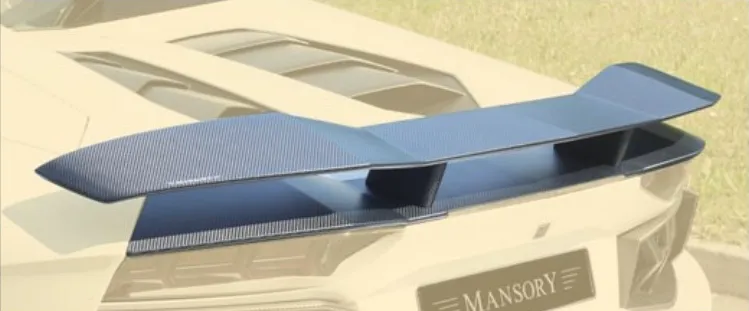
Biplane performance wing Mansory Carbon for Lamborghini Aventador S


Mansory Carbon Biplane Performance Wing for Lamborghini Aventador S
The Mansory Carbon Biplane Performance Wing is the most assertive aerodynamic statement in the rear-wing trio offered for the Lamborghini Aventador S, and it slots into the wider Mansory Body Kit for Lamborghini Aventador S as the high-downforce, high-drama option. Two stacked aerofoil planes — the lower main element and the upper auxiliary element — sit on twin swan-neck pylons that bolt to the same OEM rear-deck uprights used by the factory wing. The naturally aspirated 6.5-litre V12 still breathes through its lower-side exhaust outlets, the scissor-doors still pivot freely, and the rear-wheel-steering hardware underneath the deck is left untouched. What changes is the way air leaves the car: the biplane configuration interrupts the rear wake twice, generates a far stronger pressure differential than any single-plane variant, and gives the LP740-4 S the rear silhouette of a track special.
Construction & Materials
Both aerofoil planes are vacuum-bagged and autoclave-cured prepreg, laid up over CNC-machined male tooling so the suction-side curvature stays dimensionally honest under repeated thermal cycles. The slot gap between the two elements is set by the swan-neck pylon geometry, not by adjustable shims, which means the aerodynamic relationship between the elements is fixed at production and cannot drift with use. Endplates are bonded with a methacrylate structural adhesive and then mechanically pinned at the trailing edges. The whole assembly is bench-aligned before crating so the installer never has to chase symmetry on the car.
- 3K twill prepreg, 2x2 weave, alternated with unidirectional spar layers in the main plane
- Autoclave cure at 125 °C, 6 bar, dwell tuned for thick-section pylons
- Wall thickness: 2.4–3.0 mm on the main plane, 2.0 mm on the upper auxiliary plane
- Stainless A2 hardware, titanium-tone anodised washers, captive nut plates inside the pylon roots
- Twin swan-neck pylons mount to the OEM Aventador S wing-stand inserts — no chassis drilling
- Endplates milled from solid carbon laminate, lacquered or raw-finish on request
- Total assembled mass approx. 4.6–5.2 kg — light for a twin-tier structure
- UV-stable two-pack clear lacquer with a satin or high-gloss flow coat
Design & Visual Function
A biplane wing is not just a louder version of a single-plane wing — it is a different aerodynamic device. The lower main element does the bulk of the load-carrying work, generating a high-pressure region beneath itself and a low-pressure region above. The upper auxiliary element sits in the slot between, accelerating air through the gap and re-energising the boundary layer over the suction side of the main plane. That slot flow lets the main element run a more aggressive angle of attack before stall onset, and the result is that peak downforce arrives sooner in the speed band and stays linear deeper into the Aventador S's 350 km/h envelope.
Visually, the twin-tier reads as a deliberate, layered structure rather than a single blade hanging in space. From three-quarter rear, the upper plane breaks the line of the engine bonnet and re-frames the V12 cover as the centrepiece of the deck. Endplates extend just past the rear-bumper shoulder so the wing visually anchors to the body rather than floating above it. The Aventador S's lower-side exhaust outlets sit well clear of the wing's exit flow, so there is no acoustic muddling — the V12 intake roar through the side scoops and the exhaust note from the flank both stay clean.
Vortex management is the biplane's quieter strength. Each element sheds its own pair of tip vortices at the endplates, and the gurney-style trailing lip on the upper plane shapes the trailing wake into a more compact, predictable structure. That predictability matters when an owner pushes the car on a closed circuit: the rear axle does not surprise you mid-corner with a sudden release of grip.
Compatibility & Fitment
Designed for the Lamborghini Aventador S (LP740-4 S, MY 2017–2021) in both coupé and Roadster forms. The pylon footprint matches the OEM wing-stand inserts on the rear deck, so the lid, the engine bonnet, the rear-wheel-steering actuators and the lower-side exhaust outlets are all left in their stock condition. Pre-SVJ rear bumper geometry is fully respected, and there is no interference with the rear deck-lid release or with the engine cover's heat extraction louvres. Roadster owners can stow and deploy the targa roof panels with the wing fitted — pylon spacing was set with the Roadster's roof-stowage envelope in mind.
Installation & Reversibility
Bench time is roughly three to four hours for a competent installer, plus a one-hour pre-fit dry run. The procedure is bolt-on: the OEM wing-stand cover plates lift off, the pylon roots are dressed with butyl seal tape, the assembly is offered up by two people, and the captive nut plates inside the pylons take torque to a published spec. There is no chassis drilling and no adhesive bond to the body itself, which means full reversibility — refitting the OEM wing or one of the alternative single-plane Mansory wings is a same-day swap. We recommend a Lamborghini-certified body shop or a Mansory-trained installer for the alignment check, because endplate squareness to the rear bumper line is what separates a clean fit from a wing that looks crooked at speed.
Pairing within the Mansory Aventador S programme
The biplane sits in the middle of a three-tier wing ladder. Below it is the rear performance wing — a single-plane swan-neck blade that gives most of the visual drama of an exposed wing with a much lower drag penalty; choose that one if you live with the car on long motorway runs and want to keep top-end speed intact. Above it is the rear high-performance wing — the largest blade in the catalogue, single-plane but on a deeper chord and a taller stance, biased toward maximum standalone downforce at the cost of yet more drag. The biplane occupies the sweet spot between them: more downforce than the single-plane performance wing thanks to the slot gap and the second element, but a tighter visual footprint than the oversized high-performance blade. If a discreet, body-coloured rear treatment is the goal instead, the rear spoiler — a subtler ducktail that bonds to the engine cover — is the calmer alternative. Owners typically pair the biplane with the rear diffuser and the rear bumper air outtake cover so the lower deck reads as part of the same aerodynamic family.
Maintenance & Durability
Lacquered carbon on a high-load aerodynamic part has two enemies: UV bleach on the upper surfaces and thermal radiation drifting up from the V12 hot zone underneath. Both are managed with a quality ceramic coat (8H or better) re-applied annually, and a rinse-after-track-day habit. Avoid alkaline wheel cleaners around the pylon roots — they will haze the lacquer over a season. Use pH-neutral shampoo, two-bucket method, and a clean microfibre. If a stone chip reaches the weave, a Mansory-trained technician can scarf-repair the lacquer locally without re-shooting the whole upper surface. Ten-year lifespan is realistic for a car kept covered or in a climate-controlled garage; daily-driven examples should expect the lacquer to need a light cut and re-coat at year five.
Lead Time & Warranty
Build is to bespoke order — typical lead time is four to eight weeks from confirmed deposit, occasionally shorter when an in-stock laminate is available. Twelve-month warranty against manufacturing defects on the laminate, the lacquer and the hardware kit. Warranty excludes track-incident damage, stone-chip propagation, and any aftermarket modification of the pylon mounts.
FAQ
Q: How much more downforce does the biplane make versus the single-plane performance wing?
A: Mansory's bench testing puts it in the order of 25–35% additional rear downforce at high-speed cruise, depending on ride height and whether the car runs a lowered setup. The slot gap between the elements is what unlocks the gain.
Q: Is there a measurable drag penalty?
A: Yes. A twin-tier wing always carries more profile drag than a single-plane blade of the same chord. Expect a small reduction in measured Vmax and a slightly more eager throttle response at part-throttle motorway speeds because the V12 has more aero load to push.
Q: Does it fit the Roadster?
A: Yes — the pylon spacing was set so the targa roof panels can be removed, stowed under the front trunk and refitted with the wing in place. No clearance issue.
Q: Can the angle of attack be adjusted?
A: The relationship between the two elements is fixed at production, but the assembly as a whole can be shimmed at the pylon roots within a narrow range during fitment. We do not recommend owner-side adjustment after installation.
Q: Will the wing interfere with the lower-side exhaust outlets or the engine cover louvres?
A: No. The wing sits well above the exhaust exit plane and the engine-cover heat extraction is not blocked. V12 thermal management is undisturbed.
Q: Raw weave or lacquered finish?
A: Both are offered. Raw 3K twill with a satin matte clear is the modern preference; high-gloss lacquered is the traditional Mansory finish. Forged-look on the endplates is available as a no-cost option.
Pair the biplane with the rear diffuser and the rear bumper air outtake cover to complete the Aventador S rear treatment. Order, spec questions or a finish sample: WhatsApp +44 7488 818 747 or [email protected].