
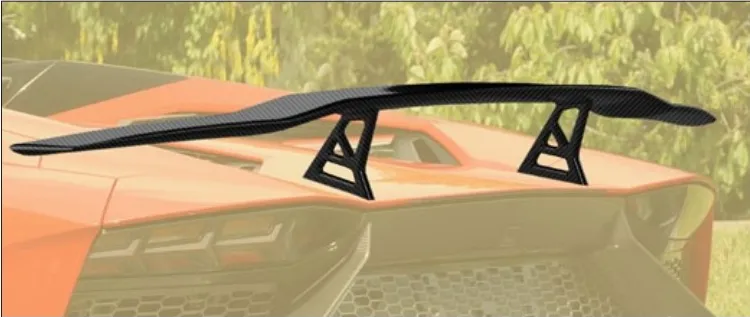
Rear high performance wing Mansory Carbon for Lamborghini Aventador S


Mansory Carbon Rear High-Performance Wing for Lamborghini Aventador S
The Rear High-Performance Wing is the largest aerofoil Mansory builds for the Lamborghini Aventador S (LP740-4 S, 2017-2021), and it sits at the apex of the three-tier wing programme inside the Mansory Body Kit for Lamborghini Aventador S. Where the standard rear-performance wing optimises for road manners and the biplane stacks two smaller blades for balanced low-speed bite, this single-plane unit chases peak downforce: the longest chord, the widest span, the most aggressive angle-of-attack envelope. The 6.5-litre naturally aspirated V12 still does the talking through the lower-side exhaust outlets, but at speed the conversation shifts to the swan-neck pylons feeding clean air to a single broad blade. Owners who track the car at Vallelunga or Anglesey, or who simply want a motorsport silhouette to match the scissor-door drama, specify this wing because nothing else in the Aventador S Mansory catalogue commits as fully to rear-axle grip.
Construction & Materials
Built as a hollow-core sandwich, the high-performance blade uses a structural Nomex honeycomb stiffener bonded between two prepreg skins. The pylons are solid-laminate carbon machined post-cure for tolerancing. Every component is autoclave-processed at roughly 6 bar and 125 deg C, then post-cured under stable temperature to relieve residual cure stress. Surface-quality control is run twice: once at green-state demould and again after wet-sand blocking before clear-coat. The trailing edge is profiled to 1.6 mm to keep the wake tight without inviting chatter.
- Weave: 3K twill 2x2 on visible faces, unidirectional carbon spine through the chord centreline for torsional rigidity
- Cure: full autoclave prepreg, 6 bar / 125 deg C, post-cure thermal soak
- Core: aerospace-grade Nomex honeycomb sandwich inside the blade, solid laminate at pylon roots
- Wall thickness: 2.4-3.1 mm skin over honeycomb, ~6 mm at endplate transitions
- Endplates: integrated, CFD-shaped, with a chord-aligned strake on the inner face
- Weight: roughly 6.4 kg complete (blade + pylons + hardware), versus a wet-laid replica that would weigh 1.5-2 kg more
- Hardware: stainless A4 fasteners, anti-vibration washers, threaded inserts moulded into the laminate at pylon feet
- Finish: high-build clear-coat on lacquered-twill spec; matte 2K lacquer optional; raw exposed weave is also available for a track-only look
Design & Visual Function
The defining choice is structural: the wing is held aloft by swan-neck pylons that grip the blade from above rather than from below. This matters aerodynamically. A pedestal-mounted wing splits the high-pressure underside of the aerofoil with two columns of disturbed air; a swan-neck arrangement leaves the pressure surface untouched, so suction on the upper face and pressure on the lower face both run uninterrupted from leading edge to trailing edge. The result is a higher lift coefficient for the same projected area, and a more linear response as you rotate the blade through its angle-of-attack range.
Chord and span are the second story. Both dimensions exceed the standard rear-performance wing's, and the aerofoil section is profiled for a higher peak Cl rather than a flat L/D plateau. That is a deliberate motorsport-leaning choice. Drivers who care about a stable mid-corner platform on a circuit, or who carry serious speed onto long straights and want the rear axle planted under braking, accept the drag penalty in exchange for the downforce. On a public road that drag costs you a handful of km/h at the top end and a measurable hit to fuel range; on a track it pays for itself in lap times and tyre temperature stability.
Visually, the wing reads as the most extreme statement on the back of the car. The single broad plane mirrors the Aventador's slab-sided rear haunches; the endplates terminate the blade cleanly without the visual fragmentation of a twin-tier biplane. Because the Aventador S has no central active-aero channel to keep clear, Mansory's engineers had full freedom to extend the blade across the full vehicle width minus a small clearance to the rear-quarter shoulders. The lacquered twill catches light along the chord like a wet runway; the optional raw matte spec drinks light and emphasises the raked profile from three-quarter rear angles.
Compatibility & Fitment
Designed for Lamborghini Aventador S (LP740-4 S) coupé and Roadster, model years 2017-2021, with the pre-SVJ rear deck contour and lower-side exhaust outlets. The pylon footprint reuses the OEM rear-deck reinforcement zone; supplied alignment templates index off two factory body datums so position repeatability between cars is within 0.5 mm. The wing clears the engine cover lift travel and does not interfere with rear-quarter glass or tail-light apertures. Reverse-camera and parking-sensor harnesses remain undisturbed. There is no central-channel constraint on Aventador S because no active aero is fitted, so the blade spans without a forced cut-out.
Installation & Reversibility
Plan for 6-9 hours including paint correction, masking, dry-fitment, drilling for the pylon studs, sealant application around the pylon feet, torque-staged tightening, and final alignment. The pylon roots reach the rear-deck composite shell rather than just the outer skin, so the bonding interface is rigid; we recommend a two-component urethane gasket plus mechanical fastening so that vibration loads at high speed are managed by the metal hardware rather than the adhesive line. Aventador's monocoque uses methacrylate-bonded panels in places, so installers should confirm primer compatibility on any painted surface the pylon feet touch. The work is fully reversible: the wing can be removed and the car returned to a stock rear deck by re-bonding small composite plug inserts at the four mounting points and refinishing the deck. A Mansory-trained installer or a Lamborghini-certified body shop is the right home for this job; this is not a DIY part.
Pairing within the Mansory Aventador S programme
The high-performance wing is the apex of a three-tier choice. The other two tiers each have their own logic, so cross-shopping is normal. Pair or compare with: Rear performance wing, the road-biased option with shorter chord and lower drag; Biplane performance wing, the twin-tier alternative that delivers strong low-speed downforce without the same top-end drag spike; and Rear spoiler, the subtle ducktail that sits at the opposite end of the spectrum for owners who want hint over statement. Choose the high-performance wing when peak grip and motorsport visual intent matter more than a few km/h at the top of fifth.
Maintenance & Durability
Lacquered twill stays at its best with pH-neutral shampoo, a soft microfibre mitt, and a quarterly machine-applied ceramic coat. Avoid alkaline wheel cleaners drifting onto the endplates after a track session; ammonia-based glass sprays misted onto the inner endplate face will dull the lacquer over time. UV is the slow killer of any clear-coated carbon part, and a wing lives in direct sun by definition, so a sacrificial UV layer renewed every 18-24 months keeps the weave from amber-shifting. Stone-chip risk is mostly at the leading edge: a 100 mm wide strip of clear protective film along the leading edge handles that without altering the visual line. Honeycomb-cored panels can be repaired locally if a chip exposes the core, but the repair is laminate work, not paint, and should go to a composite specialist. The blade itself, properly cared for, has a service life that comfortably exceeds the rest of the car.
Lead Time & Warranty
Lead time is typically 4-8 weeks from order to dispatch, reflecting Mansory's bespoke production cadence (autoclave cycle scheduling, prepreg lot control, individual QA sign-off per wing). The warranty is 12 months against manufacturing defects covering laminate integrity, bond-line continuity, and finish stability under normal use; track use is welcomed and is part of why the part exists, but stone strikes, contact damage, and finish wear are not warranty events.
FAQ
Q: How much downforce does the high-performance wing add over the standard rear-performance wing?
A: We do not publish an exact figure in newtons because Mansory's CFD work is car-by-car and ride-height-sensitive, but the high-performance unit is the largest blade in the range and is profiled for a higher peak lift coefficient. In practical terms, owners report a noticeably more planted rear axle from roughly 180 km/h upward.
Q: Does the swan-neck mount really make a difference, or is it just visual?
A: It is functional. Mounting the blade from above leaves the pressure side of the aerofoil untouched, so the suction-pressure delta runs uninterrupted from leading to trailing edge. The same blade on pedestal mounts would lose efficiency where the columns disturb pressure-side flow.
Q: What is the drag trade-off on a road car?
A: Higher than the standard performance wing or the ducktail spoiler. Expect a small reduction in top speed and a measurable hit to highway fuel economy. If you live mostly on public roads and never see a circuit, the standard wing or biplane is the more rational pick. The high-performance wing is for owners whose use case includes track days or who simply want the most committed motorsport silhouette.
Q: Will it fit a Roadster?
A: Yes. Both coupé and Roadster Aventador S share the rear-deck pylon-mount geometry. Soft-top stowage and operation are unaffected because the wing sits behind and above the active deck-lid mechanism.
Q: Can I run the wing without the rest of the Mansory body kit?
A: Mechanically yes. Visually, the high-performance wing is a strong statement; many owners pair at minimum the rear diffuser and engine bonnet to keep the rear-end story coherent.
Q: Is the angle-of-attack adjustable?
A: The default delivery is fixed at the Mansory-validated setting, which is a balance between mid-corner stability and straight-line drag. Track-focused owners can request additional pylon shims for a higher AoA bracket; this is a build-time option.
Pair this wing with the matching diffuser and rear bumper outtakes to finish the rear-end story, and contact us before placing the order so the spec sheet (lacquered twill versus raw matte, AoA bracket, paint-break detail) is locked in. Reach us on WhatsApp +44 7488 818 747 or [email protected].