
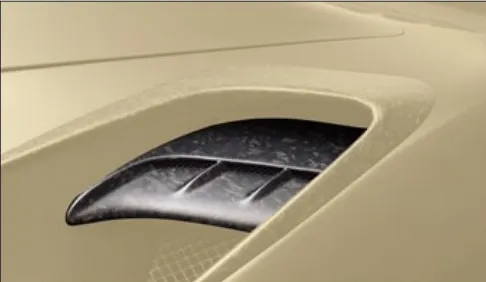
Air outtakes splitter II Mansory Carbon for Ferrari 488 Siracusa 4XX


Air Outtakes Splitter II — Mansory Carbon for Ferrari 488 Siracusa 4XX
Where splitter I is the quiet option, splitter II is the statement piece. The version II geometry stacks three vertical vanes inside the rear-quarter air outtake, all held at a steeper angle of attack and standing slightly proud of the OEM duct trailing lip so they read as a deliberate piece of carbon furniture rather than a finishing detail. Within the wider Mansory Carbon Fiber Body kit set for Ferrari 488 Siracusa 4XX programme this is the alternative geometry for owners who want the rear-quarter vent to be one of the loudest visual elements on the car. It is mutually exclusive with the version I splitter — only one fits per car — and it is bought by owners chasing the full Siracusa-spec aesthetic where every duct, lip and lid carries a sculpted carbon insert.
Construction & Materials
The three vanes share a common manufacturing route but each is laid up to a different chord length so the visual stack steps progressively from outboard to inboard, mirroring the way a wing-top vortex generator array is sized. Each vane is a foam-cored sandwich with cosmetic 3K twill on both faces, then bonded into a common carbon backbone that bridges between the inner duct walls. The backbone takes the load; the vanes never see structural force.
Because version II stands proud of the duct trailing lip, the leading edges of the vanes are the part most likely to take a fingertip nudge or a wash-mitt knock. Those edges are radiused tighter than on version I — a 1.5 mm radius rather than a soft round — and the lacquer is laid heavier across the leading 10 mm of each vane to add scratch resistance to the most exposed area. From a normal viewing distance this detail is invisible; in a service workshop with a torch on the duct it shows up as a slightly thicker clearcoat band along the front of each fin.
- Outer skins: 3K 2x2 twill prepreg, both faces of every vane and the bridging backbone
- Core: 3 mm closed-cell PMI foam in the vanes, solid 4 mm laminate in the backbone
- Cure: autoclave 120 °C, polished tool both sides, post-cure free-stand at 80 °C
- Vane chord: 95 / 110 / 95 mm (outboard / centre / inboard) — stack tapers visually
- Vane thickness: 5–6 mm finished, leading edges radiused to 1.5 mm
- Weight per side: ~190–220 g — heavier than version I but still negligible
- Mounting: backbone bonds to inner duct wall with structural methacrylate, vanes are factory-bonded to the backbone
- Finish: gloss 2K clear standard, with satin matte and forged-carbon backbone available on request
Design & Visual Function
The angle of attack on version II vanes sits at 12–15° rather than the 5–7° of version I. That is steep enough to register from a moving angle — passers-by walking past the car at a show will see the vane stack as a sequence of dark planes rather than as a single line, which is exactly the visual rhythm Mansory tools the geometry to create. Standing proud of the duct trailing lip adds a second visual cue: a shadow line that follows the vane back along the OEM rear-quarter sheetmetal, drawing the eye back through the rear of the car.
Aerodynamically the multi-vane stack does more work than version I, but it is still not a primary aero device. At motorway speeds the three vanes straighten exit flow more positively than the single vane of version I, and the slightly proud trailing edges generate a small low-pressure wake immediately behind the duct. Neither effect is large enough to register on a stopwatch, but both reduce the small amount of duct buzz some 488 owners report at sustained 200 km/h with the windows down — the multi-vane stack puts a more coherent flow structure into the wake and that takes the resonant frequency out of the duct interior.
Visual integration with the rest of the rear three-quarter is the main reason owners choose II. The Siracusa-spec rear of the 488 carries multiple carbon details — the rear wing, the rear lights cover, the engine bonnet vent on coupé builds, the rear air outtake grills cover — and version II of the splitter holds its own against that level of carbon density. Version I, by contrast, can disappear into the surrounding sculpting if the rest of the rear is fully kitted; II maintains presence.
One detail that distinguishes II from many aftermarket splitter sets is that the bridging backbone is cosmetic carbon rather than a hidden steel or plastic plate. The reason is the same as on version I — through the rear-quarter glass, a passenger can see deep into the duct, and the bridging backbone is visible from that angle. Cheap aftermarket splitter sets typically use an unfinished steel bridge here, which reads instantly as a workshop part the moment the cabin door opens.
Compatibility & Fitment
The pair fits Ferrari 488 GTB coupé and Ferrari 488 Spider, model years 2015–2020, V8 3.9 twin-turbo. As with version I, the OEM rear-quarter outtake duct geometry is shared between coupé and Spider, so the splitter drops into either body style without modification. The bonding surfaces inside the duct must be either the carbon outtake housing from the same Mansory kit (factory-prepped for methacrylate) or the original OEM plastic duct (must be scuffed and primed before bonding). Cars wearing aftermarket outtake covers from other tuners may not match the backbone footprint — send a photograph of the duct interior before ordering and we will check fitment. As stated above, version II is mutually exclusive with version I; do not order both for the same car.
Installation & Reversibility
Fitment takes around 90 minutes per side, slightly longer than version I because the backbone has to be aligned to the duct interior on three contact points instead of two brackets. Mask the duct, scuff and isopropyl-wipe the bond surfaces, dispense methacrylate onto the backbone footprint, position the assembly against an alignment template that registers off the OEM trailing lip, then leave undisturbed for 30 minutes to handling strength and 24 hours to full cure. The vanes are factory-bonded to the backbone so there is no per-vane alignment in the field. Reversibility is partial — the assembly bonds permanently to the duct wall; removal requires carefully sanding off the backbone footprint and refinishing the duct interior with paint. Cars are most often fitted with version II at the time of the wider Siracusa kit installation.
Pairing within the Mansory Ferrari 488 Siracusa programme
The natural order is to fit version II together with the carbon Air outtakes housing in a single appointment, which guarantees the bonding surfaces are factory-prepped and avoids any re-prep of the OEM duct. The aggressive geometry pairs visually with other rear-quarter carbon — most often the Rear wing for the full Siracusa rear language. Many builds also add the B-pillar trim cover so the carbon density between the rear-quarter and the side glass reads continuously rather than picking up only at the duct itself.
Maintenance & Durability
Wash routine is the same as any other visible-carbon part: pH-neutral shampoo on a clean mitt, rinse, dry with a microfibre, no solvent-based cleaners. Because the vanes stand proud of the duct lip they collect more brake dust than version I, particularly the centre vane which sits closest to the airflow centreline; expect to wipe them down at every wash rather than every other one. Pressure-washing directly into the duct is best avoided — the issue is not the carbon, which is rated for it, but the methacrylate bond, which can be progressively loaded by a high-pressure jet aimed straight at the backbone footprint. UV exposure on the outboard faces is similar to any other exterior carbon part; the 2K UV-stable clear handles it without fade for the design life. Expected service life is well beyond ten years of normal road and occasional track use.
Lead Time & Warranty
Lead time is typically 3–4 weeks from confirmed order — slightly longer than version I because the backbone-plus-three-vane assembly takes more autoclave footprint and more hand bonding before despatch. Each pair ships with a 12-month warranty against manufacturing defects, covering laminate voids, vane-to-backbone bond failure, insert pull-out and clearcoat lift. Damage from incorrect installation, from chemical attack by aggressive cleaners, or from impact during service work is not covered.
FAQ
Q: Can I have both splitter I and splitter II on the same car?
A: No. Both versions bond to the same inboard duct wall and only one fits per side. Pick the geometry that suits the rest of the build — I for restrained, II for aggressive.
Q: How much downforce does the multi-vane stack add at speed?
A: None worth quoting. The vanes are visual and flow-conditioning, not downforce-generating; the small low-pressure wake behind the proud trailing edges is incidental and below the threshold of stopwatch measurement.
Q: Will the carbon vanes vibrate or buzz at sustained motorway speed?
A: No. The vanes are factory-bonded to a stiff laminate backbone that itself bonds to the duct wall, so the assembly is rigid enough that the lowest natural frequency is well above any aero excitation in the duct.
Q: Can I order version II in forged-carbon finish to match a forged-carbon front splitter?
A: Yes. Specify forged finish on the backbone at order; the vanes can stay 3K twill or also go forged. Lead time on forged finish is one week longer than the standard 3K-only build.
Q: Does it interfere with the rear-quarter window opening on the Spider?
A: No. The splitter sits entirely inside the outtake duct and the assembly is well below the rear-quarter glass line, so Spider top operation is unaffected.
Pair II with the carbon outtake housing and the carbon rear wing for a co-ordinated rear three-quarter. CTA: WhatsApp +44 7488 818 747 or [email protected].