
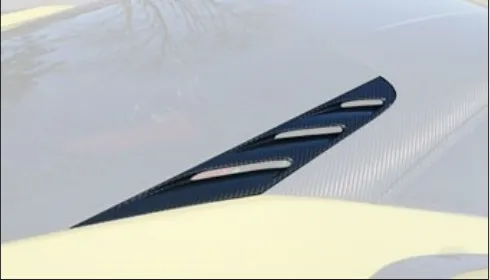
Air outtake - engine bonnet Mansory Carbon for Ferrari 488 Siracusa 4XX


Air Outtake — Engine Bonnet (Coupé) — Mansory Carbon for Ferrari 488 Siracusa 4XX
The engine-bonnet air outtake is a Coupé-only carbon vent set into the rear engine bonnet of the Ferrari 488 GTB. On factory cars the engine bonnet is closed sheetmetal with engine heat exhausted laterally through the rear-quarter outtakes; on a Siracusa-spec build the bonnet itself becomes part of the heat-dump path, with a styled NACA-derived louvre cut into the rear of the panel and a carbon surround framing the opening. Within the wider Mansory Carbon Fiber Body kit set for Ferrari 488 Siracusa 4XX programme this is one of the few parts that does meaningful aerothermal work on top of the visual job — it is genuinely useful on track-driven cars where bay temperatures climb during sustained high-load running and the rear-quarter vents alone are not quite enough.
Construction & Materials
The outtake is a two-piece assembly: a visible carbon outer surround that follows the contour of the OEM bonnet panel, and a black powder-coated mesh insert that sits behind the carbon and prevents debris ingress while still flowing air. The carbon surround is laid up on a CNC-cut tool that matches the curvature of the rear bonnet panel exactly so it sits flush rather than proud, and the cut-out edge is rebated 1.5 mm so the mesh sits below the carbon outer face — flush rather than recessed in shadow.
The OEM bonnet has to be cut to accept the louvre; this is done at installation time using a CNC-routed template supplied with the kit, after which the cut edge is sealed with a thin elastomer band before the carbon surround bonds in place. That sealing band stops bay heat soaking the bonnet underseal at the cut edge and stops moisture corroding the bare steel where the cut exposes it.
- Outer surround: 3K 2x2 twill prepreg, autoclave 120 °C, polished tool
- Mesh insert: laser-cut stainless mesh, 4 mm hexagonal cell, black powder coat
- Surround thickness: 1.8–2.2 mm finished, perimeter rebate 1.5 mm for mesh
- Weight: ~280–340 g for the surround, ~220 g for the mesh insert
- Bonding: structural methacrylate to the bonnet skin, perimeter sealed with elastomer band
- Mounting: no exposed fasteners — surround bonds, mesh slides into rebate from underside
- Cut template: CNC-routed Acetal pattern supplied with kit
- Finish: 2K UV-stable gloss standard, satin matte and forged-carbon options to order
Design & Visual Function
The louvre geometry is NACA-derived in the sense that the leading edge is recessed below the bonnet plane and the trailing edge sits flush, which is the canonical low-drag inlet shape — though here it is run in reverse, as an outlet rather than an inlet. Engine-bay air is at higher pressure than ambient at speed, so reversing the NACA geometry gives a low-drag exit path that pulls bay air out without creating a high-pressure stagnation point on the bonnet surface. At 200 km/h this typically removes 5–10 °C from peak bay temperatures during sustained running, which is enough to matter for track use but not enough to register on a road-driven car.
Visually the louvre transforms the rear of the coupé. A standard 488 GTB rear bonnet reads as a closed plane behind the rear glass; with the carbon outtake fitted, the bonnet reads as an active surface — there is a deep mesh-filled opening drawing the eye into the engine bay, hot air visibly shimmering above it on a hard run. That is the single biggest aesthetic change the Siracusa programme makes to the coupé silhouette and the part most often photographed by the press at any car-show display.
The carbon surround is dimensioned so its outer edge sits exactly flush with the OEM bonnet panel — neither raised proud nor recessed below — and the weave alignment runs square to the car centreline so it reads symmetrically from a centred viewing angle. Most aftermarket bonnet vents fail this alignment test; the Mansory tooling does not, because the surround is laid up off a tool that registers off the bonnet seam lines rather than off the panel surface itself.
The mesh is intentionally black rather than metallic. A polished stainless mesh would catch the eye and break the visual hierarchy — the carbon surround should read as the primary feature, with the mesh receding into shadow behind it. Black powder coat absorbs the light that falls into the opening and lets the eye see through to the engine bay rather than stopping at the mesh plane.
Compatibility & Fitment
The outtake is Coupé-only. It fits the Ferrari 488 GTB coupé, model years 2015–2020, with the V8 3.9 twin-turbo. It does not fit the 488 Spider, which uses a glass-panel engine bonnet of different geometry — Spider owners should look at the Spider-specific engine bonnet with glass panels instead, which is a wholly different part. Cars wearing aftermarket or non-OEM engine bonnets may not match the cut template — send a photograph of the bonnet underside and the kit number of the existing bonnet before ordering. The OEM 488 GTB rear-bonnet panel geometry is stable across the production run, so the cut template applies to every model year. Cars that have had previous accident repair on the engine bonnet should be assessed for panel-skim deviation before cutting; small deviations are absorbed by the surround bond layer, but skim discrepancies above 2 mm require the bonnet to be flatted back first.
Installation & Reversibility
Installation is a body-shop job, not a driveway one — the OEM bonnet has to be cut. The shop removes the bonnet, masks the surrounding paint, registers the supplied CNC template against the OEM seam lines, scribes the cut, then routes or jig-saws the opening. The cut edge is filed flat, sealed with a thin elastomer band, and the carbon surround is bonded with structural methacrylate. The mesh slides into the underside rebate and is retained by hidden tabs. Total bench time is approximately 4–6 hours for a competent body shop. Reversibility is severely limited — the OEM bonnet is permanently cut. If the car is ever returned to factory specification, a new OEM bonnet has to be sourced and painted; the cut bonnet cannot be repaired back to closed sheetmetal economically. Most owners treat this as a permanent modification on Siracusa-spec builds.
Pairing within the Mansory Ferrari 488 Siracusa programme
The engine-bonnet outtake is most often bought as part of the broader Siracusa rear treatment: alongside the Rear wing for full Siracusa-spec rear language, the Roof cover so the carbon flows continuously from the windscreen header back across the bonnet, and the Rear air outtake grills cover so the heat-extraction language is consistent across all the rear vents.
Maintenance & Durability
The carbon surround is washed exactly like any other body panel — pH-neutral shampoo, rinse, microfibre dry. The mesh is the only part that needs slightly different attention: bay heat carries a fine oil film that gradually deposits on the mesh underside, and a quick brush of the mesh from the engine-bay side every 5,000–10,000 km keeps the cell pattern crisp rather than progressively clogged. Avoid pressure-washing directly down into the louvre opening — the bay underneath is not designed to take that volume of water at high pressure, and the carbon surround bond can be progressively loaded by direct jet attack at the perimeter. UV exposure is similar to other exterior carbon parts; the 2K clear handles it for the design life. The elastomer cut-edge sealing band is rated for the design life of the body and is not a service item under normal use.
Lead Time & Warranty
Lead time is typically 3–4 weeks from confirmed order to dispatch — the carbon surround and mesh insert ship together as a kit with the CNC cut template included. The kit ships with a 12-month warranty against manufacturing defects, covering laminate voids, delamination, mesh powder-coat failure under normal service, and methacrylate bond failure. Damage from incorrect installation — particularly an off-template cut to the bonnet — is not covered, and is the single most common warranty-rejected scenario. Use a body shop with experience in carbon bonding and follow the supplied template precisely.
FAQ
Q: Does it fit the 488 Spider?
A: No. This outtake is Coupé-only. The Spider uses a glass-panel engine bonnet of completely different geometry — for Spider builds, look at the dedicated Spider engine-bonnet part instead.
Q: Does it actually drop bay temperatures or is it cosmetic?
A: Both. At sustained high-load running it removes about 5–10 °C from peak bay temperatures, useful on track-driven cars. On a road-only car the effect is small enough that most owners would not notice — the visual benefit is the primary reason for fitting on road builds.
Q: Does the OEM bonnet have to be permanently cut?
A: Yes. The louvre opening is cut into the bonnet at installation using a supplied CNC template. The modification is not economically reversible — a new OEM bonnet would have to be sourced if the car is returned to factory spec.
Q: Can rain enter the engine bay through the louvre?
A: Some, yes. The bay is designed to drain water through existing channels and the volume admitted by the louvre at speed is small; standing rain on a parked car runs off the bonnet camber rather than down through the mesh. Owners who park outdoors year-round should specify the optional drain channel upgrade at order.
Q: Will the louvre vibrate or buzz at speed?
A: No. The carbon surround is bonded to the bonnet skin with structural methacrylate, and the mesh is mechanically retained in the rebate so it cannot rattle. The louvre is acoustically silent across the operating range.
Pair the engine-bonnet outtake with the rear wing and roof cover for the complete Siracusa-spec rear treatment. CTA: WhatsApp +44 7488 818 747 or [email protected].