
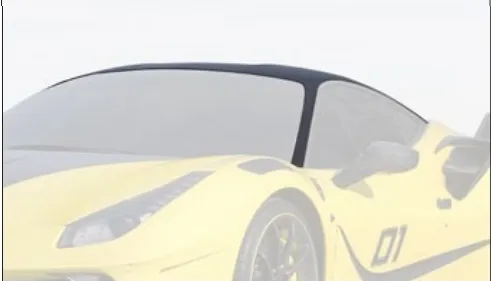
Roof cover Mansory Carbon for Ferrari 488 Siracusa 4XX


Roof Cover (Coupé) — Mansory Carbon for Ferrari 488 Siracusa 4XX
The carbon roof cover is the single largest visible piece of carbon in the Mansory Siracusa 4XX programme on the Ferrari 488 GTB. It is a Coupé-only part — the Spider has no fixed roof to skin — and it bonds directly over the OEM steel roof panel, replacing the painted body-colour surface with a continuous field of 3K twill running from the windscreen header all the way back to the rear-glass header. Within the wider Mansory Carbon Fiber Body kit set for Ferrari 488 Siracusa 4XX kit it serves two purposes: the cosmetic one is to extend the carbon language to the top of the car, completing the silhouette; the structural one is to take a kilogram or two of mass off the highest point of the body, which lowers the centre of gravity by a small but real margin.
Construction & Materials
This is the largest single piece in the kit, which makes the lay-up demanding. The cover is laid on a polished tool taken from the OEM roof geometry with a curvature-matching offset to clear the original panel and the bond line. Because the surface is so wide, the visible weave is laid up as a single continuous ply rather than as overlapping panels — any overlap line would read instantly under direct sun, particularly along the centreline of the roof where the eye lands first. A bias-laid backing fabric provides stiffness, and the autoclave cure at full pressure consolidates the laminate without porosity.
The bond to the OEM roof is made along the perimeter only, with structural urethane that retains a degree of elastic compliance to handle thermal expansion mismatch between the carbon outer skin and the steel panel beneath. Direct rigid bonding across the full surface would over-constrain the assembly and risk lacquer cracking through summer/winter cycles; the urethane perimeter bond plus a flexible damping pad on the underside is the correct approach for a long-life cover.
- Outer ply: 3K 2x2 twill prepreg, single continuous panel from windscreen header to rear glass
- Backing: bias-laid 200 gsm carbon for stiffness without print-through
- Cure: autoclave 125 °C, 6-bar consolidation, polished tool surface
- Wall thickness: 1.6–2.0 mm across the cover, locally 2.4 mm at the perimeter bond rebate
- Weight: roughly 3.2–3.6 kg finished, against approximately 5.0–5.5 kg for the painted OEM steel skin equivalent area
- Bonding: structural urethane along perimeter, NVH damping pad bonded to underside centre
- Hardware: no exposed fasteners — bonded perimeter only
- Finish: 2K UV-stable gloss as standard, satin matte and forged-carbon options available
Design & Visual Function
The roof is the most visually exposed carbon surface on a 488 because every passing pedestrian, valet, and bystander above ground level looks down on it before they look at any other part of the car. That makes the weave alignment the single most important detail in the cover. The tooling is set up so the diagonal of the 3K twill runs exactly square to the centreline of the car, and the tool is large enough that no panel join interrupts the visible field. Sun reflectivity is therefore even, with the diagonal grid reading as a single continuous pattern from any viewing angle.
Lowering the centre of gravity is the secondary benefit. The OEM steel roof panel weighs roughly 5–5.5 kg painted, and the carbon cover sitting over it weighs about 3.2–3.6 kg — net mass added is around 3.2 kg of carbon high on the body, but the perceived effect on handling balance is positive because most owners pair the cover with other carbon parts that strip mass elsewhere on the body. On its own the roof cover does not "lower" centre of gravity; it adds high-mounted mass. Where the cover earns its keep on COG is when it is fitted as part of a full carbon programme that strips the bonnet, the engine bonnet, the side skirts and the rear wing in matched carbon, in which case the net body mass falls and the high-mounted painted-steel section is replaced by lighter carbon.
Polished gloss is the default finish because gloss carbon reads strongest under direct sun, which is the lighting condition the roof sees most often. The optional satin matte is more often chosen by owners building a stealth-spec or wrap-matched car where the rest of the body is matte; the visual contrast between matte body and gloss carbon roof can read awkwardly, so most builds keep finish consistent across the panels.
The bond line at the perimeter is hidden under a tight black trim bead that follows the original roof gutter, so from any viewing distance the eye reads a continuous carbon-to-glass transition with no visible adhesive seam. That bead detail is a hand-finishing step done after the cover is bonded, and it is the single most labour-intensive part of the installation.
Compatibility & Fitment
The roof cover is Coupé-only. It fits the Ferrari 488 GTB coupé, model years 2015–2020, with the V8 3.9 twin-turbo. It does not fit the 488 Spider, which has no fixed steel roof to bond to — the Spider uses a folding hard-top whose carbon programme is a different part entirely. The OEM 488 GTB roof panel geometry is consistent across the production run, so the cover bonds onto every model year without modification. Cars that have had previous accident repair work to the roof should be inspected for panel-skim deviation before bonding; a 1–2 mm panel-skim discrepancy can be accommodated by the urethane layer thickness, but anything larger requires the OEM roof to be flatted back before the cover lands. Cars wearing previous aftermarket roof wraps must have the wrap removed and the OEM paint scuffed back to clean lacquer before the urethane bond is made.
Installation & Reversibility
Fitment is a two-day job for a body shop with experience in structural urethane bonding. The OEM roof is masked, scuffed, isopropyl-wiped and primed; the cover is dry-fitted with painters tape to verify alignment to the windscreen and rear-glass headers; urethane is dispensed along the perimeter rebate at the specified bead height; the cover is positioned and clamped against soft pads while the urethane sets to handling strength (typically four hours, full cure 48 hours). The black trim bead is hand-applied last. Tools needed are a body-shop scuff pad, a urethane dispenser gun with the correct bead nozzle, alignment templates supplied with the kit, and clean soft clamps. Reversibility is significantly more involved than for the smaller carbon parts in the kit — removal requires the urethane bond line to be cut with a dedicated cold-knife, the cover lifted off, and the OEM roof paint refinished to remove urethane residue. Most owners treat the cover as a permanent installation.
Pairing within the Mansory Ferrari 488 Siracusa programme
The roof cover is most often bought together with the other roof-and-side carbon details: the Side roof frame so the carbon language continues from the roof skin out into the side glass surrounds, the B-pillar trim cover to drop the carbon down through the pillar, and on full Coupé builds the Air outtake on engine bonnet so the rear of the roof reads into a matched carbon vent rather than a body-coloured engine cover.
Maintenance & Durability
Wash routine is identical to a body-coloured panel — pH-neutral shampoo on a clean mitt, rinse, microfibre dry. The 2K clear is UV-stable, but because the roof receives more sun than any other panel on the car, an annual ceramic or wax application is sensible to keep the lacquer shielded. Avoid abrasive polishes, which can take the top of the lacquer down over time and dull the weave. If the lacquer is ever scuffed, it can be flatted back and re-cleared by any competent paint shop without disturbing the carbon laminate underneath. Bird droppings should be wiped off promptly because uric acid will etch the lacquer if left for days in hot sun. Expected service life of the cover is well beyond ten years of normal road use; the urethane bond is rated for the design life of the body.
Lead Time & Warranty
Lead time is typically 4 weeks from confirmed order to dispatch — longer than the smaller carbon parts because the autoclave footprint of a roof-sized panel is large and a single tool occupies a full cycle. The cover ships with a 12-month warranty against manufacturing defects, covering laminate voids, delamination, urethane bond failure under normal service, and clearcoat lift. Damage from incorrect installation, accident repair work, or chemical attack by aggressive cleaners or polishes is not covered. If the cover is being bonded by a body shop unfamiliar with structural urethane, contact us first for installer guidance — incorrect bond bead geometry is the most common warranty-affecting installation error.
FAQ
Q: Does it fit the Spider?
A: No. The roof cover is Coupé-only. The Spider has no fixed steel roof and uses a different folding hard-top assembly that this cover cannot bond to.
Q: Does the cover lower the centre of gravity?
A: Slightly, only as part of a wider carbon programme. The cover itself adds about 3.2 kg of carbon high on the body. The COG benefit comes from pairing it with carbon parts that strip mass elsewhere — bonnets, side skirts, wing — so the net body mass falls and the highest section of the body is lighter.
Q: Will the bond line crack from thermal cycling?
A: No. The structural urethane bond is intentionally elastic to handle the differential expansion between the carbon skin and the steel roof beneath, and a damping pad sits between the two surfaces. The bond is rated for the design life of the body.
Q: Can I have it in forged-carbon finish instead of 3K twill?
A: Yes. Forged-carbon is offered as an option, though most owners stay with 3K twill on the roof because the diagonal grid reads strongest in direct sun. Forged-carbon adds one week to lead time.
Q: Is the OEM roof panel cut or modified during installation?
A: No. The OEM roof stays in place underneath the carbon cover. The cover bonds over the original panel; nothing is cut, drilled or removed from the body.
Pair the roof cover with the side roof frame and B-pillar trim so the carbon language reads continuously across the entire upper body. CTA: WhatsApp +44 7488 818 747 or [email protected].