
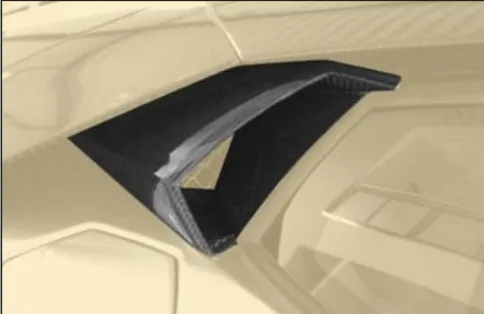
Air intake - side window Mansory Carbon for Lamborghini Aventador S


Mansory Carbon Air Intake — Side Window for Lamborghini Aventador S
The side-window air intake is the trim element that lives in the body sail-panel between the scissor-door cut and the rear quarter, framing the small triangular glass and louvre that separates cabin from engine bay on the LP740-4 S. Within the Mansory Body Kit for Lamborghini Aventador S, this part replaces or surrounds the OEM glass-and-panel surround at the C-pillar window line with a Mansory carbon scoop, recutting the visual cue that ties the door silhouette to the rear haunch. It is a coachwork-line piece — its job is to redraw the side-glass geometry in lacquered weave, hold the sail-panel as the dramatic shoulder of a mid-engine V12 silhouette, and preserve clearance for the scissor hinge as the door rises through its arc. No active aero, no ALA — just sculpted sail-panel surround tuned to the post-2017 facelift contour and the lower-side exhaust outlet line beneath it.
Construction & Materials
Built as a wrap-and-replace surround for the OEM sail-panel glass and louvre area, this carbon piece is laid up to match the compound curvature of the C-pillar where the cabin glass meets the engine-bay vent. Mansory uses prepreg twill across the visible face with backing reinforcement at the hinge-side edge, where door-arc proximity demands extra rigidity. The autoclave cure runs hot enough to drive the matrix to full Tg, and the post-cure UV-stable lacquer is mil-thickness controlled so the weave reads the same against pearl-white, Nero Aldebaran, or matte Grigio Lynx body colours.
- Weave: 3K twill on outer face, 2x2 plain at the hidden edges where door-shut radius is tight
- Cure: autoclave prepreg at 125 deg C, vacuum-bag pressure 6 bar, full post-cure for dimensional stability
- Wall thickness: 1.4–1.7 mm across the panel face, ramped to 2.0 mm at the hinge-side flange
- Weight: ~0.55 kg per side, gross of clips and seal channel
- Mounting: butyl bead at glass-line, OEM clip retention at the louvre frame, no panel drilling
- Finish: high-build UV-stable lacquer, matte or gloss; raw-weave option supplied with sealer only
- Edge treatment: rolled-flange CNC trim, no exposed dry weave at the visible perimeter
- Substrate prep: scuff-and-prime on the sail-panel donor surface; methacrylate-compatible bead where bonded
Design & Visual Function
The Aventador S sail-panel is one of the strongest geometric cues on the car — a sharp triangular plane that funnels the eye from the door-glass aft to the engine-bay vent. The Mansory carbon side-window intake honours that geometry, then sharpens it. The weave runs diagonally with the body crease so light reading off the lacquer reinforces the wedge instead of fighting it. On the inboard face you can see the woven texture continue around the radius where the OEM louvre slats meet the C-pillar; on the outboard face the trim plays against either lacquered body colour or the matte rear-quarter venturi, depending on how the kit is specified.
Functionally, the surround does not feed the V12 airbox — that intake lives behind the engine-bonnet louvres and through the side-skirt collectors. This piece is a visual aero cue: it tells you, at a glance, that the cabin-to-engine transition has been redrawn in carbon, and that the rear of the car is dressed to match. On certain configurations the surround integrates a shallow scoop above the louvre line, drawing eye-flow toward the rear haunch and softening the visual mass between the door-cut and the rear wheel-arch lip. It is a coachwork detail more than a flow detail — and on a mid-engine car with this much shoulder, that visual work matters.
For owners who keep a raw-weave aesthetic across the whole car, this part is one of the most useful in the catalogue: it bridges the mirror-housing weave at the front of the door to the rear-quarter louvre weave aft of the wheel-arch, giving an unbroken twill ribbon along the entire flank. Paired with the side-skirts-lip beneath it, the flank reads as a single carbon line from front splitter to rear diffuser shoulder.
Compatibility & Fitment
Lamborghini Aventador S (LP740-4 S, 6.5L NA V12, scissor-doors, AWD with rear-wheel-steering, aluminium-CFRP monocoque), coupé and Roadster, model years 2017-2021. The piece is cut to the pre-SVJ sail-panel contour and respects the lower-side exhaust outlet line beneath; it does not interfere with the rear-wheel arch lip or the engine-bay louvre frame. OEM glass retention is preserved — the small triangular cabin window remains in its factory frame, and the louvre slats keep their factory clip pattern. Scissor-hinge sweep is unchanged because the door-side flange of the trim is set inboard of the hinge swing radius. There is no ALA on Aventador S, so no central channel constraint applies to this part.
Installation & Reversibility
Bench time runs roughly 1.5 to 2.5 hours per side for an experienced trim fitter. The job is bonded-trim work, not panel replacement: scuff the donor area with a fine pad, clean with isopropanol to a streak-free finish, dry-fit the carbon piece against the OEM sail-panel surround to verify shut-line and louvre alignment, then run a methacrylate adhesive bead along the inboard flange and seat the part with even pressure for the cure window. OEM clips at the louvre frame take the rest of the load. Reversibility is good — the bonded flange can be pared back with a plastic wedge and the residue cleared with a citrus solvent without touching the underlying paint, provided the methacrylate cure has not been allowed to creep under the trim ring. For owners who want a fully removable specification, Mansory will supply the part with double-sided 3M VHB only; the visual fit is identical, the structural margin is slightly lower, and the part can be peeled in under 20 minutes. We recommend a Lamborghini-certified or Mansory-trained trimmer for the bonded version because the substrate chemistry on the CFRP-skinned monocoque rewards experience.
Pairing within the Mansory Aventador S programme
This trim closes the visual loop between the front of the door and the rear of the car. Pair it with the replacement big rear air intake immediately aft, so the C-pillar weave continues seamlessly into the rear-quarter scoop without a body-colour break. Drop the eye downward by adding the side skirts lip beneath, which extends the flank carbon line to the lower body and frames the lower-side exhaust outlet. Forward of the door, the mirror housing picks the weave up at the A-pillar, completing a full-length carbon ribbon from mirror to rear arch. These three siblings together turn the side profile into a single readable carbon expression rather than a set of isolated trims.
Maintenance & Durability
Lacquered carbon on the sail-panel sees the worst of two worlds — direct overhead sun in the parked-out hours and engine-bay heat radiating from the louvre slats below. Both want managing. Apply a quality ceramic coat after a deep two-bucket wash; the coating does the heavy lifting on UV defence, and a topper of carnauba twice a year keeps the gloss from going flat. Keep alkaline wheel cleaners, ammonia glass sprays, and abrasive sponges away from the lacquer; the door-shut radius has the thinnest paint on the part and is the first place to chip. Engine-bay heat is not a problem for the lacquer at idle or cruising temperatures, but on hot-shutdown soak the louvre area can climb into the upper range — leave the bonnet vents clear and avoid pressure-washing the louvre slats while the engine is hot. Lifespan on a garaged car with regular ceramic refresh is genuinely a decade-plus before any lacquer rework is needed; chip repair is a localised re-spray of the lacquer system, not a full panel job, because the carbon substrate beneath does not perish.
Lead Time & Warranty
Lead time is 4 to 8 weeks from order to dispatch, reflecting Mansory's bespoke-build cadence — colour-keyed lacquer, raw-weave option, and door-side or non-door-side handing are each set per order. The piece carries a 12-month warranty against manufacturing defects covering laminate delamination, lacquer micro-crazing, and clip-frame mis-fit; the warranty does not cover impact damage, chemical attack from non-automotive cleaners, or paint chipping caused by stone strikes from the rear wheel.
FAQ
Q: Does this part fit both the coupé and the Roadster?
A: Yes. The sail-panel geometry is shared between coupé and Roadster on the Aventador S, so the trim seats identically on both. The Roadster's targa-style top stowage does not pass through this area.
Q: Does it touch the scissor-door hinge sweep?
A: No. The door-side flange is set inboard of the hinge radius, so the door rises and falls through its full arc without contact. We verify this on the dry-fit before bonding.
Q: Is the OEM cabin glass retained?
A: Yes. The small triangular cabin window stays in its factory frame, and the louvre slats keep their original clip pattern. This is a surround trim, not a glass-replacement part.
Q: Raw weave or lacquered — which holds up better in the long run?
A: Lacquered. The UV-stable clear is what protects the resin matrix from sun-driven yellowing. Raw-weave with sealer only is the right choice for show specs but needs more frequent refresh on a daily-driven car.
Q: Does the bonded version damage the underlying body if removed?
A: Carefully done, no. Methacrylate bond lines pare back with a plastic wedge and a citrus solvent leaves the donor paint untouched. We recommend a Mansory-trained trimmer for clean reversal.
Q: Will it clear the lower-side exhaust outlet?
A: Yes. The Aventador S exits exhaust low on the rear bumper, not through the C-pillar zone, so this trim is well above the heat plume and routinely sits cool at cruise.
Pair this side-window air intake with the matched rear-quarter and skirt trims to close the carbon line along the entire flank. To order, configure handing, weave, and finish, or check current build slots, contact us on WhatsApp +44 7488 818 747 or email [email protected].