
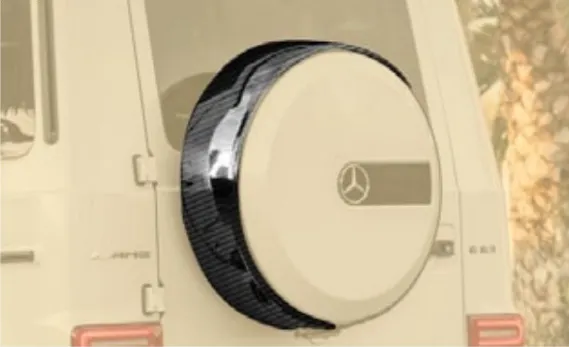
Spare wheel cover frame Mansory Carbon for Mercedes G-class G500 / AMG G63 W463A


Spare wheel cover frame Mansory Carbon for Mercedes G-class G500 / AMG G63 W463A
The Mansory carbon spare wheel cover frame is the outer ring that wraps the spare-wheel cover disc on the W463A tailgate. It turns what is otherwise a flat steel-and-plastic roundel into a stepped, layered carbon feature. As part of the wider Mansory Carbon Body Kit for Mercedes G-class W463A G500/G63 programme, the frame sits between cover disc and tailgate sheet, raises the cover six to eight millimetres, and creates the shadow-line that makes the rear face read as deliberately composed. Owners specify it when they want the spare wheel area to look engineered, not decorated.
Construction & Materials
The frame is a single autoclave-cured carbon part with a thicker laminate stack than the cover disc itself, because mechanically it does a different job: it acts as the stiffener the disc bolts and bonds onto, taking door-slam vibration, off-road tailgate loading and thermal cycling without flexing or pulling the sealant bead apart. The weave is matched to the rest of the rear ensemble — same 3K twill direction as cover II and the rear door panel — so under direct sun the three pieces read as one continuous carbon surface.
- Weave: 3K twill, twill direction aligned with cover II and the rear door panel for visual continuity
- Cure: prepreg autoclave, controlled-ramp cycle to keep the ring true and avoid pringle-shape distortion
- Wall thickness: 3.0–3.4 mm (notably thicker than the 2.0–2.4 mm cover disc)
- Weight: ~1.4–1.7 kg (the frame carries more laminate than the disc on purpose)
- Mounting: 3M VHB 5952 foam tape on the perimeter flange + Sikaflex-class polyurethane sealant bead
- Optional fasteners: M5 captive nuts pre-bonded for owners who prefer mechanical backup over adhesive-only
- Finish: high-gloss two-pack lacquer with UV inhibitors as standard, satin and body-colour paint optional
- Edge treatment: chamfered and lacquer-rolled inside diameter so the cover disc sits flush against a clean rim
The Stepped Frame as a Designer's Device
Walk around a stock W463A and the spare wheel cover is a single flat disc on a flat tailgate — competent, but visually inert. Mansory's reading of the rear is different: the tailgate is treated as a layered surface, and the spare wheel area in particular is composed in three z-axis planes — tailgate sheet, frame ring, cover face. The frame is what creates that middle plane. By raising the cover disc roughly six to eight millimetres off the door, it casts a continuous shadow line around the wheel cover that catches the eye, breaks up what would otherwise be one large flat carbon roundel, and gives the rear face the same stepped, machined-from-solid feel that the front mask establishes at the other end of the car.
The stepping is a designer's framing device, not a styling accident — it does the same thing a deep bezel does for a watch dial. With the frame in place, the cover disc sits inside its own shadow, the gap line is consistent all the way around, and the rear-three-quarter view gains a clear focal point. Weave alignment matters too — the twill is laid up so the cloth flows continuously around the ring, with seam joins hidden behind the cover disc's outer edge. The result looks turned, not patched.
Tailgate Bonding & Sealant Chemistry
The frame bonds to the painted tailgate sheet metal through a two-part adhesive system, and getting the chemistry right is the difference between a frame that lasts the life of the car and one that lifts a corner two summers in. The primary bond is 3M VHB 5952 acrylic foam tape on the inner perimeter flange — high peel strength, viscoelastic, designed exactly for bonding rigid composite parts to painted metal on vehicles. The secondary line of defence is a continuous polyurethane sealant bead (Sikaflex-class) run around the outer edge. The PU bead seals out water and provides a flexible secondary bond that shares load with the VHB at temperature extremes.
Thermal cycling is the real enemy on a tailgate-mounted carbon part. A black tailgate panel under summer conditions can run sixty to seventy-five degrees Celsius; in winter minus ten or below. Carbon and steel have different thermal expansion coefficients, so the bond line has to absorb the differential without losing grip. VHB is engineered for exactly this — its viscoelastic core flows slowly under shear and recovers. Installs that skip the PU bead and rely on tape alone fail first.
Thicker-Shell Stiffener Logic
It is worth saying plainly why the frame is built thicker than the cover disc, because owners often assume the visible part should be the heavier part. The opposite is true. The cover disc is essentially a face panel — its job is to look right and resist a wash brush. The frame is the structural element of the assembly: it transfers tailgate vibration into the cover, takes the load every time the rear door slams, and holds the bond line under wind buffeting at motorway speed. Under-build it and the disc would oscillate at its natural frequency every time the door closed, the bond line would micro-cycle, and the sealant would fatigue. The thicker laminate turns the frame into a stiff carbon ring beam that the disc rides on without shaking; the assembly behaves as one rigid object.
Compatibility (Tailgate Variants, Hinge Side)
Designed specifically for the Mercedes-Benz G-class W463A — the 2018-onward fourth-generation platform (Mercedes internal code W463A) — and engineered to fit G500, G550, G400d, G350d and AMG G63 (M177 4.0 V8 biturbo) variants that retain the rear-mounted spare wheel. Pre-2018 W463 (the original boxy generation) is not compatible: different tailgate skin, different spare-wheel mount geometry, different hinge cup placement. W464/W465 use different rear architecture and are not covered. Hinge side is irrelevant — the frame is symmetric around its vertical axis. LHD/RHD makes no difference; the frame does not interfere with the third brake light, reversing camera or rear wiper.
Installation, Surface Prep, Cure Time
Two-and-a-half to three hours at a body shop with the right consumables. The factory cover comes off first; surface preparation is the longest single step, because the bond is only as good as what you stick to. The painted tailgate area gets cleaned with isopropyl alcohol, masked, then activated with a 3M adhesion promoter wiped one direction and flashed off for the specified time. The frame's inner flange is cleaned the same way. VHB tape is applied to the frame, the release liner pulled, and the frame placed using locating pins in the existing OEM mount holes — no drilling. A roller gives the tape its initial wet-out. The PU bead is run around the outer edge, tooled smooth, and the assembly cures undisturbed for twenty-four hours before the cover disc is fitted. Reversibility is partial: removable with heat and care, but expect to refinish the tailgate paint underneath.
Pairing within the Mansory G-class W463A programme
The frame is the structural counterpart to the cover disc and the natural third element of a fully-carbon tailgate face. The most coherent pairing is with spare wheel cover II — frame plus cover II together give you the full stepped ensemble in matched twill. The obvious neighbours are rear door panel, which carries the same weave across the tailgate, and carbon door handle with logo, closing the composition with matched 3K twill at eye level.
Care, Polish, Sealant Service
Day-to-day care is unfussy: pH-neutral shampoo, soft microfibre, dry with a clean towel, and keep the high-pressure lance away from the frame's outer sealant bead. Twice a year the lacquered carbon takes a coat of carnauba or a proper SiO2 ceramic — both work on the two-pack clear, but never mix product systems in the same season. What kills carbon here is what kills it everywhere: dishwasher detergent, ammonia-based glass cleaners on the lacquer, and abrasive sponges. The frame-specific service item is the polyurethane sealant bead — inspect annually and have a body shop replace it if you see hairline cracks, flaking, or lifting at the bead-to-paint interface.
Lead Time & Warranty
Build and ship is typically three to four weeks from order confirmation. Each frame is hand-finished, lacquered, optically inspected for clarity and weave alignment, dry-fitted against a master tailgate jig and packed in foam-cradled cartons. Twelve months warranty against manufacturing defects — delamination, voids, lacquer adhesion failure, dimensional non-conformance. Warranty does not cover incorrect surface preparation at install, third-party sealant substitution, or mechanical impact.
FAQ
Q: Can the frame be retrofitted on top of the existing OEM steel spare-wheel mount?
A: Yes — the OEM steel mount stays, the frame bonds to the painted tailgate sheet around the mount. The cover disc then attaches through the existing mount hardware. No mount removal, no new holes drilled.
Q: How often does the polyurethane sealant bead need servicing?
A: Inspect annually, replace every five to seven years or sooner if you see lifting or hairline cracks. Service is a body-shop job — old bead cut out with a plastic blade, channel cleaned, surfaces re-activated, fresh PU bead tooled. Allow half a day including cure.
Q: We want the frame painted body-colour — how is paint matched to a Mercedes factory code?
A: Specify the Mercedes paint code (e.g. designo Magno, Obsidian Black, Mojave Silver) at order. The frame ships base-coated and clear-coated to that code at our finishing facility, ready to bond. We can also supply it in primer if your body shop prefers to spray it alongside the car for an in-house match.
Q: If we ever want to remove the frame, will the tailgate paint survive?
A: With patience, mostly yes. Warm the bond line with a heat gun to soften the VHB, then draw a polymer wire behind the frame to cut the tape. Slice the PU bead first with a plastic blade. Expect lacquer scuffing and adhesive residue needing polishing or full repaint of the bonded area. Plan as a body-shop task.
Q: Does the frame still work with a body-coloured spare cover instead of the carbon disc?
A: Yes — the frame fits regardless of which cover sits inside it, and a body-colour cover inside a carbon frame is a recognised Mansory look (frame as a graphic ring around a painted centre). Make sure the cover thickness matches the frame's inner step depth; cover II is dimensioned for this directly.
Pair with cover II and the rear door panel for a fully composed tailgate. WhatsApp +44 7488 818 747 or [email protected].