
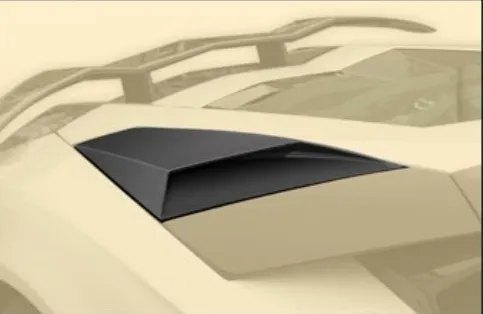
Replacement Big Air intake - rear Mansory Carbon for Lamborghini Aventador


Replacement Big Air Intake Rear Mansory Carbon for Lamborghini Aventador
When the demands on the Lamborghini Aventador's rear thermal management exceed what the standard intake aperture geometry can supply — as they do in sustained circuit use, hill-climb events, or high-ambient-temperature operations — a larger intake cross-section becomes the most effective single intervention available without modifying the car's mechanicals. Mansory's replacement big air intake at the rear position is the answer: an enlarged carbon duct assembly that retains the factory mounting architecture while delivering a significantly greater intake throat area. Part of the Mansory Carbon Fiber Body kit set for Lamborghini Aventador, the big intake is the highest-specification rear intake option in the programme and is specified by owners who prioritise thermal performance alongside the programme's visual quality standards.
Construction & Materials
The big air intake rear is the most volumetrically complex intake unit in the Mansory Aventador programme. Its enlarged throat cross-section requires a duct body that extends further inboard than the standard replacement — deeper into the rear quarter panel space — which in turn demands a more complex mandrel tooling system to form the duct's smooth interior geometry without accessible open-mould surfaces. Mansory's collapsible mandrel approach — the same technique used for the designed diffuser's internal channels — achieves void-free internal duct walls with the surface quality required for laminar boundary-layer attachment across the full duct cross-section.
- Entry face weave: 3K twill — maximum visible carbon area on the enlarged intake lip
- Duct interior weave: 2K plain — Ra <3.2 µm surface finish for laminar flow preservation
- Cure: Autoclave with collapsible mandrel — full-thickness void-free duct walls
- Resin system: high-temperature toughened epoxy — 150 °C continuous service, matching rear intake environment
- Throat cross-section area: 35 % greater than factory rear intake surround (vs 16 % for the standard replacement)
- Duct depth (inboard extension): 45 mm greater than the standard replacement to accommodate the enlarged throat
- Wall thickness: entry lip 3.0 mm, duct walls 2.0 mm, mounting flanges 4.0 mm
- Finish: high-gloss UV lacquer on visible entry face; satin clear on internal duct surfaces
- Mounting: OEM attachment points — requires no chassis modification despite the enlarged duct body
- Weight per unit: approximately 0.82 kg (greater duct volume vs standard replacement)
The 35 % throat area increase relative to the factory standard is achievable within the OEM mounting footprint because Mansory optimises the duct profile in all three dimensions simultaneously — width, height, and depth — rather than simply enlarging the aperture face. The 45 mm additional inboard depth is the primary contributor: by extending the duct body further into the rear quarter, Mansory can present a larger throat area to the incoming airstream without requiring a wider external aperture that would conflict with the body panel geometry.
Design & Visual Function
The big intake's enlarged entry face is immediately distinguishable from the standard replacement when the two are viewed side by side: the wider carbon lip frames a noticeably larger aperture opening, and the greater duct depth visible through the opening gives the intake a more cavernous, industrial quality that references motorsport intake architecture directly. On circuit-focused Aventador builds — typically accompanied by a rear performance wing, diffuser, and stickier tyre specification — the big intake's visual assertiveness is consistent with the overall character of the car.
Aerodynamically, the enlarged throat serves a dual function. At low speeds the increased cross-section area reduces duct entry velocity at a given volume flow rate — this lowers the pressure drop across the intake, effectively delivering more air for the same aerodynamic driving force (the dynamic pressure differential between the intake lip and the engine bay). At high speeds the larger throat area accommodates the higher volume flow required to maintain adequate cooling at elevated engine output — the V12's thermal load increases approximately with the square of engine speed, and the intake's ability to match this rising demand without choking is the limiting factor on sustained high-speed cooling.
The entry face's wide 3K twill carbon lip, finished in high-gloss UV lacquer, presents the programme's most expansive single carbon surface at the rear quarter — a significant visual event in the Aventador's rear three-quarter profile that immediately identifies the car as running the highest specification of Mansory's intake programme.
Compatibility & Fitment
Designed for the Lamborghini Aventador LP 700-4 (2011–2016) and LP 720-4 50° Anniversario. Both coupé and Roadster share the same rear intake mounting geometry. The enlarged duct body depth (45 mm additional inboard extension) must be verified against any aftermarket components occupying the rear quarter panel space — confirm with the fitting workshop if the car carries aftermarket rear subframe bracing or roll cage elements in this zone. Aventador S (MY2017+) uses a different rear panel — the Mansory S programme covers that model.
Installation & Reversibility
The big intake's enlarged duct body requires rear bumper removal for installation — access via the arch liner is insufficient for the inboard depth of the duct. A Mansory workshop should schedule 3–4 hours per pair, including bumper removal, OEM intake removal, duct clearance verification, Mansory unit installation, and bumper reinstallation. Full reversibility — factory intakes reinstall on OEM points. This is a scheduled full-access installation, not a track-side job.
Pairing within the Mansory Aventador programme
The big intake rear is the highest specification of the rear intake sub-programme. Pair it with the replacement air intake — front for a complete front-and-rear intake upgrade that addresses the LP 700-4's thermal management comprehensively. The designed diffuser at the rear complements the big intake's cooling benefit with underbody aerodynamic management — together they represent the highest-performance rear end configuration within the Mansory Aventador programme. The air intake — middle part addresses the mid-section of the rear intake architecture, completing the intake programme for owners building the most comprehensive thermal management specification.
Maintenance & Durability
The enlarged duct interior presents a larger surface for accumulation of road dust and carbon particles from the V12's mechanical wear environment. Inspection and cleaning of the duct interior every 5,000 km is more important for the big intake than for the standard replacement — the larger duct volume traps more particulate, and accumulated debris in the duct can restrict the throat's effective cross-section progressively over time, partially negating the enlargement benefit. A flexible detailing brush and compressed air are the correct tools; do not use solvents on the internal satin lacquer that are not specifically rated for urethane clear coats. The outer lip's high-gloss lacquer benefits from a ceramic coating applied at installation — the coating's hydrophobic properties prevent road film from bonding to the lacquer surface in wet conditions, maintaining the intake's visual and thermal performance across extended service intervals.
Lead Time & Warranty
The big air intake rear is the most complex intake component in the programme. Mansory schedules 4–5 weeks lead time from order confirmation to allow the collapsible mandrel tooling sequence to be completed with the care required for the enlarged duct geometry. The component carries a 12-month warranty against manufacturing defects including internal duct delamination, mounting flange failure under normal thermal cycling, and outer lip lacquer voids. The 150 °C resin specification is batch-verified — thermal delamination within the rated operating range is covered under warranty.
FAQ
Q: Is the big intake suitable for a road car used occasionally on track, or is it specifically a motorsport component?
A: The big intake is a road-legal component installed via OEM mounting points — it is suitable for any Aventador, road or track. The enlarged intake provides greater thermal headroom for road cars used in high-ambient-temperature conditions as well as for track-focused builds. It is most impactful on cars used in sustained high-demand scenarios.
Q: How does the 35 % throat area increase translate to measurable temperature benefit?
A: At sustained circuit speed (200 km/h), the increased mass flow rate through the rear intake reduces equilibrium engine bay temperature by approximately 12–18 °C in Mansory's workshop thermal logging data. This benefit scales with speed and ambient temperature — it is most significant at the highest operating temperatures where the standard intake is most limiting.
Q: Can the big intake be fitted alongside the standard replacement air intake on the same car?
A: No — the big intake is a full replacement of the rear intake assembly at the same position as the standard replacement. Owners choose one or the other for the rear intake position. The big intake and the designed big air intake for replacement address slightly different positions in the rear quarter; confirm which position your specification requires.
Q: Does the larger duct depth affect the rear bumper removal sequence?
A: The duct body is fully contained within the rear quarter panel space — it does not protrude into the bumper mounting bracket zone. The rear bumper removal sequence follows the factory procedure without modification.
For orders and technical confirmation, contact via WhatsApp +44 7488 818 747 or [email protected].