
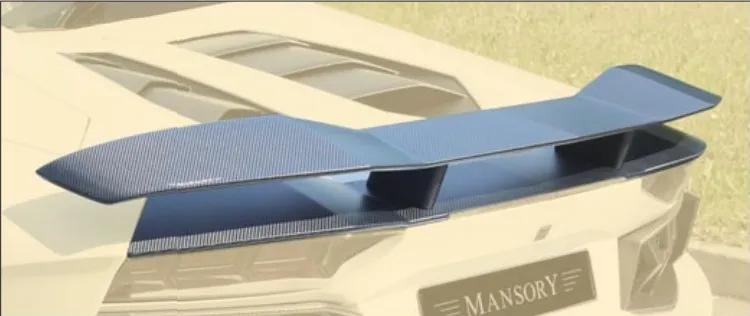
Biplane performance wing Mansory Carbon for Lamborghini Aventador


Biplane Performance Wing Mansory Carbon for Lamborghini Aventador
When a single-element performance wing reaches the limits of its downforce-to-drag optimisation, the solution adopted by Formula 1, Le Mans prototypes, and dedicated track cars is the dual-element aerofoil — two wing profiles in a carefully calibrated cascade arrangement that together generate substantially more downforce than a single element of equivalent span and chord, through the inter-element slot effect that re-energises the boundary layer between the elements and delays separation at high angles of attack. Mansory's biplane performance wing for the Lamborghini Aventador applies this aerodynamic principle to a road-legal application, delivering the highest rear-axle downforce in the Mansory Aventador programme at any given speed. Part of the Mansory Carbon Fiber Body kit set for Lamborghini Aventador, the biplane wing is the defining aerodynamic statement for owners building the highest-performance Mansory Aventador specification.
Construction & Materials
The biplane wing's dual-element arrangement introduces a structural complexity not present in the single-element performance wing: the inter-element slot gap between the main wing and the upper flap element must be maintained within ±1 mm across the full wing span, at all operating angles and under the combined aerodynamic load of both elements. This requires the standoff uprights, the main wing element, and the flap element brackets to be manufactured as a mechanically integrated assembly — not as three separately-fabricated components bolted together — with co-cured attachment interfaces that eliminate the joint-stack dimensional variability that would otherwise accumulate across multiple separate-part connections.
- Main wing element primary structure: 12K UD high-modulus carbon — controls bending under combined aero load
- Upper flap element: 12K UD primary, 3K twill outer — matched structural specification to main element
- Endplates: 3K twill, single-piece — full-height endplates spanning both elements
- Standoff uprights: co-cured with main wing mounts — ±1 mm inter-element gap maintained across span
- Cure: Autoclave, 135 °C / 7 bar
- Downforce at 200 km/h: approximately 85–130 kg depending on main wing angle setting
- Drag increase vs single wing at same setting: approximately 18 % — reflects the dual-element area increase
- Total assembly weight: approximately 9.2 kg
- Mounting: OEM trunk lid points — same as single performance wing
- Finish: high-gloss UV-clear lacquer
The inter-element slot gap of the biplane wing is set at 12 mm — a value determined through CFD and wind-tunnel correlation for the Aventador's rear deck geometry, where the slot must accelerate the inter-element airflow sufficiently to re-energise the upper flap's boundary layer without creating a choking condition that stalls the slot flow at maximum angle settings. A narrower gap (below 10 mm) chokes at angles above 10 °; a wider gap (above 15 mm) fails to re-energise the boundary layer adequately and the dual-element advantage over a single wing diminishes. The 12 mm specification is the optimised value for the LP 700-4's operating speed and angle range.
Design & Visual Function
The biplane wing's visual statement is the Mansory Aventador programme's most dramatic — and its most explicitly motorsport-derived. The dual-element profile, rising above the Aventador's tail between the full-height endplates, is immediately recognisable as a GT competition car's rear aerodynamic treatment: the gap between the main wing and upper flap reads as functional complexity, not decorative layering. On a car that already carries a comprehensive Mansory body programme — diffuser, rear bumper outtakes, body kit — the biplane wing completes an exterior specification whose functional density matches or exceeds that of a GT4 or GT3 race car's homologation package.
The full-height endplates, spanning both wing elements, serve a dual visual and aerodynamic function: aerodynamically they prevent the high-pressure zone above the upper flap from equalising with the low-pressure zone below the main wing around the endplate tip, maintaining the full pressure differential across both elements' combined chord area. Visually they create a defined lateral boundary for the wing assembly that gives the biplane a unified, architectural presence — the wing reads as a single composed object rather than two separate elements bolted in proximity.
Viewed from the rear of the car — the perspective that all following drivers have — the biplane wing's double-element silhouette is unmistakeable. No standard road car produces this rear profile: it is a completely motorsport-derived visual declaration that the car is configured for performance management, not just performance generation.
Compatibility & Fitment
Designed for the Lamborghini Aventador LP 700-4 (2011–2016) and LP 720-4 50° Anniversario. Uses the same OEM trunk lid mounting points as the single-element performance wing — the two are alternatives at the same mounting location. Both coupé and Roadster fit. The factory deployable spoiler must be removed for biplane wing installation (blanking panel supplied). Aventador S (MY2017+) uses different trunk lid geometry — the Mansory S programme covers that model.
Installation & Reversibility
Biplane wing installation requires a workshop lift and at least three technicians — the 9.2 kg assembly and its geometric alignment requirements make two-person positioning insufficient for accurate inter-element gap verification during trunk mount bolt engagement. Installation time: 4–5 hours including pre-installation gap verification, trunk mount installation, inter-element gap final check, and torque completion. Full reversibility — trunk mounts return to factory specification with Mansory's blanking panels. This installation should be scheduled as a dedicated half-day workshop event.
Pairing within the Mansory Aventador programme
The biplane wing requires the designed diffuser to be fitted simultaneously for aerodynamic balance: at 130 kg of rear downforce (maximum biplane setting), a car without the diffuser's front-rear aero balance contribution would exhibit extreme understeer at the handling limit. The rear bridge is a natural visual companion — connecting the biplane's lateral elements above the engine lid and completing the rear aero architecture into a unified structural visual statement. The rear bumper air outtake cover II's diverging blade geometry provides a visual echo of the biplane's dual-element complexity at the mid-bumper level.
Maintenance & Durability
The biplane wing's inter-element slot gap should be measured with a feeler gauge at each annual inspection — if the gap has migrated more than 1.5 mm from its commissioned setting at any spanwise position, the standoff upright joint should be assessed for loosening. The high-modulus carbon elements are brittle to point-load impact at the leading edges; high-speed motorway use places the element leading edges in the debris projection path from the Aventador's rear tyres in traffic, making trailing-car following distances important for leading-edge lacquer preservation. PPF on the leading edges of both elements is strongly recommended. The endplate outer faces accumulate rear-tyre rubber spray most intensively — a monthly degreaser application at this surface prevents rubber oil migration into the lacquer matrix over multi-year service.
Lead Time & Warranty
The biplane wing's co-cured integrated assembly requires the most rigorous production scheduling in the Mansory Aventador programme. Lead time is 6–8 weeks from order confirmation. Mansory provides a 12-month warranty against manufacturing defects including inter-element gap deviation beyond ±2 mm of the 12 mm specification under rated load, UD-layer delamination at either element, standoff co-cure joint failure, and lacquer defects on any visible surface.
FAQ
Q: How does the biplane's downforce compare to the single-element performance wing at the same angle setting?
A: At equivalent main wing angle, the biplane produces approximately 65 % more downforce than the single-element wing — reflecting the dual-element area increase and the slot effect's boundary-layer re-energisation benefit. The drag increase is approximately 18 % relative to the single wing, giving the biplane a better downforce-to-drag ratio at high angle settings than the single element.
Q: Can the biplane be used on a car primarily driven on public roads?
A: Yes — at 5 ° main wing angle the biplane's drag increase over the single wing is approximately 9 %, and the downforce increase over the passive Aventador specification is substantial without creating an impractical handling characteristic for road use. Most owners who specify the biplane use the 5 ° setting for road use and increase to 8–12 ° for track days.
Q: Is the biplane wing legal for road use in most markets?
A: The biplane wing is a road-use-compatible fixed wing. Regulations on rear wing dimensions and protrusion vary by market — confirm compliance with your local registration authority before first road use, particularly in markets with strict vehicle modification approval requirements.
Q: Can the upper flap angle be adjusted independently of the main wing?
A: The upper flap is fixed relative to the main wing element in the co-cured standoff assembly — the inter-element relationship is constant across all main wing angle settings. Only the main wing angle (at the standoff-to-trunk mount interface) is adjustable in the 3-position system.
Order or confirm specification via WhatsApp +44 7488 818 747 or [email protected].