
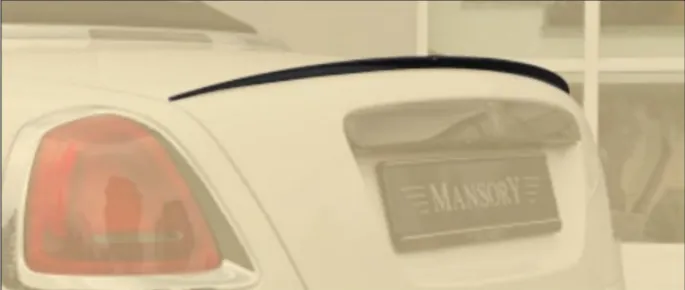
Rear decklid spoiler wide Mansory Carbon for Rolls-Royce Dawn


Rear Decklid Spoiler (Wide) — Mansory Carbon for Rolls-Royce Dawn
The wide decklid spoiler is the Mansory carbon ducktail for owners who want the Dawn's tailpiece to announce rather than whisper. Sitting along the rear deck behind the 2+2 cabin, this piece spans further outboard and rises with a more sculpted lip than its flat sibling, transforming the closing line of the silhouette into a coachbuilt gesture that catches morning light and the kerb-side reflection equally. It belongs to the wider Mansory Body Kit for Rolls-Royce Dawn programme, and on the twin-turbocharged 6.6L V12 drophead — fabric soft top, coach doors, Spirit of Ecstasy at the prow — it gives the rear three-quarter the same theatrical confidence the front fascia carries. Specified by collectors who already own the bonnet bar, the front grill frame and the side skirts, then ask for one more degree of presence.
Construction & Materials
The wide ducktail is laid up as a single-piece sculpted shell over a male tooling buck cut from a Dawn donor decklid scan. Because the spoiler reaches further across the rear deck and lifts higher at its peak, Mansory cures it as a sandwich rather than a single skin: an outer cosmetic ply of 3K twill prepreg laid over a closed-cell foam core, backed by a structural inner ply of 2K plain weave to keep panel resonance dead at autobahn cruise and at the V12's idle harmonic. The piece exits the autoclave as one continuous part, with no visible bondline along the upper crease.
- Outer cosmetic skin: 3K twill prepreg, autoclave-cured at controlled ramp to suppress fibre print-through
- Core: aerospace-grade closed-cell foam, 4 mm typical, tapering to solid laminate at the leading and trailing edges
- Inner structural ply: 2K plain-weave prepreg for torsional stiffness and acoustic damping
- Wall thickness: 2.4–3.0 mm cosmetic skin; total sandwich 6–8 mm at the peak of the lip
- Weight: ~2.6 kg finished, including hardware and gasket set — replacing nothing on the OEM car (additive piece)
- Mounting: butyl gasket bed plus six concealed M5 fasteners through pre-existing decklid threaded points; no drilling into the soft-top mechanism housing
- Finish options: Mansory deep-gloss lacquered weave; satin lacquer; or paint-broken in any Rolls-Royce coachwork colour with the leading 25 mm of the ducktail crown left in raw weave for a two-tone hand-off
- Soft-top clearance: profile is mapped against the fabric stowage envelope so the hood folds and stows with full OEM travel and no contact
Design & Visual Function
Where the flat decklid spoiler reads as a discreet edge — a coachbuilder's pencil line drawn along the boot lid — the wide variant is a sculpture. It rises in a tapered ducktail that is widest at its centreline and falls away gracefully into the rear-fender shoulder, never meeting the panel-cut harshly but flowing into the body language of the car. Viewed from behind, it gives the Dawn a discernible haunch where the OEM tailpiece is deliberately understated; viewed from three-quarter, it reads as the closing chord of a kit that already includes broader fenders and a sculpted lower fascia.
The aerodynamic role is honest rather than theatrical. At Dawn cruise speeds — let's call them the 90–140 km/h band where most owners actually drive — the wider lip nudges separated airflow off the boot lid a touch later than OEM, calming the buffet that drophead rear ends sometimes carry into open-top cabin air. It does not generate motorsport downforce and does not pretend to. What it does is settle the air leaving the car so the cabin behaves more politely with the soft top stowed. The sculpting is dictated by airflow modelling but resolved by the design studio — every section was redrawn by hand after wind-tunnel correlation, because a coachbuilt Rolls-Royce will not tolerate a part that looks like a CFD plot.
Weave alignment is treated as a coachbuilding decision, not a cosmetic one. The 3K twill is biased so its diagonal threads chase the centreline of the ducktail, meeting at the apex in a mirrored vee that any owner who walks around the car at a concours will read instantly. If the piece is paint-broken, the lacquered crown becomes the visual signature; if it is lacquered fully, the weave geometry does the talking. Either path harmonises with the polished Spirit of Ecstasy plinth and with chrome bonnet pinstripe, while never slipping into trackday vocabulary.
Compatibility & Fitment
Engineered for the Rolls-Royce Dawn (2015–2023, all variants — Standard and Black Badge). Drophead fabric-top convertible only; there is no Dawn coupé and the piece is not designed for one. The mould is taken from a Dawn-specific donor decklid, so the part respects the soft-top stowage compartment beneath the boot lid, the OEM rain gutter geometry, the parking-sensor field of view, and the boot-lid hinge throw. Mansory's intent is that nothing on the OEM vehicle has to be modified, sectioned or reprogrammed to receive this spoiler. Note that although the Dawn shares its lineage with the Wraith, the rear-deck shutline and soft-top mechanism on the Dawn are unique — this part is not a fit for Wraith.
Installation & Reversibility
Time on the lift: 2.5–3.5 hours including degrease, gasket-bed cure and fastener torque-down. The decklid is masked, the OEM clearcoat is lightly keyed only beneath the gasket footprint, and the spoiler is offered up to six pre-mapped threaded points beneath the lid skin. A butyl gasket bed seals the perimeter against water ingress and dampens any micro-resonance against the lid's inner panel. Final fastener torque is to a Mansory schedule and the boot lid is then re-balanced on its torsion springs because the additive ~2.6 kg shifts the closing effort fractionally. No drilling, no panel modification. Reversibility is good: the spoiler comes off in roughly the same time it took to fit, and the underlying decklid shows only the sealed gasket footprint, which polishes back. Recommended installer: Rolls-Royce-certified body shop or Mansory-trained fitter — DIY is technically possible for a careful coachwork specialist but is not recommended on a Dawn given the cost of the surrounding paint and the soft-top hinge geometry that has to be re-checked at the end.
Pairing within the Mansory Dawn programme
The most natural sibling decision is the flat decklid spoiler — the same family of part, the same mounting strategy, but a quieter answer to the same question. Owners who want the bonnet bar and bonnet weave to remain the loudest element of the car typically pick the flat. Owners who already specified the wide front fenders and the sculpted lower fascia, and who feel the rear has fallen behind in the conversation, pick this wide ducktail to bring the tailpiece back into balance. It is a trade-off rather than a hierarchy: each is correct for a different brief.
The closest visual companion at the rear is the rear trunk bar cover, which carries the same carbon language across the lower garnish below the boot lid — together they bookend the rear deck top and bottom, framing the registration recess in a single material story. For owners who continue the kit further beneath the bumper, the extension for rear diffuser (the slug carries the Mansory parts-catalogue typo and we keep it verbatim for ordering integrity) takes the bottom edge of the car and gives it the same sculpted depth this ducktail gives the top edge. Pick two of these three and the rear of the Dawn reads as one designed gesture; pick all three and you have the full Mansory rear treatment.
Maintenance & Durability
The Dawn is, by nature, an open-top car. That means more direct UV on lacquered carbon than a coupé would ever see, and more cold dew, salt mist and pollen than a garage queen accepts. Mansory's lacquer system is rated for that life, but the spoiler benefits from a ceramic coat applied within the first month after fitment — choose a 9H-class coating from a detailer who has worked on lacquered carbon before, and avoid carnauba waxes that will haze the gloss inside two seasons of summer use. Hand-wash only with a pH-neutral shampoo and two-bucket method. The killers of lacquered weave are alkaline traffic-film removers, ammonia-based glass cleaners overspraying onto the carbon, and abrasive yellow sponges; ban all three from your detailing kit. Stone-chip risk on a decklid spoiler is low because the part sits in shielded airflow, but a small clear PPF on the leading 30 mm is sensible if your routes include unfinished-edge gravel. If the piece does take a chip, the lacquer is repairable in a Rolls-Royce-grade booth — a Mansory-trained finisher feathers the damage, re-builds the clear and polishes back to the original orange-peel-free flatness.
Lead Time & Warranty
Lead time is 4–8 weeks from order confirmation, reflecting the bespoke autoclave production schedule and the finish specification — a paint-broken example with a colour-matched coachwork tone tends to sit at the longer end of the band, a fully lacquered weave example at the shorter end. Twelve-month warranty against manufacturing defects, with finish warranty applied to lacquer integrity under normal open-top use.
FAQ
Q: What is the visual difference between the wide and the flat decklid spoiler?
A: The flat is a low edge along the boot-lid trailing line — a coachbuilt pencil stroke. The wide is a sculpted ducktail that rises further at its centre and runs further outboard, giving the Dawn a discernible haunch from behind. Same family, very different volumes.
Q: Will this fit a Black Badge Dawn?
A: Yes — Black Badge is the same body-in-white as the Standard car, and the spoiler mounts to identical decklid threaded points. The all-black darkened brightwork on Black Badge actually pairs especially well with a fully lacquered weave finish.
Q: Does it interfere with the soft-top stowage?
A: No. The piece sits aft of the hood stowage envelope, and the inner profile was mapped against the fabric top's full folding cycle. Lower the roof at standstill, lower it on the move at allowable speed — both behave exactly as OEM.
Q: Can I have the spoiler painted to match my coachwork?
A: Yes. The most popular brief is paint-broken: the body of the spoiler in your coachwork colour, with the leading 25 mm of the ducktail crown left in raw lacquered weave. It reads as a hand-off between the painted rear deck and the carbon detail, rather than a single block of either.
Q: Will it fit my Wraith?
A: No. The Wraith and the Dawn share design language but the rear-deck geometry, the boot-lid shutlines and the soft-top mechanism on the Dawn make this part Dawn-only. Specifying it for a Wraith would mean a custom remould — not part of this catalogue.
Q: How much weight is added?
A: About 2.6 kg including the gasket and hardware. The boot-lid torsion springs are re-tensioned at fitment so closing effort feels OEM.
Pair the wide ducktail with the rear trunk bar cover and either decklid choice, and the Dawn's tailpiece becomes a single composed gesture. To specify finish, paint-break, or to discuss whether the wide or flat suits your existing kit — WhatsApp +44 7488 818 747 or [email protected].