
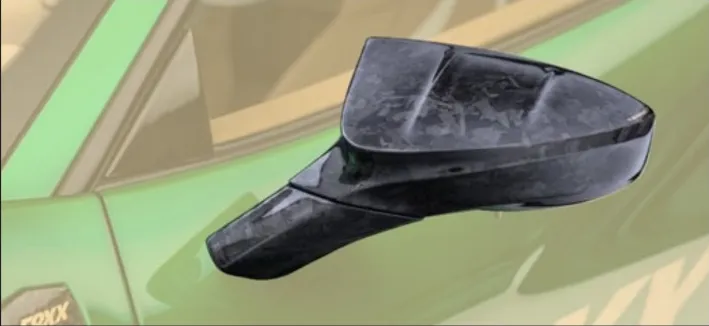
Mirror II housing and mirror foot Mansory Carbon for Ferrari F8 Tributo


Mirror II housing and mirror foot Mansory Carbon for Ferrari F8 Tributo
The Mirror II housing and mirror foot is the more sculptural of the two carbon mirror options offered inside the Mansory carbon programme for the Ferrari F8 Tributo. Where Mirror I keeps a lower-profile, near-OEM silhouette, Mirror II raises the foot, lengthens the stem and turns the entire mirror assembly into a continuous carbon gesture that extends the door-line treatment toward the A-pillar. It is part of the wider Mansory Carbon Fiber Body kit set for Ferrari F8 Tributo, sharing weave pitch, lacquer depth and edge geometry with the side blades, door handles and front fender intakes so the F8 reads as one cohesive carbon car rather than a collection of accessories.
Construction & Materials
Mirror II is laid up as a two-piece carbon assembly: an outer housing shell that wraps the glass and motor cassette, and a redesigned mirror foot that replaces the painted OEM stem with a fully carbon, aero-shaped support. The foot is the headline difference versus Mirror I; it is taller, deeper at the base and tapered along its leading edge to manage airflow as it leaves the front fender and approaches the door. The OEM mirror motor, harness, glass and any blind-spot or camera modules transfer across into the new housing, so factory electrical behaviour is preserved.
Mansory laminate work follows the same recipe used elsewhere on the F8 carbon range: pre-preg twill outer ply, bias-oriented inner plies for stiffness, autoclave cure for void-free consolidation, then a UV-stable clearcoat polished to match the rest of the door-line carbon. Edges are hand-finished so the parting line between housing and glass surround is crisp and the foot meets the door skin without a visible step.
- 2x2 twill carbon outer ply, bias-laid inner reinforcement plies
- Autoclave cure, UV-stable clearcoat with deep gloss; satin finish available on request
- Wall thickness approximately 1.6-2.2 mm in the housing, locally thicker at the foot root for stiffness
- Approximate weight 0.95-1.20 kg per pair depending on glass and motor module variant
- Bolts to factory mounting points; OEM mirror motor harness, heating element and glass cassette retained
- Compatible with blind-spot/lane-watch sensor passthrough where originally fitted
- Hand-trimmed edges, pre-aligned weave seam down the centreline of the foot
- Fasteners and mirror-base seal supplied; resealable to factory waterproofing standard
Design & Visual Function
Mirror II is positioned as the sportier sibling within the F8 mirror programme. The foot is sculpted rather than cylindrical: it leaves the door skin with a wide, almost wing-like base, then narrows as it climbs to the housing. Viewed from the side, that base reads as a small aerodynamic strake; viewed from the front three-quarter angle it visually thickens the shoulder line of the car and balances the prominent front fender intakes. The housing itself is slightly longer than the OEM mirror, which gives the carbon weave more surface to express itself and lets the lacquer depth read clearly even on darker body colours.
The weave is intentionally aligned with the carbon side blades and the outer door handle so that, when the door is closed and the car is viewed in profile, the eye travels in a continuous diagonal from the front fender intake through the mirror foot, across the door handle and into the side-skirt blade. That alignment is one of the reasons Mirror II is usually specified together with the side blades and carbon door handle rather than on its own. The taller foot also lifts the housing marginally further out into clean air, which helps reduce the buffeting harmonics some owners notice on the OEM mirror at sustained motorway speeds.
Inside the door-line carbon set, Mirror II is the louder choice. Owners who want the F8 to look more aggressive and sculptural typically choose Mirror II; owners who want a discreet, factory-plus look usually take Mirror I. Both look correct on the car, but they are different design statements and they cannot be combined.
Compatibility & Fitment
Mirror II is engineered specifically for the Ferrari F8 Tributo Coupe and F8 Spider, model years 2019-2024. It is not compatible with the 488 GTB or 488 Pista, whose mirror mounting geometry and harness routing differ, and it does not fit the 296 GTB, which is a separate platform with its own mirror housing programme. Heated, electrically adjustable and power-folding mirror functions are retained, and the factory glass cassette transfers into the new carbon housing without modification. Blind-spot and surround-view sensors, where originally fitted, pass through to the carbon shell.
An important rule for this programme: each car takes either Mirror I or Mirror II, not both. There is one mirror mounting point per side, and the foot geometry is unique to each variant, so the choice is made up front per vehicle. If you are unsure which variant suits the rest of your build, we recommend choosing based on the rest of the carbon spec - Mirror II for cars that already carry the side blades, race flaps and rear wing; Mirror I for cars built around a more restrained carbon palette.
Installation & Reversibility
Installation is straightforward for a Ferrari-experienced workshop and typically takes one to two hours for the pair. The OEM mirror is removed at the door card, the harness is unplugged, the glass cassette and motor are transferred into the new carbon housing, the carbon foot is fitted to the factory mounting point with the supplied seal, and the assembly is torqued and re-sealed to factory specification. No cutting, drilling or harness modification is required. Because the carbon clearcoat is already cured and polished, no paint preparation is needed unless the customer has specified a colour-tinted lacquer.
The conversion is fully reversible. The original mirrors can be refitted at any time without trace, which is useful for owners who lease, who plan to return the car to factory specification before sale, or who simply want to keep the OEM parts in storage. We recommend a specialist installer familiar with Ferrari electrical systems so that blind-spot calibration, where applicable, is verified after the swap.
Pairing within the Mansory F8 programme
Mirror II is most often specified alongside the door-line and front-fender carbon parts, where its weave alignment and visual mass have the strongest effect. The natural pairings are the outer door handle Mansory Carbon for Ferrari F8 Tributo, the side sirts Mansory Carbon for Ferrari F8 Tributo and the front fender air intake Mansory Carbon for Ferrari F8 Tributo. Together those four parts define the door-line carbon stripe along the side of the car. Buyers who want a quieter, closer-to-OEM silhouette should look at the Mirror I housing and mirror foot Mansory Carbon for Ferrari F8 Tributo instead - same construction, lower-profile foot, different design statement.
Maintenance & Durability
The carbon housings are clearcoated for long-term UV stability and behave like any other lacquered exterior carbon part. Wash with pH-neutral shampoo, dry with a clean microfibre, and avoid abrasive compounds on the weave. Because the mirrors sit in the leading airflow off the front fender, the outer leading edge of the housing is the area most exposed to stone chip and insect debris on motorway driving. Many owners apply a self-healing PPF strip to the leading edge of the Mirror II housing; the film is invisible against the gloss lacquer and significantly reduces the cosmetic risk of motorway miles. Light scratches in the clearcoat can be machine-polished by a detailer experienced with carbon; deeper damage to the laminate should be referred back through Mansory's authorised channel for assessment.
Lead Time & Warranty
Production lead time for Mirror II is typically four to eight weeks from order confirmation, depending on Mansory's current build queue and on whether you have specified standard gloss clearcoat or a tinted/satin variant. Each pair carries a 12-month manufacturer warranty against laminate defects and clearcoat failure under normal road use. Stone-chip damage, accident damage and damage caused by automated car-wash brushes are not covered, which is one of the reasons we recommend PPF on the leading edge.
FAQ
Q: What is the difference between Mirror I and Mirror II?
A: Mirror I keeps a lower, more OEM-like foot profile. Mirror II uses a taller, sculpted foot with more carbon area and sharper aero shaping. Both are full carbon housing-plus-foot assemblies; Mirror II is the bolder visual choice.
Q: Can I fit Mirror I on one side and Mirror II on the other?
A: No. The foot geometry is unique to each variant and the car takes one mounting design per side. You choose either Mirror I or Mirror II for the whole car.
Q: Does Mirror II fit the F8 Spider as well as the Coupe?
A: Yes. The mirror mounting points and harness are common to both F8 Tributo Coupe and F8 Spider, model years 2019-2024.
Q: Will it fit my 488 GTB or 296 GTB?
A: No. Mirror II is engineered for the F8 Tributo only. The 488 and 296 use different mirror mounting geometry and have their own carbon programmes.
Q: Are heated, electric and folding mirror functions retained?
A: Yes. The OEM motor, glass cassette, heating element and any blind-spot sensor module transfer across into the carbon housing. No electrical modification is required.
Q: What happens if a housing is damaged by a stone strike?
A: Light clearcoat damage can be machine-polished. Deeper laminate damage is assessed case by case; replacement housings are available through the Mansory channel. PPF on the leading edge significantly reduces the risk.
Pair Mirror II with the carbon outer door handle, side blades and front fender intake to complete the door-line carbon set on your F8. To configure the build, confirm spec or place an order, contact us via WhatsApp +44 7488 818 747 or [email protected].