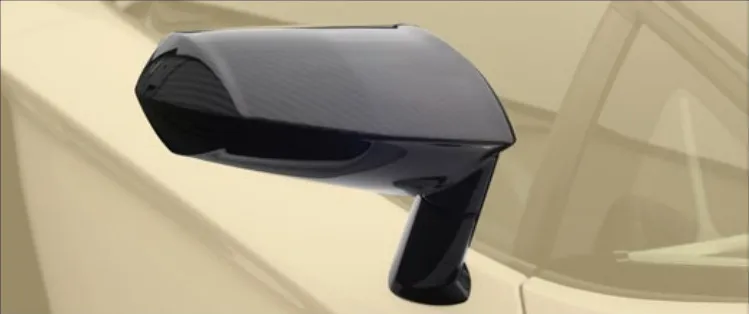
Mirror housing Mansory Carbon for Lamborghini Aventador Competition


Mansory Carbon Mirror Housing for Lamborghini Aventador Competition
The carbon mirror housings sit on the most exposed sliver of the Aventador silhouette: two stalk-mounted pods that hover beside the scissor-doors, catching every reflection on the way past. Mansory's housing pair belongs to the broader Mansory Carbon Body Kit for Lamborghini Aventador Competition programme — an SVJ-rooted dressing that respects the naturally aspirated 6.5-litre V12, the ALA 2.0 corridor and the aluminium-plus-CFRP monocoque while sharpening every visible carbon surface. Owners commission the housings as the smallest, fastest visual upgrade on the car: a pair of blade-shaped shells that swap the rounded OEM bulb for a slimmer aerodynamic profile, expose Mansory weave at eye level through the side glass, and finish the door cut without touching paint or motor electronics.
Construction & Materials
Each housing is laid up over a male tool, then post-cured in autoclave to lock fibre alignment along the stalk axis. The blade shape demands tighter draft angles than a flat panel, so Mansory uses a hybrid lay-up: 3K twill on the outer skin for visual symmetry across the door cutline, and a thinner 1K plain backing where the shell wraps the OEM motor housing. The result is a shell that mates the pre-existing OEM stalk without spacers, while presenting a uniform weave to the camera lens of any passer-by.
Hardware mirrors the OEM clip-and-screw system: three internal lugs grip the OEM mirror sub-frame, and one captive M5 fastener at the inboard edge replaces the factory shroud screw. No drilling, no body adhesives — the carbon shells are mechanical replacements for the painted plastic OEM caps.
- Outer skin: 3K twill prepreg, 0.85 mm wall — directional weave aligned with door curve
- Inner reinforcement: 1K plain prepreg, 0.6 mm wall — keeps motor cavity dimensionally identical to OEM
- Cure: autoclave, 6 bar, 125 °C dwell, controlled cool-down to limit residual stress around the indicator-lens cut-out
- Pair weight: ~480 g (vs ~720 g OEM painted plastic); per-side saving ~120 g at the highest moment-arm point of the door
- Mounting: three internal lugs + one captive M5 — reuses OEM threaded inserts
- Indicator-lens aperture: laser-trimmed to OEM amber lens outline; lens snaps in unchanged
- Finish options: gloss 2K clear, satin 2K clear, raw matte (UV-stabilised resin), forged-look insert on inboard cheek
- Edge sealing: vinyl-ester gel coat on internal cut-edges to block moisture wicking around the motor harness grommet
Design & Visual Function
The OEM Aventador mirror is a soft bulb — generous radius, painted in body colour, designed to disappear into the silhouette. Mansory's brief inverts that priority: the housing should read as a deliberate aerodynamic blade, narrow at the leading edge, broadening over the motor cavity, then tapering back to a sharp trailing lip. The blade form does not pretend to be a wing — it cannot generate meaningful downforce at this scale — but it does shave frontal area roughly 12 % versus the OEM bulb, and that translates into a quieter side-glass at autobahn cruising speeds. The narrower wake also reduces the buffeting that the OEM mirror throws across the door cutline, which is why Aventador owners who run with windows down often note a calmer cabin after the swap.
Weave alignment is the second design lever. Because the housing curves outward from the stalk, the door's body-line continues visually across the carbon shell — the twill warp follows the door's high curve, while the weft tracks the stalk axis. From a quartering-front camera angle, the eye reads a single continuous arc from the front fender, across the scissor-door, into the carbon shell. Mansory tools each shell to a specific door curvature, which is why coupé and Roadster shells are pulled from the same mould pair: the door geometry is shared across both body styles.
Light reflection is the third lever. Lacquered carbon at this height catches the shoulder of the Aventador's hexagonal cabin cues and amplifies them in late-afternoon light. The forged-look inboard cheek option (a marbled chopped-tow patch on the side facing the driver) breaks the twill repetition and is the choice on cars that already wear lacquered weave on the A-pillar or roof — it stops the cabin from reading as one continuous twill blanket.
Compatibility & Fitment
Compatible with all Lamborghini Aventador variants that share the door-mounted stalk-mirror: LP700-4, LP750-4 SV, S, SVJ, Ultimae — coupé and Roadster. Mansory makes one housing pair for the entire run because Lamborghini did not redesign the mirror sub-frame across the production cycle. The housings clear the scissor-door hinge throw at full open and do not foul the door-edge protector strip on cars equipped with the optional Lamborghini accessory. SVJ-specific clearances (ALA 2.0 channel, central twin-exhaust outlet) are not in play here — the mirror sits well forward of any SVJ aero hardware. The housings retain OEM Lamborghini blind-spot LED apertures where fitted (regional option), the heated-glass element, the indicator side-repeater amber lens and the puddle-light projector on cars equipped with that option.
Mirror motor electronics are untouched. The OEM connector remains seated, the fold-in motor retains its full travel, and the glass-tilt actuator continues to map to the driver-seat memory positions. Owners who park their Aventador on tight European streets keep the auto-fold function and the kerb-tilt-down behaviour on the passenger side.
Installation & Reversibility
Per side, the swap takes 25–35 minutes for an experienced owner with the correct trim tool. The OEM cap is removed by releasing three internal clips with a plastic spudger inserted at the inboard upper corner, then backing the captive M5 screw at the lower edge. The carbon shell lowers onto the same lugs in the same orientation, the M5 screw torques to 2.2 Nm, and the indicator lens snaps back through the carbon aperture. No paint prep, no primer, no adhesive — the substrate of the OEM sub-frame is glass-filled polyamide, untouched by the swap.
Reversibility is total. The OEM cap pair is the only thing the owner needs to keep in storage to revert at sale time; the carbon shells go back in their foam crate. Because no body panel is touched, the Aventador's CFRP monocoque adhesive bonds and the methacrylate panel-to-monocoque seams are not part of this installation — that warning belongs to the bonnet, fender and quarter-panel parts in the wider programme. DIY-grade install is appropriate for this part; a Lamborghini-certified body shop is not required.
Pairing within the Mansory Aventador Competition programme
Three siblings share the same eye-level visual band as the mirror housings and are the most common pairings on commission sheets. The A-pillar cover continues the lacquered weave from the windshield base up across the roof rail; many owners specify the same gloss/satin pairing on both parts so the cabin's vertical edges read as a single carbon ribbon. The Carbon windshield wipers cover closes the loop at the cowl, replacing the painted plastic wiper trough with a weave panel that the eye reads as part of the same carbon family when the bonnet is up. The Air intake — side window piece sits a metre behind the mirror on the same flank and is the natural rearward companion for the housing pair — the two parts together frame the scissor-door cut in carbon from leading edge to trailing edge.
Maintenance & Durability
The mirror housings live in a punishing micro-climate: door-jamb water, road salt, parking-bay scrapes from neighbouring car doors, and the constant flick of insects at 250 km/h. Lacquered weave at this height needs a quarterly two-bucket wash with a pH-neutral shampoo, followed by a top-up of a hard ceramic coating (9H, ≥36-month durability) every twelve months. Avoid alkaline traffic-film removers, ammonia-based glass cleaners that drift onto the shell, and any abrasive sponge — the 2K clear coat is harder than show-car paint but still scratches under microfibre that has picked up grit. Never pressure-wash directly into the indicator-lens seam at <500 mm range; the lens gasket is OEM and not sealed to the carbon aperture by Mansory's process.
UV is the slowest enemy. The 2K clear is UV-stabilised, but a decade of summer parking outside will eventually pearl the lacquer. Owners who garage the car between drives report no measurable degradation at the eight-year mark. Stone-chip repair on the leading edge is a 30-minute workshop job: feather the chip with 2000-grit, fill with matched 2K clear, polish back. Do not attempt to repaint the housing — the OEM cap is plastic-painted, the Mansory shell is lacquered weave, and the two finish chemistries are not interchangeable.
Lead Time & Warranty
Mansory holds tooling but produces to order in batches. Typical lead time is 4–6 weeks for the standard pair, 6–8 weeks if the forged-look inboard cheek is specified. Warranty is 12 months against manufacturing defects: delamination, lay-up voids, lacquer fish-eye. Impact damage, kerb scrapes, parking-lot dings and chemical attack from incorrect cleaners are not covered.
FAQ
Q: Will the auto-fold motor still work after the swap?
A: Yes. The OEM fold-in motor and connector are untouched; the carbon shell is a direct cap replacement and the motor's travel envelope is identical to OEM.
Q: Does the indicator side-repeater lens move to the carbon shell?
A: The OEM amber lens snaps into the carbon aperture in the same orientation as on the OEM cap. No rewiring, no resealing — the lens gasket and harness remain seated in the OEM sub-frame.
Q: How much weight does the pair save?
A: Roughly 240 g across the pair, or ~120 g per side. The saving is at the door's outermost moment-arm point, which is where Aventador owners feel the difference most when blipping the door open at low speed.
Q: Will the shells fit my LP700-4 if my car was built in 2012?
A: Yes. Lamborghini did not redesign the mirror sub-frame across the LP700-4, S, SV, SVJ or Ultimae production cycle — one shell pair fits the entire run, coupé and Roadster.
Q: Can the shells be matched to a body-colour paint instead of raw weave?
A: Mansory does not paint the shells in body colour as a standard option — the design intent is exposed weave. A bespoke paint commission is possible on request but voids the visual rationale of the part and adds 4–6 weeks to lead time.
Pair the carbon mirror housings with the A-pillar cover and the side-window air intake to close the carbon band along the entire flank of the scissor-door. Configure your pair, request finish swatches, or place a commission via WhatsApp +44 7488 818 747 or [email protected].