
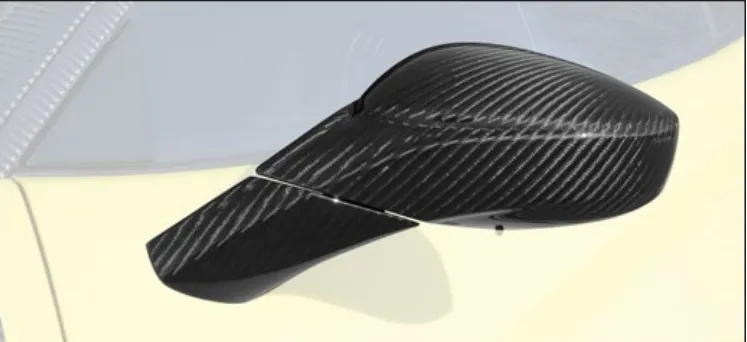
Mirror and mirror foot Mansory Carbon for Ferrari 488 Siracusa 4XX


Mirror and Mirror Foot — Mansory Carbon for Ferrari 488 Siracusa 4XX
The standard Mansory carbon mirror is the luxury-tone option in the 488 catalogue, sold against the rounder Mirror II housing and mirror foot as a mutually exclusive choice. Where Mirror II rounds off the leading edge for a sportier read, the standard mirror keeps a slightly edgier upper crease and a longer, more elegant stem — the silhouette buyers building a refined, road-focused car tend to gravitate toward. Within the wider Mansory Carbon Fiber Body kit set for Ferrari 488 Siracusa 4XX programme it sits as the side-window-line detail that the eye lands on first: the door is the first surface a passenger touches, the mirror is the first carbon piece they see at arm's length, and the standard mirror is the one most cars in the catalogue wear unless the brief explicitly calls for the rounder housing. Pick this one for builds that want presence rather than aggression.
Construction & Materials
Construction is shared with Mirror II at the lay-up level — same 3K twill, same autoclave cycle, same lacquer recipe — so finish and weave depth match across the catalogue and the two mirrors are visually interchangeable in everything except silhouette. The differences are in the tooling: the standard housing uses a male-and-female tool set with a longer leading-edge crease, and the foot is a longer, more slender stem with the same aluminium insert at the door bolt boss. Both halves of the housing are bonded along the lower seam and sealed with an EPDM gasket where the housing meets the foot, exactly as on Mirror II.
- Housing skin: 3K 2x2 twill prepreg, hand-aligned along the leading-edge crease
- Foot: 3K twill outer with bias-laid 200 gsm reinforcement around the bolt boss
- Aluminium insert: 6082-T6 alloy, bonded into the foot during cure to carry bolt load rather than letting the carbon laminate take it
- Cure: full autoclave at 125 °C, 6-bar consolidation, post-cure free-stand at 80 °C
- Wall thickness: 1.6–2.0 mm on the housing skin, 2.0 mm on the slimmer standard foot stem
- Weight saving: roughly 0.4–0.6 kg per side against the OEM body-colour mirror, i.e. 0.8–1.2 kg over the pair — same envelope as Mirror II
- Mounting: bolts to the OEM mirror mount on the door using the original three M6 fasteners
- Finish: gloss 2K UV-stable clearcoat as standard, satin matte on request
Design & Visual Function
The standard housing is the more sculpted of the two mirrors. Its leading-edge crease catches direct sun cleanly, throwing a sharp highlight along the upper edge of the housing — a styling feature that reads instantly in studio photographs and at evening events. Mirror II softens that highlight into a continuous arc; the standard mirror keeps it sharp. Buyers choose between the two based on what they want the eye to do at the side of the car: linger on a defined edge (standard), or sweep along a continuous curve (Mirror II).
The longer stem matters too. By holding the housing further out from the door surface, the standard mirror gives the side profile of the car a slightly broader visual stance — the mirror reads as more deliberately placed rather than tucked in. That is why this variant suits cars that wear lower side flaps and a quieter rear flap; the visual weight balances. Builds that wear the high rear flap usually tip toward Mirror II for cohesion. The carbon weave on the standard housing runs along the leading-edge crease, the same alignment principle as on Mirror II — twill diagonals tracking the silhouette rather than running flat across it.
The carbon foot is the under-appreciated half of the part. The OEM foot is a body-colour stub that breaks the carbon line of the housing visually; the carbon foot continues the carbon language from the housing all the way down to the door surface. Without the carbon foot the mirror would still be a carbon piece but it would read as bolted onto a painted stem; with the carbon foot it reads as one continuous shape, which is the entire reason both mirrors are sold as housing-plus-foot rather than as housing only.
Compatibility & Fitment
Fits both the 488 GTB coupé and the 488 Spider, model years 2015–2020, with the 3.9-litre twin-turbo V8. The OEM mirror mount on the door is shared between body styles — three M6 bolts on a recessed boss with the wiring loom passing through — so a single pair covers both coupé and Spider. Standard Mirror is supplied as a left-and-right pair. It is mutually exclusive with Mirror II housing and mirror foot; pick one or the other for the car. Cars retrofitted with non-OEM mirror modules in prior repair should send a photograph before ordering so the housing's glass aperture can be confirmed against the as-fitted module.
Installation & Reversibility
Installation is identical to the Mirror II procedure — around 45–60 minutes per side. Open the door card edge enough to reach the mirror wiring loom, disconnect the connector, undo the three M6 bolts on the mirror mount boss, lift the OEM mirror away, transfer the OEM glass-and-motor module into the new carbon housing, route the loom through the carbon foot, and bolt the new mirror onto the original boss. The OEM glass module is reused so all electrical functions — heater, electric fold, electrochromic dimming — keep working. Reversibility is complete because the OEM mirror is undisturbed during the glass transfer and can be re-fitted in reverse if the car ever returns to factory specification. Most owners have the job done by a body shop with the right trim-removal tools.
Pairing within the Mansory Ferrari 488 Siracusa programme
Standard Mirror is most often ordered alongside the side roof frame and the B-pillar trim cover, because those three parts together build the side-window-line carbon scene in one consistent finish run. Luxury-tone builds usually round the brief out with the rear kit low flap so the rear stays road-elegant rather than aggressive — the visual tone of the standard mirror and the low rear flap match each other rather than cancelling out.
Maintenance & Durability
Care is identical across both mirror options. A soft microfibre wash mitt and pH-neutral shampoo are the right combination; avoid pressure-washing the housing-to-foot seam at very close range because heat soak from the jet can age the EPDM gasket faster than ambient weathering would. Keep the gasket clean of road film — a hardened gasket lets the housing buzz at idle, which is the only failure mode the part has. UV exposure on a side mirror is heavy, but the 2K UV-stable clearcoat holds its colour through the warranty period and beyond. Lacquer scuffs from parking incidents can be flatted and re-cleared by a competent paint shop without disturbing the laminate. Expected service life is well beyond ten years of normal ownership.
Lead Time & Warranty
Lead time is 3–4 weeks from confirmed order. The longer lead than other trim pieces is driven by the housing-to-foot bond and the EPDM gasket fitment, which add manual stages after the autoclave run. Each pair ships with a 12-month warranty against manufacturing defects: laminate voids, delamination, gasket seal failure, lacquer lift, foot-insert bond failure. Damage from collision impact, from aggressive solvent cleaning, or from incorrect installation is not covered.
FAQ
Q: How does the standard Mirror differ from Mirror II?
A: The standard mirror has a sharper upper-edge crease and a longer, slimmer foot stem; Mirror II rounds the upper edge into a continuous arc and uses a shorter, thicker stem. They are alternative options — pick one for the car, never both.
Q: Are heater, electric fold and dimming retained?
A: Yes. The OEM glass-and-motor module transfers from the original mirror into the carbon housing, so all electrical functions continue to work exactly as before.
Q: Why is the standard mirror sold with the foot rather than housing only?
A: Because the OEM body-colour foot would visually break the carbon line of the housing — the eye would read the mirror as bolted onto a painted stub. The carbon foot extends the carbon language from the door surface up to the glass, so the part reads as one continuous shape.
Q: Is the carbon weave on the housing horizontal or aligned to the curve?
A: Aligned to the leading-edge crease. A horizontally aligned weave on a curved housing reads as visually nervous from a three-quarter angle; the curve-aligned weave keeps the diagonal grid running cleanly with the silhouette under any viewing angle.
Q: Will the foot insert work loose at the door bolts over time?
A: No. The aluminium insert is bonded into the foot during the autoclave cure rather than glued in afterwards, so the bond is full-strength and matched to the cure cycle. The bolt load passes through the metal insert rather than crushing the carbon laminate, which is what would otherwise cause progressive loosening.
Order standard Mirror as the more sculpted, road-elegant alternative to Mirror II — one of the two, not both, depending on the visual brief for the build. CTA: WhatsApp +44 7488 818 747 or [email protected].