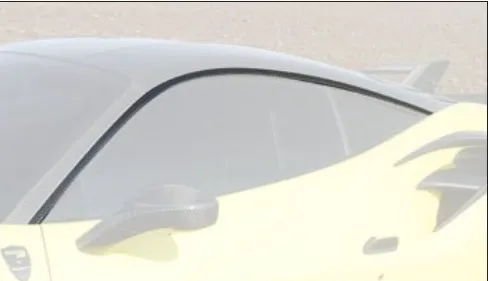
Side Roof frame Mansory Carbon for Ferrari 488 Siracusa 4XX


Side Roof Frame — Mansory Carbon for Ferrari 488 Siracusa 4XX
The side roof frame is the carbon trim that wraps each side of the greenhouse — running from the A-pillar at the top of the windscreen, along the upper edge of the side glass, around the rear-quarter window aperture, and finishing at the C-pillar. On a stock Ferrari 488 this trim is body-coloured painted aluminium; on a Siracusa-spec build it becomes visible-carbon, which transforms the side profile of the car. Within the broader Mansory Carbon Fiber Body kit set for Ferrari 488 Siracusa 4XX kit it is one of the trim parts that contributes nothing aerodynamically but a great deal visually — when paired with the roof cover above and the B-pillar trim below, it ties the entire upper body into a single continuous carbon language. The pair fits both 488 GTB coupé and 488 Spider.
Construction & Materials
The frame is a long, thin part that follows complex curvature — it bends around the rear-quarter glass corner, twists along the roof rail, then bends again at the A-pillar transition. That mix of curves makes the lay-up demanding because the prepreg has to drape into a narrow channel without the weave distorting around the corners. The fabric is hand-cut into segmented strips that are positioned individually rather than draped as a single sheet, then consolidated under vacuum and cured against a polished tool that follows the OEM trim contour exactly.
Bonding to the OEM aluminium trim is done with structural methacrylate along the full length of the frame, with positioning tabs at each end to hold alignment while the adhesive sets. Because the frame is essentially a cosmetic skin over the OEM trim, no body cutting or panel modification is required — the original trim stays in place underneath, and if the car is ever returned to OEM specification the frame can be removed by the same shop using a cold-knife cut along the bond line.
- Outer ply: 3K 2x2 twill prepreg, hand-segmented to follow the frame curvature without weave distortion
- Backing: bias-laid 200 gsm carbon for stiffness and edge stability
- Cure: autoclave 120 °C, vacuum-bag plus 4-bar consolidation, polished tool
- Wall thickness: 1.4–1.8 mm finished, locally 2.2 mm at the bond rebate
- Weight per side: ~340–390 g, pair under 800 g
- Bonding: structural methacrylate over the full length, alignment tabs at A-pillar and C-pillar terminations
- Hardware: no exposed fasteners — bonded skin only
- Finish: 2K gloss as standard, satin matte to order, forged-carbon as a premium option
Design & Visual Function
The frame draws the eye along the greenhouse in a way no other part of the kit does. On a stock 488 the eye reads the side profile as a sequence of separate elements — windscreen, side glass, rear-quarter window, body — each separated by a body-coloured trim that the brain treats as a soft transition. With carbon trim in place those transitions become hard lines: the eye picks up the dark carbon edge running from A-pillar all the way to C-pillar and reads the entire greenhouse as a single continuous shape, which makes the car look longer and lower than the OEM trim treatment ever did.
Weave orientation is set so the diagonal of the 3K twill runs along the length of the frame rather than perpendicular to it. That choice matters because the frame is so narrow — typically 18–24 mm wide — that a perpendicular weave would read as almost solid black at any normal viewing distance, losing the visible-carbon hierarchy entirely. Running the diagonal lengthwise lets the weave pattern remain legible even on the narrowest sections of the frame, particularly along the upper roof rail.
The terminations at A-pillar and C-pillar are the most carefully tooled parts of the frame because they have to land on adjacent painted bodywork without a visible step. The frame edge is feathered in the lay-up so the carbon thins from full thickness to roughly 0.6 mm at the very tip, which lets the bond line disappear under the paint transition rather than showing as a hard step. That feathering is one of the details that distinguishes this frame from cheap aftermarket window trims, which usually terminate as a hard edge that catches the eye instantly.
Light reflection along the frame is the secondary visual effect. Direct sun on a polished gloss carbon frame creates a continuous highlight line running along the top of the greenhouse — visible from the side or three-quarter front, but particularly striking from the front three-quarter where the highlight catches at the same moment the headlights do. Owners building photographic show cars typically specify gloss for this reason; satin matte loses the highlight effect but reads stronger against a body-colour matte wrap.
Compatibility & Fitment
The frame pair fits Ferrari 488 GTB coupé and Ferrari 488 Spider, model years 2015–2020. The OEM side-glass and roof-rail trim geometry is shared between coupé and Spider, so the frame fits either body style without modification. On Spider cars the rear-quarter section of the frame is slightly different in length to accommodate the folding hard-top stowage line, but the kit ships with both terminations included so the installer can trim to the correct stop point at fitment. Cars that have had previous accident repair around the door, side glass, or pillar should be checked for trim deviation before bonding; small deviations are absorbed by the methacrylate layer thickness, but anything beyond about 1.5 mm of panel-skim discrepancy requires the OEM trim to be flatted back first. Cars wearing aftermarket window trims from other tuners may not match the bond rebate footprint — send a photograph of the existing trim before ordering and we will confirm fitment.
Installation & Reversibility
Fitment is a half-day body-shop job. The OEM trim is cleaned, scuffed, and isopropyl-wiped along the full length; the frame is dry-fitted with painters tape to verify alignment to the windscreen header, the rear-quarter glass corner, and the C-pillar termination; methacrylate is dispensed along the bond rebate at the specified bead height; the frame is positioned and clamped against soft pads while the adhesive sets to handling strength (typically 30 minutes, full cure 24 hours). Tools needed are a body-shop scuff pad, methacrylate dispenser, alignment templates supplied with the kit, and clean soft clamps. Reversibility is good for this size of part — the frame can be cold-knifed off in a workshop visit, the OEM trim wiped clean of methacrylate residue, and the original aluminium trim is back to factory finish without further work.
Pairing within the Mansory Ferrari 488 Siracusa programme
The frame is most often bought together with the carbon details that flow into it visually: the Roof cover on Coupé builds so the carbon language continues across the entire greenhouse, the B-pillar trim cover so the dark carbon runs continuously from the A-pillar all the way down through the B-pillar to the rocker, and on full builds the Front side window cover so the carbon picks up the small front-quarter trim and the side language reads as one piece end-to-end. Many builds also add the Mirror and mirror foot in matched carbon so the only painted detail interrupting the side profile is the door skin itself.
Maintenance & Durability
Wash routine is identical to any other exterior carbon part — pH-neutral shampoo, rinse, microfibre dry, no abrasive polishes. The frame sits along the upper edge of the side glass, which means it sees the same UV and rain exposure as the roof cover, and the same annual ceramic or wax application is sensible to keep the lacquer shielded. Because the frame is narrow it sees a higher concentration of edge wear from accidental contact (door seals being lifted, microfibres being dragged across) than wider carbon panels do; a soft-trim approach during routine cleaning is recommended. If the lacquer is ever scuffed it can be flatted back and re-cleared by any competent paint shop without disturbing the carbon laminate. The methacrylate bond is rated for the design life of the body. Expected service life of the frame is well beyond ten years of normal road use.
Lead Time & Warranty
Lead time is typically 2–4 weeks from confirmed order to dispatch — variable because the frame is a long autoclave job on a complex tool and finish choice (gloss runs faster than satin matte or forged). The pair ships with a 12-month warranty against manufacturing defects, covering laminate voids, delamination, methacrylate bond failure under normal service, and clearcoat lift. Damage from incorrect installation, accident repair, or chemical attack from aggressive cleaners is not covered. The most common warranty-rejected scenario on this part is misalignment at the C-pillar termination from rushed installation — follow the supplied alignment templates precisely.
FAQ
Q: Does it fit both Coupé and Spider?
A: Yes. The OEM trim geometry is shared between body styles. Spider cars use a slightly different rear termination to clear the folding hard-top stowage line, and the kit ships with both terminations so the installer trims to the correct stop point at fitment.
Q: Does the OEM trim need to be cut or removed?
A: No. The carbon frame bonds over the original aluminium trim, which stays in place underneath. No body cutting or panel modification is required.
Q: Will the frame interfere with the side window operation?
A: No. The frame sits on the outboard face of the OEM trim and does not encroach on the window seal or the glass travel. Window operation is unchanged.
Q: Can I have the frame in forged-carbon to match a forged front splitter?
A: Yes. Forged-carbon is offered as a premium option and adds about one week to lead time. Most owners choose forged on the front and the frame so the high-visibility surfaces match.
Q: Will the bond line read along the upper edge of the windscreen?
A: No. The frame edge is feathered to roughly 0.6 mm at the A-pillar termination, so the bond line disappears under the paint transition rather than showing as a hard step. From a normal viewing distance the carbon reads as continuous trim.
Pair the side roof frame with the roof cover and B-pillar trim so the entire greenhouse reads as a single carbon shape from A-pillar to C-pillar. CTA: WhatsApp +44 7488 818 747 or [email protected].