
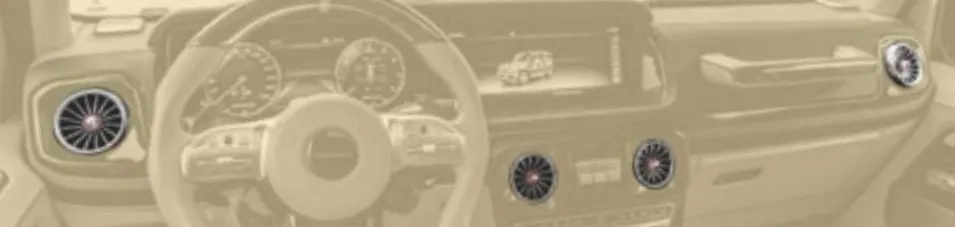
Turbine Air Vents with Ambient Light


Turbine Air Vents with Ambient Light — Mercedes-Benz G-Class W465 Gronos
The Mansory Turbine Air Vents are the dashboard signature inside the Gronos cabin on the new W465 platform. They are not a sticker, not a cosmetic ring glued onto the OEM grille, and not a generic universal vent kit. They are full-replacement vent assemblies machined to the exact W465 dashboard aperture, designed as a turbine — a rotating outer ring of CNC anodised aluminium spinning around a fixed carbon-fibre centre hub — with a circumferential PMMA light pipe tied into the car's factory 64-colour ambient lighting system. Both driver and passenger sides are upgraded as a matched pair, sharing colour, brightness, and animation with every other ambient zone in the cabin.
Turbine-Style Vent Geometry
The architecture is simple to describe and meticulous to manufacture. The outer ring is a precision-machined aluminium hoop with eight angled blade ribs cut into its inner face, indexed with a knurled grip on the outer face. The ring rotates a full 360° on a low-friction Delrin bushing, and rotation steers the airflow direction in the same way the OEM louvres do — except the actuation surface is the entire visible circumference rather than a thin plastic toggle. The centre hub is fixed: a carbon-fibre disc holding the airflow throttle paddle that opens and closes the vent. Behind the hub sits the OEM ducting, untouched. The blade ribs inside the rotating ring are profiled with a slight twist so the discharged air column has a measurable swirl component, which Mansory's interior team claim improves cabin air mixing at low fan speeds. Whether you can feel the swirl is debatable; what is not debatable is the visual: the ring looks like the inlet face of a small turbojet, and at night the ambient pipe lights it up like an APU on standby.
Materials and Tolerances
- Outer ring: 6082-T6 aluminium billet, CNC three-axis machined, hard-anodised to a matte charcoal or polished satin finish depending on the trim package. Wall section 3.5 mm at the blade root, tapering to 1.8 mm at the visible bezel edge. Ring outer diameter sized to the W465 vent aperture with a target radial gap of 0.4 mm to the dashboard surround.
- Centre hub: 2x2 twill prepreg carbon, autoclave-cured, 1.6 mm laminate over a structural ABS spider. Visible weave in gloss or matte, optional forged-carbon variant on request.
- Light pipe: automotive-grade PMMA round rod, approximately 3 mm OD, side-emitting through a fine laser-etched diffusion pattern, end-fed by a 5050-series RGB LED through an internal reflector. Material transmittance is around 80%, which keeps the ambient colour clean and saturated rather than the muddy off-white you get from cheap optical-fibre runs.
- Bushings and hardware: Delrin (POM) rotation bushing, stainless A2 retention clips, anti-rattle silicone gasket on the dashboard interface.
Ambient Light System
This is the part most people care about, so it gets a full section. The W465 ships with Mercedes' current 64-colour Ambient Lighting package, which is bus-controlled rather than wired per zone — the head unit broadcasts colour and brightness commands on the LIN sub-bus, and each ambient module ID listens for its address and updates its own LEDs. Mansory's vent module is built to the same protocol: it presents itself as an additional ambient zone, takes its address from a small DIP block during installation, and follows whatever the user has set in the COMAND/MBUX ambient menu. Change the cabin from amber to ice-blue and the vent rings change with it, with no separate app or controller.
- Compatibility: Mercedes Ambient Lighting 64-colour package (factory option on W465 from launch). Compatible with the colour zones, the music-sync animation, and the assistance-feedback colour cues.
- Bus tap: inline LIN tap into the existing dashboard ambient harness, secured with a butt-splice and heat-shrink. No CAN-bus coding is required for the basic colour-follow function.
- Power: approximately 0.6 W per vent at maximum brightness, ~1.2 W combined. Vehicle parasitic-load impact: negligible.
- Animation: follows the head unit. Static colour, slow fade, music-reactive, and welcome-sequence pulse all work out of the box.
Fitment to the W465 Dashboard
The vent module is sized to the OEM aperture on the new G-Class dashboard — the wide horizontal vent panel that runs across the upper fascia. Both driver and passenger side outlets are replaced as a matched pair; the centre vent stack is left untouched because its geometry is different and is best handled by the dedicated centre-vent module if the customer wants to extend the look. The aperture interface is 1:1 with the OEM vent so no dashboard cutting, no trim modification, and no fascia disassembly beyond removing the original vent units is required. The retention strategy is dual: four sprung clips engage the original mounting tabs in the dash structure for primary location, and a perimeter ribbon of 3M VHB 5952 acrylic foam tape provides a secondary bond and acts as the anti-rattle gasket. VHB 5952 was chosen specifically because it tolerates the dashboard temperature swing — from sub-zero cold-soak to ~70°C summer cabin peaks — without creep or adhesive transfer onto the painted fascia.
Installation
Installation is a one-hour job for an experienced auto-electrician with the dashboard trim already familiar. The condensed sequence:
- Remove OEM vent assemblies — they unclip from the front face with a soft trim tool, no screws on this generation.
- Disconnect OEM ambient harness at the inline connector behind the vent.
- Locate the dashboard LIN ambient run and prepare the tap point. Mansory supplies a pre-terminated harness with butt-splices sized for the OEM conductor gauge.
- Set the DIP address on each vent module — driver and passenger get distinct addresses so the head unit can address them individually if a future firmware exposes per-vent control.
- Press-fit the vent into the aperture. Sprung clips engage with an audible click; the perimeter VHB bonds on first contact and reaches full hold strength after 24 hours.
- Reconnect harness, key on, run through the ambient menu to verify colour-follow on both sides, verify animation sync, verify rotation of the outer ring is smooth without contact noise.
Recommended tools: trim removal forks, butt-splice crimper, heat gun for shrink tube, multimeter for LIN voltage check at the tap point. Total bench time once the dashboard is exposed: 45–75 minutes for the pair.
Care and Cleaning
The visible surfaces are forgiving. Anodised aluminium is robust against fingerprints and household solvents; carbon centre hub is clear-coated and scratch-resistant within reason. Recommended care:
- Microfibre cloth, dry, for daily dust removal.
- Microfibre cloth lightly damped with isopropyl alcohol (IPA, 70% or higher) for fingerprints, kids' juice, and the occasional smudge of dashboard cleaner overspray.
- Avoid silicone-based dashboard sprays directly on the ring — they don't damage the anodise but they leave a film on the PMMA light pipe that dulls the ambient brightness over time.
- Do not press solvents directly into the rotation gap; over-saturation can carry residue into the Delrin bushing and create a sticky rotation feel.
Position Within the Mansory Gronos Interior Programme
The Turbine Air Vents are an interior signature module within the broader Mansory Gronos kit for the W465 G-Class. They are designed to coexist with the rest of the Mansory cabin upgrades — the carbon dashboard trims, the perforated leather seat package, the steering-wheel rework, the ambient-lit door cards. Visually they are the part that catches the eye first when a passenger sits down, and they are what tells the world the cabin has been worked on rather than just re-skinned. The parent kit is the full Mansory body and interior programme for the W465 Gronos, and the vents are sold both as a stand-alone interior accessory and as a bundled component of the wider build.
Ordering
To order or to get a quote with shipping included to your country:
- WhatsApp +44 7488 818 747 — fastest channel, finish selection (matte / satin / polished), confirmation that your car is the 64-colour Ambient Lighting variant, lead-time and freight quote.
- [email protected] — written quote, invoice, payment options, and any documentation requests.
Parent kit reference: Mansory Gronos for Mercedes-Benz G-Class W465.
FAQ
Will the vents work with my car's ambient lighting?
If your W465 was built with the 64-colour Ambient Lighting package — the standard option that drives the door cards, footwells, and dashboard light strip — then yes, the Turbine Vents tap into the same LIN bus and follow the head unit's colour and animation choices automatically. If you have a base interior with no ambient package at all, see the retrofit question below.
How hard is the install really?
For an experienced trimmer or auto-electrician it is a calm one-hour job with the radio off. For an enthusiastic owner with no dashboard work history it is a do-it-once-with-help job — the clips are easy, but the LIN tap needs a clean butt-splice and a multimeter check before you commit, and a botched tap can make the cluster throw an ambient-zone fault. We strongly recommend a workshop install for the warranty to remain clean.
Can I retrofit these on a car that doesn't have ambient lighting?
Yes, with an extra step. Mansory ships an optional standalone driver module that takes 12 V switched ignition, runs a small built-in colour controller with its own button on the underside of the passenger glovebox, and drives the vents directly without needing the LIN bus. You lose the head-unit colour-follow, but you gain a working ambient ring. Specify the standalone driver at order time so we ship the right harness.
What is the returns policy?
Returns on bespoke and trim-matched parts are limited. We accept returns within 14 days of delivery if the items are unused, in original packaging, and with no installation marks. Once the VHB perimeter has been bonded into a dashboard, the part is treated as installed and is non-returnable except under warranty. Defects in materials or workmanship are covered for 24 months.