Illuminated entrance panels Mansory for Mercedes G-class G500 / AMG G63 W463A


Illuminated entrance panels Mansory for Mercedes G-class G500 / AMG G63 W463A
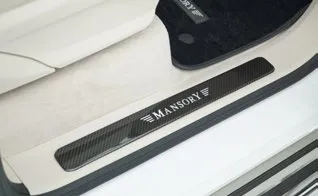
The Mansory illuminated entrance panels are the threshold-level signature of the W463A widebody programme — the moment a door swings open, the carbon-capped sill lights up and the "MANSORY" wordmark blooms across the door tread. This card covers the full four-piece set: two longer front-door panels and two shorter rear-door panels, all edge-lit through laser-etched acrylic and finished with a 3K twill carbon overlay protected by an abrasion-resistant clear-coat. They sit on top of the OEM sill, draw their 12V feed from the existing door-courtesy circuit, and read as a factory-style upgrade rather than an aftermarket bolt-on. They are the natural cabin-entry pair to the rear-door easy-entrance assist, both extending the carbon language used elsewhere in the Mansory Carbon Body Kit for Mercedes G-class W463A G500/G63.
Construction & Materials
Each panel is a three-layer sandwich. The base is a milled aluminium carrier shaped to the OEM sill profile of the W463A, which gives the assembly its rigidity and absorbs the impact of shoes, boots and luggage. Above that sits a laser-etched optical-grade PMMA (acrylic) light guide, edge-fed by a row of side-firing surface-mount LEDs that bounce light through the etched "MANSORY" pattern. The visible top surface is a 0.6 mm 3K twill carbon skin, trimmed flush with the lettering window so the wordmark reads clean against the weave.
The top-surface lacquer is the most important detail: a hard polyurethane clear-coat formulated for sole abrasion, not a thin show-car gloss. It accepts the daily scuffing of leather soles, sand grit and the occasional dragged buckle without dulling, and the carbon underneath stays legible for the life of the part.
- Carbon weave: 3K 2×2 twill, 0.55–0.65 mm visible skin, alignment book-matched front-to-rear.
- Light guide: 4 mm optical PMMA, laser-etched diffusion pattern under the "MANSORY" wordmark.
- LED engine: side-firing 2835 surface-mount diodes, 3000 K warm-white standard; 5050 RGB option with a small CAN module that follows the OEM ambient-light hue.
- Cure: vacuum-bagged carbon skin, room-temperature cured, then bonded to the milled carrier.
- Substrate: anodised aluminium plate, ~2.5 mm wall, foam-gasketed at the underside.
- Top finish: PU clear-coat tuned for shoe abrasion, satin or full-gloss to match cabin trim.
- Mounting: pre-applied 3M VHB acoustic foam tape (5952 grade) plus two hidden OEM clip points per panel.
- Wiring: 0.5 m flying lead per panel, JST-style connector, splices into the door-courtesy 12V/ground at the OEM sill loom.
- Set weight: front pair ~0.95 kg, rear pair ~0.70 kg — a small mass adder under the doors, not a structural carbon piece.
Design & Visual Function
The geometry is dictated by the W463A door tread. The front-door panels are noticeably longer than the rear; both are stepped at the inboard edge so the rubber door seal still meets a flat surface and the cabin retains its acoustic seal. The "MANSORY" wordmark is centred on the visible run of the panel — far enough inboard that it isn't obscured by the door rubber, far enough outboard that it reads from a normal standing position rather than only when you're already seated.
The lighting behaviour is the headline. With the doors closed, the panel is dark and the carbon weave reads as a quiet luxury detail — no glowing strip, no aftermarket aura. As soon as the door is unlatched, the LEDs along the inboard edge ramp up over roughly 250 ms, the etched lettering fills with even illumination and the panel becomes a soft pool of light around the occupant's feet. The pattern is a backlit wordmark, not a uniform flood, so it doesn't blow out the cabin or interfere with the OEM puddle lamps.
Visually, the panels integrate the slab-sided W463A flank with the carbon used on the turbine air vents with ambient light and the door switch panel. Owners who specify these three together get a single, coherent lighting signature: doors open, sill glows, vents glow, switch panel glows — all from the same carbon family and, in the RGB variant, all in the same hue.
Compatibility & Fitment
The set is cut for the Mercedes-Benz G-class **W463A** — the 2018+ fourth-generation platform internally coded W463A by Mercedes. It fits G500, G550, G400d, G350d and AMG G63 (M177 4.0 V8 BT) equally, since the door-tread geometry and door-courtesy circuit are common across the range. Pre-2018 W463 ("old box" G-Wagen) is **not** compatible — the sill profile, wiring and door rubber are completely different. Mansory's own W463A Gronos uses dedicated panels and W465 next-generation platform requires its own set as well.
LHD and RHD cars are both supported — the front-left and front-right panels are mirrored, as are the rear pair, so handing is simply a matter of selecting LHD or RHD at order. Cars with the AMG package, with or without the optional electric step provision, all retain factory clearance because the panels add only their own thickness on top of the OEM sill, not below it. Sunroof and spare-wheel-on-tailgate options have no bearing on the part.
Installation & Reversibility
Fit time for the four-piece set is about 60–90 minutes for a careful DIY and roughly 45 minutes in a Mansory-trained workshop. The OEM sill cover is unclipped from each door aperture, the wiring loom around the kick panel is exposed, and the existing door-courtesy 12V/ground wires are tapped at the sill connector with the supplied splice clips — no relay, no module coding, no ground-loop fix. The new panel is offered up to verify alignment, the 3M VHB liner is peeled, and the panel is pressed home for thirty seconds to seat the adhesive against the cleaned aluminium sill. Two hidden OEM clip pegs lock front-and-aft position so the VHB does the holding and the clips handle the shear.
The installation is reversible. Lifting the panel cleanly requires fishing-line under the VHB strip and a heat-gun pass at low setting; the OEM sill underneath is untouched, undrilled and unpainted, which keeps resale value intact. Owners with a cabin coded above standard (factory ambient lighting + AMG performance package) sometimes prefer a Mansory-trained installer, since the colour-link RGB variant benefits from a clean tap into the ambient bus rather than the door-courtesy line.
Pairing within the Mansory G-class W463A G500/G63 programme
The illuminated entrance panels are the cabin-entry signature, so they pair best with the other interior carbon-and-light pieces. Most owners specify them alongside the rear-door easy-entrance assist, since both elements are felt the moment a passenger enters the cabin — the rear panel manages the awkward "step over the side rail" motion, the sill glows below them as they sit. The second natural pair is the turbine air vents with ambient light, which gives the cabin a synchronised hue when the RGB variant is specified. A third sibling worth considering is the door switch panel, since the upper and lower carbon-on-door surfaces then read as one continuous trim run.
Maintenance & Durability
Day-to-day care is microfiber and a pH-neutral interior cleaner — never bathroom or kitchen detergents, which contain ammonia or aggressive surfactants and will haze the PU clear-coat over time. The clear-coat itself is the abrasion barrier, so do not run a stiff brush over it; a soft brush is fine for sand and grit out of the door tread. A twice-yearly wipe with a dedicated carbon-safe sealant or a light ceramic spray topper keeps the lacquer hydrophobic and the weave optically deep.
UV exposure is modest because the panels live under the door overhang, but desert and high-altitude sun still reach the front-door tread when the door is open. The PU lacquer is UV-stabilised; expect ten-plus years of clarity in normal use. The LED engines are rated for 30,000+ hours and run cool because they are edge-firing, not down-firing — there is no heat path into the carbon skin. If a single panel ever takes a deep gouge from a dropped buckle or zip, the carbon skin alone can be re-finished without replacing the aluminium carrier or the light guide.
Lead Time & Warranty
Lead time on the four-piece set is 2–3 weeks for the warm-white 3000 K configuration and 3–4 weeks for the RGB CAN-linked variant, since the latter is paired with an ambient-bus module that is laid out per market. Mansory's standard 12-month warranty applies against manufacturing defects — delamination of the carbon skin, voids in the lacquer, LED failure, fitment offsets outside specification. Wear damage to the clear-coat from shoe abrasion is expected and not a warranty event; that is precisely why the lacquer is over-specified to begin with.
FAQ
Q: Will the panels fit a 2017 G500 with the older W463 body?
A: No. The pre-2018 G-Wagen has a completely different sill profile and a different door-courtesy circuit. These panels are cut for the 2018+ W463A only.
Q: Do I need to recode the car or fit a relay?
A: No. The set taps into the existing door-courtesy 12V/ground at the kick panel. The LEDs follow the OEM door-open behaviour automatically, with no relay, no resistor pack, no SCN coding.
Q: Warm-white or RGB — which do most owners pick?
A: About two-thirds choose 3000 K warm-white because it matches the OEM puddle-lamp temperature and reads as a factory upgrade. The RGB CAN-linked variant is the choice when the cabin already has factory ambient lighting and the owner wants the sill, vents and switch panel to share one hue.
Q: How well does the lacquer hold up to shoe abrasion?
A: The PU clear-coat is hardness-tuned for sole contact — much harder than a typical body-panel show-car lacquer. Expect years of daily use before any visible matting; the most common failure mode in our experience is a buckle or a zip catching the surface, not gradual wear.
Q: Can I keep the panels if I sell the car?
A: Yes — the install is reversible. Fishing-line under the VHB and a low-setting heat gun lift the panels cleanly; the OEM sill is undrilled and untouched.
Pair the illuminated entrance panels with the rear-door easy-entrance assist and the turbine air vents with ambient light for a single, synchronised cabin-entry signature. CTA: WhatsApp +44 7488 818 747 or [email protected].