
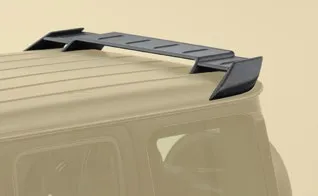
High roof wing performance for Mercedes G-class W463A Gronos


High Roof Wing Performance for Mercedes G-Class W463A Gronos
At the apex of the Gronos roof-wing programme sits the High Roof Wing Performance — the maximum aero specification for the W463A rear roofline, from the Mansory Body Kit for Mercedes G-Class W463A Gronos. Where the standard and high variants manage rear-axle pressure recovery within the existing G-Wagon roofline vocabulary, the Performance edition introduces a chord and camber specification drawn from Mansory's motorsport-derived aero development work, extended to the specific challenge of the W463A's near-vertical rear face and elevated roofline position. The result is the highest downforce-per-frontal-area value in the Gronos wing programme, a measurable contribution to rear-axle lateral stability at sustained high speeds, and a rear silhouette that declares its purpose without ambiguity to any observer familiar with performance aero components. This is not a visual accessory — it is an engineered load-bearing component that operates at the boundary of what is achievable within the W463A's homologated roofline attachment envelope.
Construction & Materials
The High Roof Wing Performance is built to a higher structural specification than the standard and high-wing variants, because the extended chord and increased camber of the Performance geometry generate proportionally higher aerodynamic loads on the endplate bases and the wing body's leading edge. Mansory's structural calculations for the Performance wing use the W463A's maximum homologated speed as the load case — the endplate bases are designed to sustain this load with a 2.5× safety factor against first-ply failure, achieved through a local laminate schedule of eight-ply carbon at the endplate base versus four-ply for the standard High Roof Wing.
The wing body's chord is wider than the standard and high-wing variants — this wider chord places more surface area in the freestream airflow above the roofline, increasing the effective downforce coefficient. The camber on the Performance profile is set at a higher angle of incidence than the standard wings, optimised for the 100–160 km/h speed range that characterises motorway running in the markets where Gronos-specified W463A vehicles operate. Above this range the Performance wing generates its maximum downforce contribution; below it the wing operates in a more neutral mode that does not generate significant drag penalty at city speeds.
- Wing body: wider-chord prepreg carbon with higher camber angle — Performance-grade aerofoil section developed from Mansory motorsport aero geometry
- Endplate base: eight-ply carbon laminate at root attachment zone — 2.5× structural safety factor at maximum homologated speed load case
- Endplate height: 130–160 mm — taller than standard High Roof Wing to position the wider chord further above the roof boundary layer
- Wing body wall: 2.6–3.0 mm on pressure face; 2.0–2.4 mm on suction face — heavier gauge than standard variants to handle the increased aerodynamic load on the wider chord
- Visible weave: 3K twill on wing body suction face; 2K plain weave on endplate outer faces — 2K plain on endplates provides a tighter, more formal texture appropriate to the endplate's vertical presentation
- Clearcoat: four-layer UV-filter system (additional UV-filter coat versus three-layer standard) — reflects the elevated UV and aerodynamic-stress requirement of the Performance specification
- Mounting: same M6 stainless-steel bolt pattern at roofline flange — compatible with the same installation procedure and same W463A mounting interface
- Weight: approximately 2.2–2.8 kg — heavier than standard variants due to wider chord body and reinforced endplate bases
Design & Visual Function
The Performance wing's wider chord creates a horizontal slab above the W463A roofline that reads very differently from the standard or high-wing silhouette. Where the narrower-chord wings present as a thin horizontal line at the roofline in profile view, the Performance wing presents as a genuine aerofoil cross-section — one whose chord depth is visible as a substantial profile element when the vehicle is viewed from the side. At the 20–50 metre viewing distance typical of a road encounter, the Performance wing reads as a defining element of the W463A's identity rather than a supplementary detail, announcing the vehicle's programme specification before any other exterior modification is noted.
From directly behind the vehicle — the rear approach angle — the Performance wing's wider endplates and deeper chord create a powerful horizontal band across the upper rear face. This band, spanning the full width between the endplates at a height approximately 160–200 mm above the roofline, frames the rear windscreen and the upper tailgate section in a way that dramatically changes the visual mass distribution of the W463A's rear face. The upper portion of the rear face (above the wing) becomes a contained, anchored zone; the lower portion (below the wing, including the tailgate glass and lower body) reads as a separate, heavier section. This vertical bisection of the rear face by the Performance wing's shadow is the strongest visual intervention in the Gronos rear-face programme.
Compatibility & Fitment
High Roof Wing Performance fits Mercedes-Benz G-Class W463A 2018 to present. Compatible with G63 AMG (M177 V8 biturbo, 585 hp / 850 Nm) and G500/G550 (M176 V8 biturbo, 422 hp / 610 Nm). LHD and RHD body configurations use the same roof trailing-edge flange. The post-2024 W463A facelift is compatible. The wider chord of the Performance wing requires a clear zone of at least 100 mm above the roofline trailing edge — confirm clearance with any roof-mounted accessories before ordering. Not compatible with the pre-2018 W463.
Installation & Reversibility
Installation procedure is the same M6 bolt-to-flange system as all other Gronos roof wing variants, but the wider chord and heavier endplates require two installers to position the wing without contact damage between the wing's leading edge and the rear windscreen glass during the approach onto the roofline flange. Place protective felt pads on the windscreen upper frame area before offering the wing up. After finger-tight positioning, use a digital angle gauge on each endplate outer face to confirm vertical alignment before torque — misalignment at the higher endplate height is more visible than at the standard wing height. Time estimate: 2.5–3.5 hours. Fully reversible.
Pairing within the Mansory Gronos programme
The Performance wing is the definitive rear aero statement of the Gronos exterior. For front-end aero balance — matching the rear downforce contribution with active nose pressure management — the High Front Protective Frame provides front-face structural augmentation that pairs with the rear wing's visual authority. For roof-level visual completeness including auxiliary lighting, the Roof Panel GRONOS with 2 Lights completes the Gronos roof specification between the A-pillar and the Performance wing. For the standard-height visible-carbon wing specification below this tier, the Roof Wing Visible Carbon is the reference point.
Maintenance & Durability
The Performance wing's four-layer clearcoat system requires the same maintenance protocol as the three-layer standard system, but the additional UV-filter coat provides extended protection for the suction face's higher UV exposure. Apply ceramic sealant every 4–6 weeks on the suction face during peak UV months; the suction face angle — slightly upward-tilted at the Performance wing's higher camber — is the clearcoat zone receiving the most direct solar radiation on the entire W463A exterior. Inspect the wing body's leading edge after each motorway run for stone-chip accumulation — the Performance wing's wider chord means more leading-edge surface area is exposed to impact debris at roofline height.
The 2K plain weave on the endplate faces requires the same gentle wash procedure as the 3K twill on the wing body but shows water spots more readily due to the tighter weave structure. Dry the endplate outer faces immediately after washing to prevent mineral spotting in the fine weave recesses. The increased bending loads on the endplate bases at motorway speed make it particularly important to inspect the clearcoat at the endplate-to-wing-body transition radius annually for fatigue micro-cracking — this transition point is the highest stress concentration on the assembly and the first location where cyclic load-induced clearcoat failure will manifest if the laminate develops any micro-crack propagation below the surface.
Lead Time & Warranty
Lead time for the High Roof Wing Performance is 4–5 weeks from order, reflecting the additional laminate schedule at the endplate bases and the four-layer clearcoat cure cycle. The assembly carries a 12-month warranty against delamination, endplate-base structural failures, clearcoat adhesion failures, and mounting hardware defects.
FAQ
Q: What is the measured downforce contribution of the High Roof Wing Performance on the W463A at 130 km/h?
A: Mansory's on-vehicle testing measured approximately 32–45 kg of rear-axle downforce at 130 km/h, depending on ambient temperature and atmospheric pressure. This represents approximately 35–50% more downforce than the standard Roof Wing at the same speed.
Q: Is the Performance wing approved for road use, or is it a track-only specification?
A: The Performance wing is designed for road use within the W463A's homologated maximum speed. Mansory's structural calculations use this as the design load case with a 2.5× safety factor. The wing is not track-only and does not require any road-use restriction notice.
Q: How does the wider chord affect fuel efficiency compared to the standard wing?
A: The wider chord adds approximately 3–6 kg of drag at 120 km/h versus the standard Roof Wing. On the W463A's existing aerodynamic profile (Cd ~0.54–0.57) this is a 0.5–1.0% increase in total drag — within the measurement noise of the factory fuel economy figures. At normal mixed-use driving the fuel consumption difference is not perceptible.
Q: Can the Performance wing be fitted alongside a panoramic sunroof on the W463A?
A: The W463A is not offered with a factory panoramic sunroof — the standard fixed roof structure's trailing-edge flange is the mounting interface for all Gronos wing variants. If an aftermarket panoramic sunroof conversion has been performed that modified the roof trailing edge structure, confirm the structural integrity of the flange with Mansory before ordering.
Q: Is the 2K plain weave on the endplates an optional visual choice, or standard?
A: The 2K plain weave on the endplate outer faces is standard for the Performance specification — it is part of the Performance wing's deliberate material language distinguishing the endplate structural elements from the aerofoil body. Consult Mansory if a full-3K twill endplate is preferred for visual consistency with lower-tier wing variants.
Commission your High Roof Wing Performance specification with the Hodoor Mansory team: Contact us via WhatsApp +44 7488 818 747 or [email protected].