
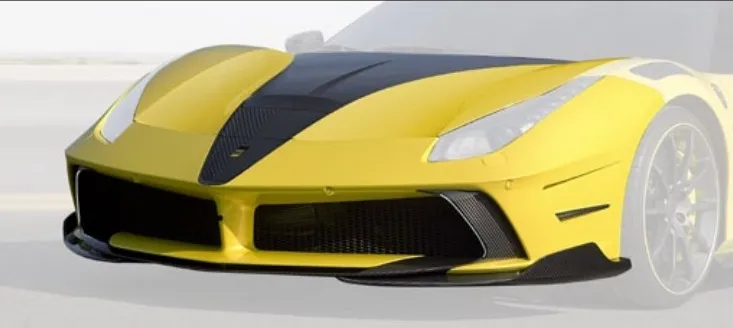
Front kit 4xx low flap Mansory Carbon for Ferrari 488 Siracusa 4XX


Front Kit 4xx Low Flap — Mansory Carbon for Ferrari 488 Siracusa 4XX
The 4xx low-flap front kit is the road-biased version of the Mansory front aero for the Ferrari 488 Siracusa programme. It replaces the entire factory front bumper with an autoclave-cured carbon shell and carries a shallow leading flap along the bottom edge of the splitter. Within the wider Mansory Carbon Fiber Body kit set for Ferrari 488 Siracusa 4XX kit this part defines how the car meets the air at speed: the geometry is set up to keep flow attached across the lip rather than to deliberately stall and redirect it the way the high-flap variant does. Owners pick this version when they want the visual presence of the Siracusa programme without giving up daily-driver ride height, kerb clearance and motorway composure. It is the front aero you fit to a 488 that still has to live with speed bumps, valet ramps and long autostrada runs at three-figure speeds.
Construction & Materials
The bumper is laid up over a male tool taken directly from the OEM nose so every locator, sensor cut-out and crash-bar mounting point lands on factory geometry. The flap is co-cured into the splitter rather than bolted on as a separate part, which is why the leading edge reads as a single uninterrupted carbon line under bonnet light and why it cannot rattle loose against the under-tray fasteners. The lay-up is biased for stiffness near the leading edge, where pressure peaks at speed, and softer through the inboard cheeks where the bumper has to absorb occasional kerb contact without cracking the laminate.
The whole shell is one continuous prepreg surface — there are no overlap joints visible from the outside, and the trim line at the wheel arch is rolled rather than cut so the carbon does not show a raw edge against the tyre.
- Outer ply: 3K 2x2 twill aerospace prepreg, weave centred on the car centreline so the diagonals run square to the splitter trim
- Backing: bias-laid 200 gsm carbon plus localised unidirectional reinforcement under the splitter and around the radar cut-out
- Cure: full autoclave cycle, ramp to 125 °C with 6-bar consolidation pressure, 90-minute dwell
- Resin: high-Tg epoxy rated for sustained sun-load on dark carbon, 150 °C continuous service
- Wall thickness: 2.4–2.8 mm across the bumper face, stepped to 4.0 mm through the splitter and flap leading edge
- Mounting: OEM bumper carrier, OEM crash-bar bolts, OEM under-tray fasteners — no chassis modification
- Hardware: stainless ferrules pre-bonded at every fastener so the laminate cannot crush under torque
- Finish: deep gloss 2K clear as standard, satin matte on request, exposed-weave matte black available
Design & Visual Function
The low flap is not a styling concession — it is a specific aerodynamic choice. A shallow flap presents a small angle of attack to the oncoming flow, so the boundary layer stays attached along the splitter and the air leaves the underside still energised rather than tumbled. That matters at the front of a mid-engined car like the 488: the flow that exits the splitter has to travel under the floor and feed the rear diffuser cleanly. A high-flap profile separates flow earlier and dumps energy in front of the wheel — useful on a track where peak downforce matters more than balance, but counterproductive on a road car where the front and rear have to stay matched.
The visible geometry follows that aerodynamic logic. The splitter projection is around 35–40 mm forward of the OEM nose line, the flap rises by roughly 18–22 mm and the leading-edge radius is generous rather than sharp, all numbers chosen to keep the front pressure coefficient close to the OEM Siracusa baseline rather than chasing peak load. Estimated steady-state front-axle download at 250 km/h is in the order of 12–18 kg over the OEM bumper, distributed broadly rather than concentrated at the lip.
Visually, the low flap reads as a clean horizontal line that wraps around the corners of the splitter into the wheel-arch openings. The carbon weave is square to that line, so when the car is photographed from the front three-quarter the eye picks up a continuous diagonal grid running across both the bumper face and the splitter top — the sort of detail that separates a properly tooled Mansory part from generic aftermarket fibreglass. Mansory branding is laser-etched into the lacquer near the corner of the splitter, not silkscreened on top, so it cannot peel.
Compatibility & Fitment
The kit fits the Ferrari 488 GTB coupé and the 488 Spider across model years 2015–2020 with the 3.9-litre V8 twin-turbo. The OEM front bumper carrier, the parking-sensor harness, the radar bracket and the under-tray fasteners are all reused without modification. Cars with the factory front-axle lift system retain full lift travel — the splitter projection has been tuned specifically so that maximum lift still clears a 1-in-6 driveway ramp without scraping. If the car is running aftermarket suspension that drops front ride height below the OEM Siracusa figure, send the measured ride height before ordering and we will confirm clearance against the splitter underside profile.
Installation & Reversibility
The bumper swap is a half-day job for a competent body shop. Remove the OEM bumper as a complete assembly — eight bolts plus the wheel-arch liners — transfer the parking sensors, radar bracket and grille mesh into the new carbon shell, then re-fit. The crash-bar geometry is unchanged so the airbag system sees the same impact path it would on the OEM bumper. Total bench time is around three to four hours including sensor calibration. Reversibility is total — the OEM bumper goes straight back on with the same bolts if the car is ever returned to factory specification for sale or insurance work.
Pairing within the Mansory Ferrari 488 Siracusa programme
Most owners who fit the low-flap front pair it with the matching Rear kit 4xx low flap so the front and rear aero balance is preserved end-to-end — fitting one end without the other biases the car toward whichever axle was upgraded and undoes the careful balance the kit is tuned around. The skirts that round out the road-spec stance are the Side set low flap, which seal the underbody flow between the front splitter and the rear diffuser. If the build later wants more rear download for occasional track days, the Rear wing can be added without re-tuning the front, because the low flap leaves enough margin in the front pressure map to absorb extra rear load without pushing the car into understeer.
Maintenance & Durability
The bumper lives in the worst part of the car for stone chips, but the lacquer system is specified for that environment. After a long motorway run wash with pH-neutral shampoo and a soft mitt — avoid pressure washers within half a metre of the splitter leading edge, where the high-pressure jet can lift lacquer at a chip site. UV-stable 2K clear holds colour and weave clarity for the life of the car under normal exposure. Stone chips can be touched in by any decent paint shop without disturbing the laminate. Expected service life under road use is well beyond ten years.
Lead Time & Warranty
Each bumper is laid up to order rather than pulled from stock. Typical lead time is 3–4 weeks from confirmed order, longer if a satin or exposed-weave matte black finish is specified because those finishes require an additional flat-and-cure step. The part carries a 12-month warranty against manufacturing defects covering laminate voids, delamination, ferrule pull-out and clearcoat lift; impact damage and chemical attack from aggressive cleaners are excluded.
FAQ
Q: How does the low flap differ from the high flap aerodynamically?
A: The low flap presents a shallow angle of attack and keeps flow attached along the splitter, biasing front balance toward calm, predictable behaviour at road speeds. The high flap deliberately forces flow separation for a higher peak download at the cost of a steeper drag rise.
Q: Can the OEM front-axle lift system still clear ramps?
A: Yes. The splitter projection is calibrated specifically so full lift travel still clears a 1-in-6 ramp without contact.
Q: Will the parking sensors and front radar still work?
A: Yes. The sensors and radar transfer into the carbon shell using the OEM brackets and require no recalibration beyond the standard self-learning cycle the car runs on first drive.
Q: Does it fit the Spider as well as the GTB?
A: Yes. The front-end geometry is shared between coupé and Spider so the bumper crosses freely between body styles.
Q: What downforce gain should I expect?
A: In the order of 12–18 kg of additional front-axle download at 250 km/h over the OEM bumper, distributed broadly rather than as a peak figure.
Order the front low flap together with the matching rear low flap and side set so the car carries one consistent aero language end-to-end. CTA: WhatsApp +44 7488 818 747 or [email protected].