Front fenders Mansory Carbon for Rolls-Royce Cullinan Coastline


Front Fenders — Mansory Carbon Cullinan Coastline
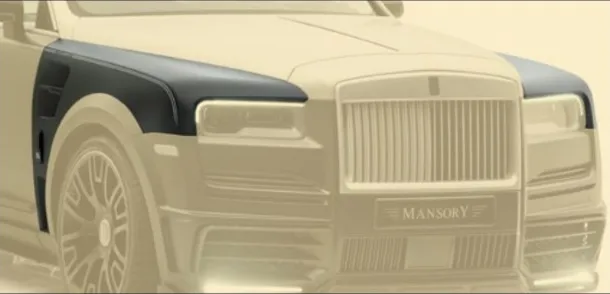
The Mansory Carbon front fenders are the panels where the Coastline programme finally announces itself in the metal — except, of course, there is no metal. These are full bespoke composite wings for the Rolls-Royce Cullinan Coastline, replacing the OEM aluminium pressings on either side of the engine bay and rewriting the geometry of the Cullinan's shoulder line in autoclaved twill. They are part of the broader Mansory Body Kit for Rolls-Royce Cullinan roster — a complete carbon programme for the only SUV Rolls-Royce has ever built, sitting on its 6.75-litre twin-turbocharged V12, ZF satellite-aided eight-speed automatic, AWD with rear-wheel steering, coach doors, Spirit of Ecstasy mascot and Starlight headliner. The fenders integrate functional side air outlets that vent V12 underhood heat, and they sculpt a shoulder crease that flows uninterrupted from the Pantheon grille across the engine bonnet bar and down the flank toward the D-pillar.
Construction & Materials
Each fender is laid up as a full structural panel rather than a cosmetic overlay. The blank is taken directly off a CNC-machined master that mirrors the OEM fender's mounting geometry, then drape-formed with multiple plies of pre-impregnated carbon and a closed-cell PMI core in the wheel-arch return for stiffness. The result is a panel that holds its line under door-shut pressure, hot-day sun and motorway cross-wind without flexing or groaning at the A-pillar interface.
The lay-up is finished to the same paint or exposed-weave brief as the rest of the Coastline carbon package, with the side air-outlet louvres trimmed and back-painted in matt black so the slot reads as architectural rather than decorative.
- Outer skin: 3K twill 2x2 prepreg, weave aligned vertically across the fender shoulder so it runs parallel to the Pantheon grille bars.
- Cure: full autoclave cycle, ~120°C / 6 bar, post-cure tempering for dimensional stability through summer underhood soak.
- Core: PMI closed-cell foam in the inner wheel-arch return; aluminium honeycomb local reinforcement around the headlamp and door-hinge pickup points.
- Wall thickness: 2.4–3.2 mm on the outer skin, stepped up to ~6 mm at hinge bosses and parking-sensor cones.
- Mass per side: ~3.6–4.2 kg depending on outlet trim spec, against ~6.8 kg for the OEM aluminium pressing — a meaningful drop in unsprung-adjacent mass at the front axle.
- Hardware: OEM-spec fastener pattern retained, stainless captive nuts bonded into the inner skin, EPDM gasket strip along the bonnet shut-line.
- Finish: deep-gloss UV-stable lacquer over weave, or matched to a bespoke Rolls-Royce coachwork colour, or the Coastline two-tone painted-lamel treatment for the air-outlet blades.
- Side-outlet mesh: laser-cut anodised aluminium honeycomb backed with stainless debris guard, painted satin black behind the carbon louvres.
Design & Visual Function
The Cullinan's OEM front fender is dignified but reserved — a clean shoulder line that respects the Spirit of Ecstasy and the Pantheon grille without competing with them. Mansory's Coastline fender takes that same restraint and quietly widens the stance, flares the wheel-arch lip by a few millimetres for the larger Mansory wheel package, and cuts a louvred outlet aft of the wheel where heat actually wants to escape. The shoulder crease is sharpened so it carries the eye from the leading edge of the Pantheon grille, across the bonnet bar, down the fender top, and into the front door without a stutter.
The side air outlets are not decoration. They sit directly above the wheel-arch liner, in the low-pressure pocket aft of the front wheel, and vent hot air pulled through the V12 bay by the engine's twin turbochargers and intercooler circuits. On a 2.66-tonne SUV that can be specified to 600 hp in Black Badge form, that ducted relief is a real thermal benefit on long high-speed waft sections — the bay runs cooler, the under-bonnet wiring sees less soak, and the brake-cooling airflow at the front wheel is less polluted by recirculated heat. None of that disturbs the magic-carpet ride; it simply means the carpet stays cool.
Visually, the louvre slot is set into the fender so it reads as a horizontal punctuation, deliberately echoing the Pantheon grille verticals on the front mask without copying them. The outer carbon blades can be left in raw twill so the weave catches morning light, or two-tone painted in a bespoke Coachline accent for the Coastline programme — same matrix language Mansory uses on the ambient grille lamels, carried back along the flank.
Compatibility & Fitment
Designed for the Rolls-Royce Cullinan from 2018 onwards, both Standard and Black Badge, including Series II Coastline cars after the MY2024 facelift. Sized exclusively for the Cullinan front mask, fender-to-A-pillar shut-line and bonnet-to-fender shut — they will not fit Phantom, Ghost or Wraith. The panel retains the OEM front parking-sensor cones, fender repeater-lamp aperture, ambient bonnet pinstripe geometry on cars specified with the illuminated bonnet bar, headlamp washer jets, and the air-suspension self-levelling sensor lead-through. Coach-door hinge clearance and the front wing-to-door cutline are preserved exactly. Series I and Series II differ slightly in headlamp-cutline radius — specify build year at order so the correct master is used.
Installation & Reversibility
Estimate 6–9 hours per side for a Rolls-Royce-certified body shop or Mansory-trained installer. The OEM aluminium fender comes off through the front door aperture and the underbonnet hinge boss; the Mansory carbon panel mounts to the same factory pickup points with stainless captive hardware. Parking-sensor harness is unclipped and re-routed unchanged into the carbon panel; the side-outlet mesh and inner liner are dressed before final torque. If the fenders are specified body-coloured rather than exposed weave, painters should follow Rolls-Royce coachwork prep — flat, two-tone if specified for the Coastline lamel treatment, then UV-stable lacquer. The conversion is fully reversible: the OEM fenders can be refitted at any future date without trace, since no factory bodywork is cut and no pickup points are modified. Air-suspension self-levelling sensor calibration should be checked after refit because the sensor lead-through grommet sits in this panel.
Pairing within the Mansory Cullinan Coastline programme
Front fenders are the third panel in the front-mask carbon trio and almost always specified alongside the bonnet and grille frame. Recommended pairings: the Engine Bonnet with Bar (Exposed) Mansory Carbon so the bonnet shoulder crease meets the fender shoulder crease in one continuous line across the front of the car; the Widebody Kit Mansory Carbon so the wider arch geometry is consistent fender-to-rear-quarter rather than only at the front; and the Air Intakes Cover Mansory Carbon on the front bumper so the front-mask carbon vocabulary reads as one composition from the Pantheon down to the splitter.
Maintenance & Durability
Lacquered carbon on a luxury SUV used as both school-run and long-distance car sees more rock-chip exposure than a coupé would — that is the honest reality of front fenders on a car that lives on motorways and gravel hotel driveways. Specify clear PPF over the leading edge of each fender and the wheel-arch lip; refresh every 36–48 months. Wash with neutral pH shampoo and a soft mitt only — never alkaline traffic-film removers, ammonia-based glass cleaners drifting onto the lacquer, or any abrasive sponge. Carnauba or hybrid SiO2 sealant gives the lacquered weave its depth; ceramic coating extends UV protection but should be applied only after a full cure cycle on freshly painted panels. Side-outlet mesh should be vacuumed and brushed at every service to prevent leaf-litter and pollen building up in the duct. If a chip ever does breach the lacquer, repair is a localised gel-coat repair plus relacquer at a Rolls-Royce coachwork shop — Mansory holds matching prepreg lots in archive for at least three production seasons.
Lead Time & Warranty
Lead time is typically 4–8 weeks from order confirmation, reflecting Mansory bespoke production cadence and the autoclave cycle for full structural panels. The fenders are covered by a 12-month warranty against manufacturing defects. Custom finish briefs (specific Coachline two-tone painted lamels, specific bespoke Rolls-Royce coachwork colours, or layered metallic-over-weave finishes) may extend lead time slightly and are quoted individually.
FAQ
Q: Do the fenders fit Black Badge as well as Standard Cullinan?
A: Yes — both Standard and Black Badge use identical front-mask metalwork from 2018 onwards. Specify Series I or Series II Coastline at order so the correct headlamp-cutline master is used.
Q: How much weight is saved compared with OEM aluminium fenders?
A: Roughly 2.6–3.2 kg per side depending on outlet trim spec — a small but real reduction at the front axle, exactly where you want it on a 2.66-tonne SUV.
Q: Do the side air outlets actually vent twin-turbo V12 heat or are they cosmetic?
A: They are functional. The slot sits in the low-pressure pocket aft of the front wheel and connects to the engine bay via a backed honeycomb mesh, so hot air pulled through the V12 bay can exit cleanly rather than recirculating around the intercooler ducting.
Q: Are the OEM parking sensors and fender repeater retained?
A: Yes. The carbon panel reproduces the parking-sensor cones, the repeater-lamp aperture and the headlamp-washer jet positions exactly. The OEM harness re-clips into the carbon shell unchanged.
Q: Raw exposed weave or painted to coachwork?
A: Both are catalogue options. Exposed twill keeps the carbon vocabulary visible and pairs naturally with an exposed bonnet bar; coachwork colour keeps the Coastline character quieter. The two-tone painted-lamel treatment can also be applied to the outlet blades only.
Q: Air suspension and ride-height — does the panel affect approach angle?
A: No. The fender geometry sits above the front bumper line, so approach angle on the air-suspension off-road setting is unchanged. The self-levelling sensor lead-through is preserved.
Specify with the engine bonnet, grille frame and air intakes cover for a coherent front-mask carbon composition. To configure spec, finish and lead-time, contact WhatsApp +44 7488 818 747 or [email protected].