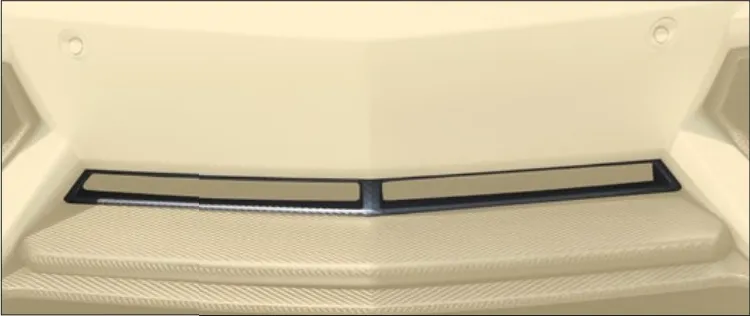
Front bumper grill Mansory Carbon for Lamborghini Aventador


Front Bumper Grill Mansory Carbon for Lamborghini Aventador
The Lamborghini Aventador's front bumper integrates a large central lower grill opening that serves the car's radiator and front brake cooling ducts — a functional aperture that is also one of the most photographed design elements on the car's face. Mansory's carbon front bumper grill replaces the factory painted-plastic or black-mesh treatment with a structural carbon framework that elevates this aperture from a functional necessity to a design centrepiece. Part of the Mansory Carbon Fiber Body kit set for Lamborghini Aventador, the carbon grill is among the most visually impactful single components in the programme relative to its surface area — because it occupies the geometric centre of the car's most scrutinised frontal view.
Construction & Materials
A front bumper grill presents an unusual carbon manufacturing challenge: the grill bars and surrounding frame must be thin enough not to obstruct airflow into the radiator and brake cooling ducts, stiff enough to retain their geometry under the aerodynamic stagnation pressure that builds at the bumper's leading face, and visually refined enough to carry the Mansory programme's quality standard in the most viewed part of the car. Mansory resolves all three requirements through a precision multi-piece carbon assembly — grill bars and surround frame are co-cured into a single assembly to eliminate the mechanical joints that would otherwise be visible and vulnerable to fatigue.
- Grill bar weave: 2K plain — tighter fibre pitch preserves bar width accuracy and eliminates the cloth waviness that can distort the weave pattern on thin curved sections
- Frame surround weave: 3K twill — visual priority on the wider frame faces that frame the aperture
- Cure: Autoclave, co-cured assembly — bar-to-frame joints fully integrated
- Grill bar wall thickness: 1.2 mm — maintains 3 mm bar face width visible from the front
- Frame wall thickness: 2.5 mm on outer frame, 1.8 mm on inner bar support ribs
- Effective open area: greater than 75 % of aperture area — preserves radiator airflow within 2 % of the factory open mesh
- Finish: high-gloss UV-clear lacquer on all forward-facing surfaces; satin lacquer on rear-facing surfaces
- Mounting: snap-fit into OEM bumper aperture frame with secondary stainless-wire retention at four corner points
- Weight: approximately 0.45 kg
The 75 % minimum effective open area is a critical specification for a car with the LP 700-4's cooling requirements. The V12's radiator is undersized relative to the engine's thermal output by motorsport standards — it relies on the full frontal aperture remaining unobstructed in all operating conditions. Mansory's grill preserves this aperture fraction by designing bar widths to the minimum structurally viable dimension for the carbon laminate thickness, rather than optimising bar width for visual preference as a purely cosmetic grill designer might.
Design & Visual Function
The front bumper grill is the face the Aventador presents most directly at eye level — standing in front of the car, the grill is the first detail the eye settles on after taking in the overall silhouette. Mansory's carbon replacement transforms this focal point from a practical mesh into a woven grid of extraordinary visual complexity: each carbon bar reflects the overhead light differently depending on the weave orientation relative to the viewer, creating a moiré depth effect that shifts continuously as the viewing angle changes.
The grill's depth — the distance between the forward bar face and the aperture's inner edge — is significant: at 35 mm, it creates shadow lines behind each bar that increase the apparent thickness of the grill framework in side lighting. This shadow play gives the grill a three-dimensional presence that flat mesh treatments cannot achieve. In direct sunlight the forward bar faces read as bright highlights; in shade they become the darkest element on the car's front face, anchoring the composition against the reflective painted panels above.
The surround frame's 3K twill weave matches the Mansory front bonnet and body kit elements — maintaining visual material consistency across the full front face of the car. Owners who have specified multiple Mansory components will notice that the grill's frame weave aligns at the bumper edge with the bonnet's leading edge weave, creating a continuous material narrative at the most prominent seam on the car's exterior.
Compatibility & Fitment
Designed for the Lamborghini Aventador LP 700-4 (2011–2016) and LP 720-4 50° Anniversario. The front bumper grill aperture geometry is shared between coupé and Roadster — one grill fits both body styles. The Aventador S (MY2017+) uses a revised front bumper with a different grill aperture shape; the Mansory S programme covers that model. Both LHD and RHD cars use identical front bumper geometry at the grill aperture.
Installation & Reversibility
Grill installation is a short procedure — the snap-fit frame engages with a firm press into the OEM aperture, with four stainless retention wires securing the corners. Total installation time is 30–45 minutes including removal of the factory grill, cleaning of the aperture frame edge, and wire-retention verification. No tools beyond a trim tool and needle-nose pliers for the retention wires are required. The factory grill reinstalls on the same mounting system — full reversibility. This is the programme's simplest visual upgrade and the one with the highest visual-impact-per-hour-of-installation ratio.
Pairing within the Mansory Aventador programme
The front bumper grill pairs naturally with the front bumper air intake — together they complete the front bumper's full carbon aperture treatment, addressing both the central grill and the lateral intake openings in the same material. Add the carbon flaps for the original front bumper to continue the carbon vocabulary across the bumper's remaining trim sections. For owners building out from the grill as the first piece, the front add-on lip is the most impactful next step — the lip's lower bumper presence and the grill's central aperture treatment together define the car's front face from ground level to mid-height.
Maintenance & Durability
The front bumper grill's forward-facing position makes it the programme's primary insect and road-debris impingement surface. Clean the grill bars at every wash session — accumulated insects and road tar between the bars restrict airflow and are considerably harder to remove after heat-cycling. Use a dedicated insect remover formulated for lacquered surfaces and a soft natural-bristle detailing brush to reach between the bars without scratching the forward face. The wire retention system at the four corners should be inspected annually — UV and thermal cycling can embrittle plastic-coated retention wire over multi-year service; replace with fresh stainless wire if any brittleness is detected. Avoid high-pressure washing directly into the grill aperture at close range; at greater than 500 mm distance and below 80 bar, pressure washing is safe for the external bar surfaces.
Lead Time & Warranty
The front bumper grill is a precision multi-piece co-cured assembly. Lead time from order confirmation is 2–4 weeks. Mansory provides a 12-month warranty against manufacturing defects including bar delamination, frame-to-bar joint failure, lacquer voids on forward-facing surfaces, and wire-retention socket cracking under normal thermal cycling. Aperture-obstruction damage from road debris — typically a bent grill bar — is a maintenance item rather than a warranty claim; individual bars can be replaced by the Mansory service centre.
FAQ
Q: Does the carbon grill affect radiator cooling performance?
A: No. The grill is designed to maintain greater than 75 % of the factory aperture's effective open area — within measurement tolerance of the factory open-mesh specification. Mansory's cooling team has verified that LP 700-4 operating temperatures remain within factory parameters with the grill installed.
Q: Can the grill be installed without removing the front bumper?
A: Yes. Access to the aperture from the front of the car is sufficient for snap-fit installation and wire retention. Full bumper removal is not required, which makes this the only Mansory front-end component installable without a lift.
Q: What happens if a stone strike damages one of the carbon bars?
A: A stone strike energetic enough to crack a 1.2 mm carbon bar will also mark the factory mesh. Mansory can supply replacement bar elements through the service programme — contact the fitting centre with a photograph of the damage to confirm the appropriate repair approach.
Q: Is the grill available in a raw (unlacquered) weave finish for a more aggressive look?
A: Yes. The unlacquered finish is available at the order stage. Note that unlacquered carbon without UV protection will yellow over multi-year outdoor exposure — Mansory recommends a UV-protective wax for raw-weave components used in high-UV environments.
Get in touch via WhatsApp +44 7488 818 747 or [email protected] for orders and specification advice.