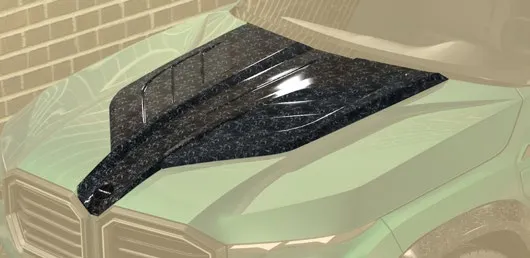
Front bonnet with logo Mansory for BMW XM


Front bonnet with logo Mansory for BMW XM
The Mansory front bonnet with logo is the largest and most structurally significant single exterior component within the Mansory Carbon Fiber Body kit set for BMW XM, replacing the BMW XM's factory steel hood with a full-carbon fibre panel that integrates the Mansory emblem as a cast-metal element bonded at the bonnet centroid. The G09 front bonnet spans approximately 1,600 mm in width and 1,200 mm in longitudinal length — a vast flat-ish surface area that, in carbon fibre, transforms the visual mass of the XM's long hood run from painted metal to a live-weave panel that shifts character under every lighting condition. The thermal management brief of the BMW XM's S68 4.4-litre twin-turbo V8 combined with the high-voltage battery inverter stack makes the bonnet's hot-air extraction geometry critical: Mansory replicates the OEM bonnet's vent apertures and leading-edge seal geometry exactly, ensuring that the S68's heat-shield region, turbocharger exit path, and cooling airflow exit routes all function identically to the factory specification. The carbon hood is approximately 40% lighter than the OEM steel unit — at the XM's ~2,750 kg kerb mass this translates to a meaningful reduction in front-axle sprung mass that M engineers cite as directly beneficial to steering response linearity.
Construction & Materials
The front bonnet uses a hybrid laminate architecture: the outer skin is 3K twill carbon cloth in 200 g/m² areal weight, maintaining the visual consistency with the lip, spoilers, and skirts of the Mansory programme. The inner skin is 2×2 twill carbon for stiffness efficiency at the closed panel section, with a structural polyurethane foam core at 25 mm thickness in the bonnet-crown section to provide the panel rigidity needed to resist front-corner pedestrian impact loading and prevent bonnet flutter at motorway speed. The leading edge and hinge-area flanges are reinforced with additional unidirectional carbon tape to handle the concentrated stress at the latch striker and hinge attachment points without the metal inserts that lower-grade composite bonnets require.
All laminate work is performed over a full-size matched-metal closed-tool set machined from a BMW XM body-measurement scan, producing the identical outer surface geometry including the XM's characteristic bonnet centre ridge, kidney-grille alignment datum surfaces, and lateral crease lines. The Mansory emblem is a hand-finished cast alloy badge bonded to the bonnet centre using a structural-grade two-component epoxy adhesive with a mechanical countersink backup — it cannot be removed without damaging the carbon skin, providing permanent emblem security.
- Outer skin: 3K twill carbon cloth 200 g/m² — visual match to lip, spoilers, skirts
- Inner skin: 2×2 twill carbon for panel stiffness at closed-section geometry
- Core: polyurethane structural foam 25 mm at bonnet crown section
- Reinforcements: unidirectional carbon tape at leading edge, hinge flanges, and latch striker zone
- Tool: full-size matched-metal closed-tool from BMW XM body-measurement scan
- Cure: autoclave 120 °C, 6 bar; 6-hour dwell for full-size panel consolidation
- Weight: approximately 8.0–9.5 kg versus ~22 kg for OEM steel bonnet (est. 40% mass reduction)
- Emblem: cast alloy Mansory badge, structural epoxy bond + mechanical countersink backup
- Finish: 2K polyurethane clear coat; the full bonnet surface is finished in a single lacquer application to avoid colour-variation boundaries
Design & Visual Function
The Mansory carbon bonnet's 3K twill outer skin covers the full 1,920 cm² of the G09 hood surface in a single continuous weave direction, producing the programme's largest single-surface carbon statement. The twill diagonal runs at 0°/90° alignment to the vehicle longitudinal axis — perpendicular to the front lip's 45° diagonal weave — creating a deliberate rotational contrast between the hood surface and the lower-body carbon elements below. This orthogonal weave relationship is a Mansory styling signature that differentiates between functional aero panels (canted weave, implying dynamic loading) and structural body panels (orthogonal weave, implying rigidity). Under overhead lighting — typical of showroom and indoor photography — the orthogonal twill produces a sharp chessboard micro-texture across the full hood surface that no painted or vinyl-wrapped alternative can replicate.
The S68 twin-turbo V8's hot-air management path exits through the bonnet's vent geometry and around the leading-edge seal. Mansory replicates these features precisely: the bonnet vent slot pattern from the OEM unit is reproduced in the carbon panel with CNC-trimmed apertures and OEM-identical vent louver templates, maintaining the S68's cooling airflow extraction through the bonnet surface. This is particularly important during hybrid-boost operation when the S68 is making maximum thermal output alongside the electric motor — unrestricted hot-air exit from the engine bay prevents temperature rise at the high-voltage battery control module located at the firewall immediately behind the S68 assembly.
The Mansory emblem at the bonnet centroid provides a focal point for the programme's visual identity that aligns directly with the kidney grille below. When viewed from the front three-quarter angle, the emblem anchors the hood's visual centre, preventing the wide flat carbon surface from reading as blank. Its cast alloy construction and polished-face finish create a metallic-versus-carbon material tension that is a recurring design theme across Mansory programmes globally.
Compatibility & Fitment
Confirmed fitment: BMW XM G09 2023-onwards, base XM (M Hybrid 644 hp) and XM Label Red / 50 Jahre M (748 hp). The bonnet replicates the OEM hinge bolt pattern, latch striker geometry, and bonnet-edge seal profile. LHD and RHD variants share identical bonnet geometry on the G09. Fitment requires transfer of the OEM gas-strut supports, latch mechanism, and sealing strip — all hardware reinstalls to the Mansory panel's pre-tapped inserts without modification.
Installation & Reversibility
Bonnet replacement is a 1.5–2.5 hour job at a workshop with a body lift or suitable support arrangement for the panel during transfer. Procedure: disconnect the OEM bonnet gas struts from the strut tips; unbolt the two hinge assemblies (4× M10 bolts each side); transfer the struts, latch assembly, and perimeter sealing strip to the Mansory panel's pre-tapped positions; refit the bonnet to the OEM hinge mount points and adjust for the 4–5 mm panel-gap tolerance at the front quarter panel joints. The OEM steel bonnet should be retained — the Mansory carbon panel is a reversible upgrade in the sense that the original bonnet can be refitted if required, and all OEM hinge and latch hardware transfers back without modification. The Mansory bonnet's reduced mass (8.0–9.5 kg vs ~22 kg) means the gas struts will operate at a higher-than-designed preload; Mansory supplies replacement lower-preload gas struts sized for the carbon panel weight as part of the kit.
Pairing within the Mansory BMW XM programme
The front bonnet with logo is naturally paired with the Logo for front bonnet Mansory for BMW XM, which provides the equivalent Mansory emblem as a standalone add-on for owners who retain the OEM steel bonnet — the two products serve the same emblem function for different bonnet configurations. For owners adding the full exterior programme, the Mirror cover LHD Mansory for BMW XM extends the 3K twill carbon surface treatment from the bonnet upward and outward to the door-mirror housings, creating a continuous carbon narrative from hood to shoulder line. The Front lip Mansory for BMW XM at the base of the same front face aligns the lower fascia carbon with the bonnet's orthogonal twill above.
Maintenance & Durability
The front bonnet is the highest-surface-area carbon component on the vehicle and requires the most attention. Its nearly horizontal upper surface accumulates airborne pollutants, bird droppings, and tree sap at a higher rate than any other panel — all of which should be removed promptly, as prolonged acidic or alkaline organic deposits will etch through the 2K polyurethane clear coat into the fibre surface within weeks at warm ambient temperatures. Maintain a SiO₂ ceramic coating on the bonnet surface at all times, refreshed every 3–4 months for outdoor-parked vehicles and every 6–8 months for garaged vehicles. Use a pH-neutral snow foam that does not exceed a 3-minute dwell time before rinsing. The Mansory emblem's polished alloy face should be treated with a dedicated metal polish and then sealed with the same SiO₂ product used on the carbon — the seal coat prevents fingerprint and water-mark accumulation on the polished metal surface. The polyurethane foam core is moisture-resistant and does not require special attention, but any delamination at the bonnet edge flange should be addressed promptly by injecting low-viscosity epoxy to prevent moisture tracking into the foam cell.
Lead Time & Warranty
The front bonnet with logo has the longest production lead time in the exterior aero programme — 4–6 weeks from confirmed order — reflecting the full-size closed-tool setup, 6-hour autoclave cure cycle, emblem bonding and cure, and comprehensive pre-delivery dimensional inspection against the body-measurement scan reference. The 12-month warranty covers outer-skin delamination, inner skin void formation, core-to-skin bond failure, emblem adhesive separation, and clear-coat crazing under normal service. The gas struts supplied with the bonnet carry a separate 12-month mechanical warranty against preload loss and seal failure.
FAQ
Q: Does the carbon bonnet pass road-worthiness inspection in all markets?
A: Mansory designs the bonnet to replicate the OEM panel's pedestrian-impact geometry, vent apertures, and seal profile. Road-worthiness assessment is the responsibility of the owner and their local inspection authority — requirements vary by jurisdiction. Mansory does not certify the bonnet for any specific market homologation, and owners should confirm local requirements before fitting if road-worthiness certification is required.
Q: Will the reduced bonnet mass affect the front-to-rear weight distribution noticeably?
A: The OEM bonnet weighs approximately 22 kg; the Mansory carbon unit weighs 8.0–9.5 kg — a saving of roughly 12–14 kg at the front axle. At the XM's ~2,750 kg kerb mass, this represents a front-axle mass reduction of approximately 0.5%, shifting the weight distribution marginally toward the rear. BMW M's adaptive damper system adjusts continuously for weight distribution changes; the change is within the self-calibration range of the adaptive M Suspension and requires no recalibration.
Q: Can I order the bonnet without the Mansory emblem?
A: The standard configuration includes the Mansory emblem bonded at the bonnet centroid. An emblem-free variant is available on special order — the bonnet centroid receives a flush-filled carbon patch in the emblem-free version. Specify at order time; the emblem cannot be removed post-production without damage to the outer carbon skin.
Q: Do the OEM bonnet insulation pads transfer to the Mansory panel?
A: Yes — the OEM insulation blanket transfers to the Mansory panel's inner skin using the replicated OEM clip locations. Retain it during the bonnet swap procedure.
Transform the front face of your BMW XM with the Mansory full carbon bonnet. Reach our team: WhatsApp +44 7488 818 747 or [email protected].