
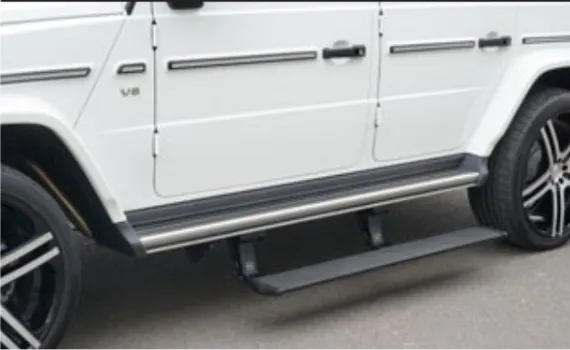
Electrical auto side steps - long Mansory for Mercedes G-class G500 / AMG G63 W463A


Electrical auto side steps - long Mansory for Mercedes G-class G500 / AMG G63 W463A
The LONG variant of the Mansory power-deploying running boards turns the W463A's slab-sided rocker zone into one continuous expedition-grade footplate, extending uninterrupted from the front wheel-arch all the way back to the rear arch. It is the part you specify when the car has been lifted, when small kids climb in and out daily, when a livery operator wants the cabin to feel like a carriage, or when a chrome-and-leather build needs a full visual baseline along the lower body. Within the wider Mansory Carbon Body Kit for Mercedes G-class W463A G500/G63 programme this is the most physical, most theatrical of all entry parts — bigger, heavier, slower-to-deploy than the SHORT version, and far more present when stowed.
Construction & Materials
The deploying rail is a single aerospace-grade extruded aluminium beam, anodised matte black, with cast end-caps and a non-slip rubber-and-aluminium tread insert running the full length. The structure is two-piece per side: an inner mounting bracket bolted to the body, and an outer rail that travels on a sealed four-bar linkage. Two synchronised electric actuators — one near the A-pillar mount, one near the rear arch — drive the rail in unison so the bar never racks or twists, even when a passenger steps on one end first.
- Rail material: 6082-T6 anodised aluminium extrusion, hard-anodised matte black
- Tread insert: TPV rubber + checker-pattern aluminium strip, full-length, replaceable as a wear part
- Wall thickness: 4.0–5.0 mm at load points, 3.2 mm along the tread surface
- Total weight per side: ~11 kg (≈22 kg pair) — heaviest of the two side-step variants
- Mounting hardware: OEM rocker bolt-points + reinforced steel sub-frame plate, M10 stainless fasteners, anti-corrosion sleeves
- Actuators: 2× sealed 12V DC linear motors per side (4 total), IP67-rated, 8 A peak / 2.5 A holding
- Linkage: four-bar geometry, sealed bushings, no greasing required for first 30,000 cycles
- Finish: matte black anodise on rail; tread cap available in bare aluminium, satin black, or full black
Design & Visual Function
Visually, the LONG step is a horizontal anchor. Where the SHORT step floats between the wheel arches and looks like a deployable footplate, the LONG step reads as architecture: it gives the W463A a continuous lower line that visually drops the body and balances the squared-off shoulders of the widebody fenders. When stowed it sits flush with the rocker, tucked tight against the body so off-road approach geometry along the side is unaffected; when deployed it forms a parallel rail roughly 220–240 mm out from the body and ~250 mm below the door sill — a comfortable single-step entry for a child, an elderly passenger, or anyone in formal wear.
Functional design notes: the bar is angled very slightly inboard at the top tread surface so water drains away from the body rather than splashing the door card. The end-caps are radiused to deflect kerb strikes rather than catch them. Underneath, a steel skid plate protects the actuators from stone-throw on lifted G-class builds where the rail sits noticeably lower than stock.
Because the LONG variant doubles as a rocker-panel guard, owners on lifted suspensions often pair it with the front protective frame and skid plates — the rail catches debris before it reaches the body, and clip-on tread sections can be swapped in matte-grey or full-black to match wheel finish.
Compatibility & Fitment
The kit fits the Mercedes-Benz G-class W463A generation (2018-onward, fourth-generation, Mercedes internal model code). Confirmed for G500, G550, G400d, G350d and AMG G63 (M177 4.0 V8 BT). Pre-2018 W463 (the original boxy G-Wagen) is not compatible — different rocker geometry, different mounting points, no factory door-trigger CAN signal. The W464/W465 platforms (Gronos and successor) use a separate step kit and are not interchangeable. Both LHD and RHD bodies are supported; the actuator looms are mirrored at assembly. Cars already wired for factory power steps benefit from a plug-and-play harness; cars without the option will need a small CAN interface module supplied with the kit.
Installation & Reversibility
Installation is bolt-on at OEM rocker mounting points — no drilling into the body, no welding. Estimated bench time is 4–6 hours per car for an experienced fitter, including harness routing, CAN module pairing, and the 3-stage delay-timer programming via the bundled diagnostic plug. The rail-side bracket clamps to existing factory threaded inserts; the inner sub-frame plate distributes load along the rocker, important on lifted cars where the step takes more dynamic loading from passengers stepping up rather than across.
Reversibility is full — remove four bolts per side, unplug the harness, and the body returns to factory state. We recommend a Mercedes-trained installer or Mansory-certified body shop for first-time fitment because the door-trigger calibration and delay-timer settings need to be matched to the specific car's door-open angle sensor (the rail must not deploy until the door is fully clear of it, otherwise the door card edge can clip the rising rail).
Pairing within the Mansory G-class W463A G500/G63 programme
The LONG step makes most sense alongside the most aggressive bodywork specs. Owners typically pair it with the panelled widebody — widebody kit with panels (Mansory carbon) — so the lower line of the rail visually echoes the lower line of the side-skirt panels. Carbon mirror caps complete the silhouette: Mansory carbon mirror housings. For owners who want both options on a single build (a daytime SHORT step for low garage clearances, swappable for the LONG step on event nights), the SHORT sibling lives here: electric auto side steps SHORT.
Maintenance & Durability
The rail itself is essentially maintenance-free. The hard anodise resists salt, brake-dust acids, and UV. The actuators are sealed (IP67) and have been validated to 30,000 deploy cycles with no greasing. What does need attention is the tread insert: grit pressed into a TPV strip eats it from underneath, so a quick rinse with neutral pH shampoo every couple of weeks keeps the rubber alive. Avoid solvent cleaners (brake cleaner, acetone) directly on the tread — they harden the rubber and shorten its life. Inspect the linkage bushings annually; if there is any side-to-side play in the deployed rail, ask the shop to replace the bushing kit (~10-minute job).
For lifted cars used genuinely off-road, check the underside skid plate after rough trips for stone strikes; replace if dented through. The aluminium rail will absorb minor kerb taps and rebound; severe kerb strikes can bend the linkage geometry — a single linkage arm can be replaced as a service item without changing the rail.
Lead Time & Warranty
Lead time on the LONG step kit is typically 4–6 weeks from order, longer than a single trim part because each rail is built to the specific car's door-trigger spec and the actuator looms are pre-tuned to the delay-timer values requested by the owner (default deploys at door 60° open, retracts 1.2 s after door close). A 12-month warranty covers manufacturing defects: actuator failure, anodise delamination, linkage bushing premature wear. The tread insert is a wear item and not warranty-covered. Kerb-strike damage and off-road impact damage are not covered but parts are stocked for fast replacement.
FAQ
Q: How is the LONG variant different from the SHORT?
A: SHORT runs roughly between the wheel arches; LONG runs the full rocker length, almost wheel-edge to wheel-edge. LONG is heavier (~22 kg pair vs ~14 kg), uses dual actuators per side (vs single), and works as a rocker-panel guard in addition to a step.
Q: Will the rail clip the door when it deploys?
A: No, provided the 3-stage delay timer is calibrated correctly during installation. The rail only begins to deploy after the door angle sensor reports the door is past 30°, and only completes once the door is past 60°. This is why the kit ships with a diagnostic plug for door-angle calibration.
Q: Does it work with a lifted G-class on 35-inch tyres?
A: Yes. In fact LONG is the variant most often specified on lifted builds because the step compensates for the higher entry height and the rail acts as a rocker guard against trail debris. Confirm exact lift spec at order — extreme lifts may need a custom mounting plate.
Q: Can I retrofit it onto a pre-2018 boxy G-Wagen?
A: No. Pre-2018 W463 has different rocker mounting geometry, no door-angle CAN signal, and a different door-card profile. The kit is W463A-only (2018+).
Q: Is there a kick-sensor option for opening with a full hand of bags?
A: Yes — an optional foot-wave sensor mounts under the rocker and triggers the step independently of the door, useful when the door is already open for a passenger and you are loading the boot.
Pair the LONG step with the panelled widebody and carbon mirror caps for the most cohesive lower-body silhouette on the W463A. Order: WhatsApp +44 7488 818 747 or [email protected].