Rear bumper air outtake cover II Mansory Carbon for Lamborghini Aventador


Rear Bumper Air Outtake Cover II Mansory Carbon for Lamborghini Aventador
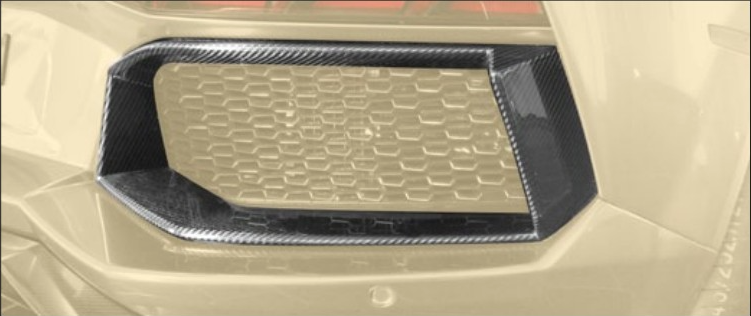
Where the standard Mansory rear bumper air outtake cover delivers a clean horizontal-blade pattern, the Cover II offers an alternative geometry — a diverging blade arrangement that opens outward from the aperture centre, adding an additional layer of visual dynamism to the Aventador's rear treatment. As a distinct element within the Mansory Carbon Fiber Body kit set for Lamborghini Aventador, the Cover II serves owners who want to push the rear-end aesthetic further while maintaining the same thermal extraction performance and high-temperature carbon construction that the programme demands from any component positioned near the V12's exhaust heat field.
Construction & Materials
The Cover II shares the material specification of the standard outtake cover — the temperature and vibration environment at the rear bumper aperture is identical regardless of blade geometry. The distinguishing feature is the tooling: the diverging blade pattern requires a more complex mandrel sequence, with each blade formed at a progressively wider angle from vertical as it moves outward from the housing centreline. This demands precise drape sequencing of the prepreg cloth to maintain fibre continuity through the blade-root junctions.
| Property | Cover II Specification |
|---|---|
| Visible blade weave | 3K twill, continuous across diverging blade faces |
| Housing surround | 3K twill, matched to adjacent bumper weave |
| Cure | Autoclave, co-cured — blade roots integrated, no bonded joints |
| Resin system | Toughened epoxy, 130 °C continuous-service rating |
| Blade wall thickness | 1.0 mm |
| Blade divergence angle | 0 ° at centre rising to 25 ° at outer blades |
| Finish | High-gloss UV-clear lacquer |
| Mounting | Snap-fit, OEM aperture — identical to Cover I |
| Weight per unit | approx. 0.38 kg |
The blade divergence geometry was adopted from motorsport-derived diffuser end-plate designs, where angling outer flow elements outward improves lateral flow separation at the rear tyre boundary — reducing the turbulent wake that would otherwise recirculate around the tyre sidewall and erode underbody suction at the diffuser's lateral edges.
Design & Visual Function
The Cover II's diverging blade pattern creates a fan-like spread of carbon lines that radiates outward from the aperture centre — an unmistakeable visual signature that differentiates it from the Cover I's orderly parallel rows. In photography the Cover II reads as inherently more dynamic: the spreading angle implies outward-directed airflow, and the asymmetric light reflection across the diverging blades creates a more complex interplay of highlights and shadows at any viewing angle.
At speed the aerodynamic effect complements this visual language: the diverging blades direct hot rear-bay air not just rearward but outward toward the rear tyre shoulders, reducing the high-temperature air concentration behind the rear wheel arches. This modest lateral spreading of the exit plume can reduce rear tyre heat soak on sustained track sessions where the Aventador's rear quarters are running hot from braking load. It is a small effect in isolation, but combined with the Mansory diffuser's underbody management and the engine bonnet's outtake at the front, the total thermal management picture is meaningfully improved.
Owners who specify the Cover II often do so for the same reason they choose the biplane wing over the standard performance wing — a preference for the more visually assertive interpretation of the Mansory programme, where form and function are in active dialogue rather than quiet equilibrium.
Compatibility & Fitment
Designed for the Lamborghini Aventador LP 700-4 (2011–2016) and LP 720-4 50° Anniversario. The Cover II uses the same snap-fit aperture interface as the Cover I — the two variants are interchangeable at the mounting level. The Roadster's rear bumper uses the same aperture geometry as the coupé. Aventador S (MY2017+) has a different rear bumper; the Mansory S programme addresses that model. The Cover II is also interchangeable with the Cover I post-installation: owners who fit the Cover I first can upgrade to the Cover II without any additional preparation work.
Installation & Reversibility
Installation follows the identical procedure to the Cover I: remove the factory bumper filler or Cover I, seat the Cover II into the OEM aperture, engage the snap-fit, and insert the retention pins. Time required: 20–25 minutes per side. The process is completely reversible — no permanent modifications to the bumper. The Cover II can be swapped back to the Cover I (or to the factory filler) at any time without tools beyond a trim tool for the snap-fit release.
Pairing within the Mansory Aventador programme
Pair the Cover II with the biplane performance wing for a rear-end specification that maximises both visual drama and aerodynamic function — the biplane's dual-element profile above, the Cover II's diverging blades mid-bumper, and the designed diffuser below form a cohesive rear aero hierarchy. The rear bridge connects the wing's lateral elements above the engine lid, completing the rear architecture for owners building the most comprehensive Mansory Aventador aero specification.
Maintenance & Durability
Maintenance requirements are identical to the Cover I. The diverging blade geometry does create slightly wider inter-blade gaps at the outer blades — these wider gaps accumulate tar and rubber spray more readily than the tightly spaced central blades. A dedicated soft-bristle detailing brush reaches between the outer blades easily; add this to the post-drive cleaning routine for cars used on track where rear tyre rubber projection onto the rear bumper is higher. The retention pins should be inspected every 5,000 km for migration — the diverging blade mass distribution creates a slightly different vibration mode than the parallel-blade Cover I, and pin retention should be verified after the first 1,000 km on a new installation.
Lead Time & Warranty
The Cover II's more complex blade geometry requires additional tooling time. Lead time is 3–4 weeks from order confirmation. Mansory provides a 12-month warranty against manufacturing defects including blade delamination, lacquer voids, and snap-fit housing cracking under normal thermal cycling. The high-temperature resin specification is verified per batch — delamination attributable to thermal exposure within the 130 °C continuous-service rating is a manufacturing defect covered under warranty.
FAQ
Q: Can the Cover II be fitted alongside the Cover I on the same car?
A: Yes — some owners specify Cover I on one side and Cover II on the other for an asymmetric rear treatment. This is unconventional but technically valid; both covers use the same aperture interface. Most owners choose one variant per pair for visual symmetry.
Q: Does the diverging blade pattern reduce effective outtake area compared to the parallel Cover I?
A: The total aperture area is identical. The diverging geometry spreads the exit plume laterally rather than concentrating it centrally — a different flow distribution, not a smaller one.
Q: Is the Cover II heavier than the Cover I due to the blade angle complexity?
A: Approximately 30 g heavier per unit — negligible on a 1,625 kg supercar.
Q: Is the Cover II available in matte finish to match a matte-wrapped car?
A: Yes. A matte UV-clear lacquer is available at the order stage. Specify before lacquering — the finish cannot be changed afterwards without re-preparation of the blade surfaces.
Contact the team via WhatsApp +44 7488 818 747 or [email protected] to confirm availability and finish options.