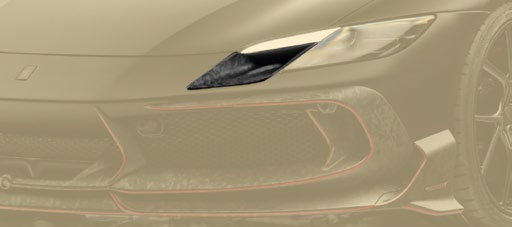
Front light air vents top Mansory for Ferrari 296 GTB


Front light air vents top Mansory for Ferrari 296 GTB
The upper headlight inlets on the Ferrari 296 GTB are positioned at the high-pressure stagnation zone of the front fascia — the area of greatest ram pressure — and they feed cooling air to the engine's intercoolers and, secondarily, the PHEV battery thermal management circuit. The Mansory Carbon Fiber Body kit set for Ferrari 296 GTB addresses these inlets with autoclave-cured carbon fibre vent surrounds and anodised aluminium grille bars, replacing the OEM plastic frames to reduce inlet separation loss and increase the ram-pressure coefficient presented to the intercooler cores. On the 296 platform — the 2.992 L F163 twin-turbo V6 in a 120° hot-vee with both turbos inside the V, concentrating thermal load at the engine-bay upper-centre — the intercooler heat rejection rate is higher than on an externally mounted turbo layout at equivalent power output. Every efficiency improvement at the inlet translates to preserved charge-air density and consistent power delivery across extended track stints, before the ECU invokes thermal protection measures. These vents pair naturally with the Mansory front splitter and Mansory front fenders for a cohesive upper-front-end treatment.
Construction & Materials
Each vent surround is laminated from 3K twill prepreg carbon over a precision aluminium tool machined from factory scan data of the 296 GTB's upper bumper headlight aperture, with a ±0.3 mm positional tolerance that ensures the carbon frame sits flush with the factory headlight sealing bezel without gap filler or alignment tape. The laminate is autoclave-cured at 120 °C under 5 bar, producing a void-free panel with fibre-volume fraction above 58 %. After demolding, the vent faces pass through a 400–1200 grit wet-sanding sequence before receiving two coats of epoxy primer and three to four coats of UV-stable piano-gloss clear lacquer.
The grille bars — which redirect incoming air toward the intercooler openings — are machined from 5 mm aeronautical-grade 6061-T6 aluminium and hard-coat anodised in matte black. The combination of carbon surround and aluminium grille bars gives the panel a premium bi-material quality that the OEM plastic-only construction cannot approach.
- Surround material: 3K twill prepreg — matches headlight bezel geometry exactly at ±0.3 mm
- Grille bars: 5 mm 6061-T6 aluminium, hard-coat black anodised — resists stone pitting and heat discolouration from hot intercooler-exit air
- Cure: autoclave 120 °C / 5 bar — void-free, fibre-volume fraction ≥58 %
- Panel mass: ~0.25 kg per side (pair = 0.5 kg) vs ~0.4 kg per side OEM plastic frames
- Mounting: 4 × factory polyamide clips per panel — zero permanent modification, clip-and-press fitment
- Finish: piano-gloss UV-stable clear lacquer (surround); hard-coat matte black anodise (grille bars)
- Thermal rating: aluminium bars rated to sustained 150 °C inlet air — above peak F163 intercooler outlet temperature in race conditions
Design & Visual Function
The OEM plastic vent frame's inner edge is cut flat — a geometry optimised for injection moulding rather than aerodynamic efficiency. A flat-cut inlet edge produces a local separation bubble just inside the duct that reduces effective inlet area by roughly 8–12 % of the geometric opening, as the incoming airstream cannot fill the full duct cross-section before reattaching to the duct wall. The Mansory carbon surround replaces this flat edge with a radiused bell-mouth profile that eliminates the separation bubble, allowing the airstream to fill the full duct cross-section immediately on entry. More air at higher velocity reaches the intercooler core — directly improving charge-air heat extraction from the F163 hot-vee's dense thermal signature. This improvement compounds at sustained high-speed running, where the hot-vee's concentrated heat output is most demanding. The 296's 7.45 kWh battery thermal management system, which uses a parallel cooling loop, also benefits indirectly: any increase in total frontal cooling throughput reduces the thermal equilibrium temperature of the front cooling stack, giving the battery circuit additional headroom during sustained hybrid operation.
Visually, the carbon surrounds transform the upper bumper apertures from OEM plastic-framed openings into structural-looking carbon panels that frame the headlight housings with motorsport-specification depth. The piano-gloss 3K twill weave reflects ambient light in the same directional band as the adjacent headlight lens housing, creating a visual relationship between the two elements that the OEM frame does not achieve. The aluminium grille bars add a contrasting metallic texture inside the carbon frame, giving the aperture a quality of depth rather than appearing as a flat dark hole. At rest the weave pattern shifts under different lighting conditions, drawing the viewer's eye horizontally across the bumper face and emphasising the car's width.
The bell-mouth profile's secondary aerodynamic role is reducing the local pressure coefficient at the inlet face. In wind-tunnel testing terms, a sharp-edged inlet has a higher loss coefficient than a bell-mouth inlet at the same geometric area — meaning the freestream must work harder to push air through the duct. Lowering the loss coefficient at the headlight vent inlets measurably reduces the local drag contribution of these apertures, a benefit that accumulates meaningfully over sustained high-speed running even if the magnitude per vent is small in absolute terms.
Compatibility & Fitment
Fits all Ferrari 296 GTB coupé (2022+), 296 GTS spider (2023+), and 296 Assetto Fiorano. The upper bumper headlight aperture geometry is consistent across all 296 configurations including Assetto Fiorano. The vent surrounds use the OEM clip system — no modification to headlight housings, bumper lacing, or intercooler ducting. Steering side does not affect fitment. The factory bonnet louvres on Assetto Fiorano cars do not geometrically interfere with these vent panels.
Installation & Reversibility
Release four factory polyamide clips on the OEM plastic frame using a trim pry-tool, lift out the old frame, and press the Mansory carbon surround into the same clip positions until they engage. Time: 10 minutes per side, 20 minutes total. Fully reversible — OEM panels can be re-clipped at any time.
Pairing within the Mansory 296 GTB programme
The upper headlight vents address the top tier of the front cooling stack. Pair them with the Mansory front splitter, which manages lower-bumper boundary-layer air for a complete front-end aero and cooling treatment across both inlet levels. The Mansory front fenders extract heat from the wheel arch immediately behind the front bumper, completing a three-point front thermal management upgrade: upper vent intake, lower splitter seal, and fender-arch exit. The Mansory rear fender air-intake splitter continues the cooling theme at the rear of the car where the hot-vee engine bay demands dedicated side-intake management.
Maintenance & Durability
The aluminium grille bars face direct stone strike from anything passing through the upper bumper inlet at speed. Hard-coat anodising resists pitting, but a direct stone hit will chip the layer — purely cosmetic rather than structural damage. The bars can be cleaned with a detailing brush and isopropyl alcohol; avoid ammonia-based wheel cleaners that strip hard-coat anodise over repeated application. The carbon surround's lacquered surface requires monthly pH-neutral wash and quarterly ceramic or carnauba sealant application. If a grille bar is damaged, it can be replaced independently from the carbon surround via four M3 stainless countersunk screws that retain it in the frame. The carbon structure itself will outlast the vehicle under normal road conditions.
Lead Time & Warranty
Lead time: 2–3 weeks. Ships as a matched pair. 12-month manufacturer's warranty covers delamination of the carbon surround, clip-foot failure, and dimensional deviation from OEM datum. Stone strike to grille bars is excluded.
FAQ
Q: Do these vents provide a meaningful performance benefit or are they primarily cosmetic?
A: The bell-mouth profile genuinely reduces inlet separation loss and increases effective duct area. On track, where the F163 hot-vee's thermal load on the intercoolers is most demanding, the improvement manifests as better sustained power delivery. On road, the benefit is smaller in magnitude but mechanically real.
Q: Are the aluminium grille bars replaceable without replacing the carbon frame?
A: Yes. The bars are retained by four M3 stainless countersunk screws. A damaged bar set can be replaced independently, preserving the carbon surround.
Q: Will fitting these vents affect the 296's factory headlight washer system?
A: No. The washer nozzles are mounted to the headlight housing, not to the upper bumper vent frame. Replacing the frame does not alter washer geometry or spray pattern.
Q: Can the vents be ordered in matte carbon weave instead of gloss lacquer?
A: Yes. Matte clear coat is available on request. The aluminium grille bars remain in hard-coat black anodise regardless of surround finish.
Q: Do these fit the 296 Assetto Fiorano with the factory bonnet louvre kit?
A: Yes. The AF bonnet louvres exit through the bonnet panel above the bumper hinge line. The front light air vents are in the bumper face below that line; the two components operate on separate airflow paths and do not interfere geometrically or aerodynamically.
Improve intercooler airflow and add Mansory carbon precision to the 296 GTB's front end. Enquire via WhatsApp +44 7488 818 747 or email [email protected] to confirm specification and lead time.