
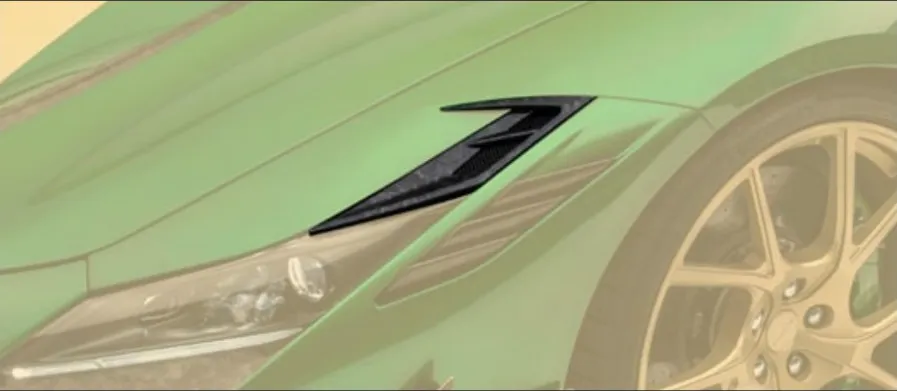
Front fender air intake Mansory Carbon for Ferrari F8 Tributo


Front Fender Air Intake — Mansory Carbon for Ferrari F8 Tributo
The front fender air intake is the carbon trim that frames the OEM extractor vent set just aft of the front wheel arch on the Ferrari F8 Tributo and F8 Spider. Functionally it manages the exit path for hot air leaving the front-brake bay, the wheel arch and the lower radiator core; visually it slots between the front-kit and the side-sirts as a small, body-coloured-or-bare-weave punctuation mark on the fender flank. Within the broader Mansory Carbon Fiber Body kit set for Ferrari F8 Tributo programme it is the part that quietly separates a fully-built F8 from a half-built one — the detail you notice on the second walk-around. Owners who already run carbon-ceramic brakes hard on track days specify it because the extractor lives where the heat actually is.
Construction & Materials
The intake trim is laid up as a thin, geometrically tight carbon shell that follows the fender's compound curvature on three axes. Mansory builds it as a one-piece moulding so the weave runs continuous across the leading edge of the vent, the upper fence and the trailing exit lip — there is no visible joint where two skins meet. The internal mesh is integrated at the cure stage rather than glued in later, which keeps the assembly stiff under high-velocity exit air at sustained track pace.
- Weave: 3K twill 2x2, fine pitch chosen to wrap the tight fender radius without distortion; forged-look option on request
- Cure: prepreg in autoclave at controlled ramp/dwell, vacuum-bag consolidation for cosmetic A-surface
- Wall thickness: ~1.6–2.0 mm across the visible shell, locally thicker at the mounting tabs
- Weight per side: ~0.35–0.45 kg, replacing the OEM painted plastic trim
- Mounting: OEM clip pattern plus 3M VHB perimeter for vibration damping at the high-flow trailing edge
- Mesh: stainless honeycomb or hex pattern, black PVD-finished, co-cured into the carbon flange
- Finish: deep-gloss UV-stable lacquer as standard; raw weave with matte UV clear on request
- Edge treatment: rolled and lacquer-sealed so the inner lip does not chip when stones flick out of the wheel arch
Design & Visual Function
The fender extractor on the F8 is one of the few overt aero cues on the car's flank — Ferrari's design team kept the side surface largely uninterrupted, which makes the vent itself read as a deliberate piece of engineering rather than ornament. Mansory's carbon trim respects that decision: the new shell follows the same intake aperture, the same fence height, the same exit angle. What changes is material — woven carbon replaces painted plastic — and the way the weave catches light along the fender shoulder line. The 3K twill is laid so the diagonal of the cloth runs roughly parallel to the body's character line, which keeps the eye moving forward toward the front wheel rather than snagging on a misaligned vent.
Functionally the part lives in a high-energy zone. With carbon-ceramic brakes working hard — they need to live on the hot side of their friction window to perform — the air leaving the front wheel arch carries serious thermal load. The extractor is the path of least resistance for that air, and a clean, sharp-edged carbon lip helps the flow detach predictably rather than tumble back into the arch. The integrated mesh also keeps debris out of the wheel-well and the front-end S-Duct ducting downstream. None of the OEM aero geometry is altered: the S-Duct intake aperture in the front bumper, its bonnet exit, the blown-spoiler rear-bumper aero — all stay exactly as Maranello signed them off.
On the Spider the part reads slightly differently because the folding hard-top changes the way light falls across the rear of the fender; the carbon catches the sun more obviously when the roof is stowed. Owners commissioning a fully colour-matched build typically paint the intake to match body colour and let only the mesh read as black; owners going for a Ferrari Challenge-flavoured aesthetic leave the carbon raw and let the weave read as an honest material statement against painted bodywork.
Compatibility & Fitment
Designed for Ferrari F8 Tributo Coupé and F8 Spider, model years 2019–2024 — the entire production run of the F154 V8 BiTurbo Tributo platform. The trim is dimensionally specific to the F8's fender geometry and is NOT compatible with the 488 GTB, 488 Pista or 488 Spider (different fender stamping, different vent aperture and a different parent kit) nor with the 296 GTB (a hybrid V6 car on a separate platform with its own dedicated fender treatment). Parking sensors, side-marker lights, the mid-engine cooling apertures aft of the door, the iconic Lexan rear-three-quarter window with longitudinal louvres and the OEM blown-spoiler rear-bumper aero are all preserved untouched. Front-side and rear-side intakes operate independently from this trim; specifying it does not constrain choice on the rest of the kit.
Installation & Reversibility
Plan on roughly 60–90 minutes per side in a clean, well-lit bay. The OEM trim is a clip-and-tab part; removal is straightforward with a plastic trim tool, taking care not to mark the fender paint along the upper edge. The Mansory shell registers onto the same OEM clip pattern, with a perimeter bead of 3M VHB tape providing the vibration-damping seal that matters once the front end is generating real downforce. Surfaces should be wiped with isopropyl alcohol and brought to body temperature before the VHB is committed; in cold weather, warm both surfaces with a heat gun on low to keep the adhesive working as the chemist intended. The job is fully reversible — there is no cutting, no drilling and no permanent bonding to the fender. A Ferrari-certified body shop or a Mansory-trained installer will turn it around inside a morning. Owners who insist on DIY can manage it with patience, but a proper alignment jig keeps the trailing exit lip flush with the fender's character line. Note that as with any non-OEM cosmetic on a current Ferrari, owners should think through how their dealer service relationship treats aftermarket bodywork; the warranty position on the powertrain is unaffected.
Pairing within the Mansory F8 programme
The fender intake is small in surface area but disproportionately effective when paired with the right neighbours. The natural triplet is the front-kit (full carbon front bumper assembly with S-Duct geometry preserved), this fender intake, and the rear-fender-air-intakes-splitter — front, mid and rear extractors all reading in the same weave, telling a single thermal story along the flank. Owners who want the front end to read more aggressively can add the race-flaps-front-bumper for a Ferrari Challenge-adjacent stance.
Maintenance & Durability
Lacquered carbon is robust but not invincible. The biggest enemies are alkaline wheel cleaners drifting across the fender during a wash, ammonia-based glass products oversprayed onto adjacent panels, and abrasive sponges used on bug-strike. Use pH-neutral shampoo, a clean microfibre mitt and a separate wash bucket for lower bodywork. A modern ceramic coating layered over the lacquer is the preferred protection — it sheds brake dust more easily and gives a sharper reading of the weave under direct sun. Carnauba is fine but needs more frequent reapplication on a part that lives this close to the brake heat plume. Carbon-ceramic brake dust is hot, glassy and abrasive; a fortnightly inspection of the inner mesh and the trailing edge of the extractor is sensible for cars that see real track use. PPF is generally not necessary on the fender intake itself because it sits behind the front wheel rather than in the stone-strike line, but owners running road-and-track schedules sometimes add a small clear film cap on the leading lip as cheap insurance. If a panel chips, repair is local: a Mansory-trained refinisher can re-lacquer the affected zone without re-skinning the whole moulding.
Lead Time & Warranty
Lead time is typically 4–8 weeks from order confirmation, reflecting Mansory's bespoke autoclave production schedule and the prepreg cure cycle. Mansory provides a 12-month warranty against manufacturing defects on the carbon shell, the integrated mesh and the lacquer system; cosmetic damage from impact, track debris or aggressive chemicals is excluded.
FAQ
Q: Does the carbon fender intake fit both the F8 Tributo Coupé and the F8 Spider?
A: Yes — the fender stamping is shared between Coupé and Spider, so the same intake trim fits either body style without modification.
Q: Will it bolt onto a 488 GTB, 488 Pista or 296 GTB?
A: No. The 488 cars use a different fender pressing and a different vent aperture; the 296 GTB is a hybrid V6 on a separate platform with its own fender treatment. This part is F8-specific.
Q: Is the integrated mesh purely cosmetic?
A: No — it is functional. It keeps stones, road debris and tyre pickup out of the front wheel arch and downstream ducting while remaining transparent enough to the high-velocity exit air that it does not choke the extractor.
Q: Does it disturb the S-Duct or the OEM aero balance?
A: Not at all. The S-Duct intake in the front bumper, its bonnet exit, the blown-spoiler rear-bumper geometry and the underfloor balance stay exactly as Ferrari signed them off. The fender extractor manages air that has already done its work in the wheel arch.
Q: Raw weave or painted to body colour?
A: Either — both are offered. Raw 3K twill under matte UV clear leans Ferrari Challenge; deep-gloss lacquer with the carbon visible is the most popular middle ground; body-colour paint with the mesh left black is the most discreet option.
Q: How much weight does it actually save?
A: A few hundred grams per side — small in absolute terms, but at the very front of the car where every gram pays double in polar moment. The headline reason to fit it is material honesty, not lap time.
Q: Can the lacquer be repaired locally if a stone chips it?
A: Yes. A Mansory-trained refinisher can spot-repair the lacquer and feather the edge without re-laying the carbon underneath, provided the weave itself is intact.
Pair it with the front-kit and the rear-fender-air-intakes-splitter for a flank that reads as one continuous carbon thermal statement. To configure a build, talk specs or arrange a workshop slot, reach the Hodoor desk on WhatsApp +44 7488 818 747 or write to [email protected].