
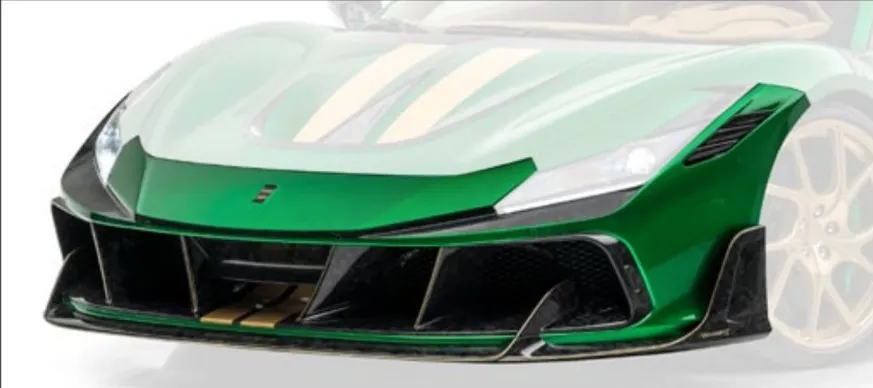
Front kit Mansory Carbon for Ferrari F8 Tributo


Mansory Carbon Fibre Front Kit for Ferrari F8 Tributo & F8 Spider
The Mansory carbon-fibre front kit is a complete replacement for the OEM front bumper assembly of the Ferrari F8 Tributo Coupé and F8 Spider, the 720 PS mid-engine V8 BiTurbo built around the F154 CB engine and the F1 dual-clutch transaxle. It is the lead aero panel of the wider Mansory Carbon Fiber Body kit set for Ferrari F8 Tributo programme, and it sets the visual register for the rest of the carbon roster — Ferrari Challenge-flavoured, motorsport-adjacent, engineered rather than ornamental. The defining mandate of the part is non-negotiable: the F8's signature S-Duct front-end aero is preserved exactly, intake aperture and exit-vent geometry untouched, with Mansory's weave wrapping around OEM ducting paths rather than rerouting them.
Construction & Materials
Production is bespoke prepreg layup with autoclave cure under controlled vacuum, the same family of process Mansory runs across its track-leaning Ferrari roster. The skin laminate is 3K twill on the visible faces with biaxial backing layers oriented to handle the bending loads a front bumper sees from airflow pressure at three-figure speeds and from low-speed scrape events on driveway lips. Wall thickness varies across the panel — thinner on the upper bumper face for weave clarity, thicker on the splitter lip and around the S-Duct mouth where stone strikes are routine.
- 3K twill carbon-fibre outer skin, 2×2 weave, autoclave-cured prepreg laminate
- Biaxial backing layers and localised reinforcement around the S-Duct aperture and brake-cooling ducts
- Wall thickness 2.0–3.2 mm depending on zone (splitter lip thickest, upper face thinnest)
- Net weight saving versus OEM front bumper assembly approximately 4.8–6.5 kg depending on options
- Mounting hardware: factory bumper-bar geometry, stainless fasteners, rubber-isolated spacers
- Finish options: deep-gloss UV-stable lacquer or exposed weave with matt UV clear
- OEM parking-sensor cones and rear-camera washer routing retained — no new apertures cut into the airflow path
- Optional ceramic-coat pre-treatment available before despatch for owners running mixed road and track use
Design & Visual Function
The F8's front-end is one of the most aero-literate noses Maranello has signed off in the past decade. The S-Duct intake — the central front-facing aperture that swallows air at the leading edge, climbs through an internal duct and exits up through the bonnet vent — is the engineered solution to a textbook problem: how to scrub drag while loading the front axle with downforce. Mansory's front kit treats that geometry as sacred. The intake aperture is reproduced one-for-one, the lip radius is preserved, and the internal duct walls follow the original cross-section. There is no aesthetic narrowing of the mouth, no splitter blade across it, no decorative carbon mesh that would choke the column.
Around that core the panel is re-sculpted in a way that reads as race-bred. The lower splitter is deepened, the side air dams are pulled forward to feed the front-fender intakes, and the brake-cooling ducts are redrawn with a sharper inboard edge to channel a tighter column of air at the carbon-ceramic rotors. The visual signature is the woven 3K twill carrying light along the upper bumper line back towards the bonnet shut, where it meets the front-bonnet panel and the S-Duct exit vent. Owners specifying the matching front-bonnet see a single uninterrupted carbon flow from leading edge to windscreen base.
Aero balance with the rest of the F8 platform is preserved by design. The OEM blown-spoiler integrated into the rear bumper is engineered around a specific front-end pressure profile, and Mansory's front kit holds that profile rather than rewriting it. Owners pairing this front kit with the rear-kit and rear-spoiler-with-wing therefore inherit a coherent front-to-rear aero map rather than a mismatched pair of statements.
Compatibility & Fitment
The front kit is engineered exclusively for the Ferrari F8 Tributo Coupé and F8 Spider, model years 2019–2024. It is not compatible with the 488 GTB or 488 Pista — the predecessor cars share family DNA but use a different front-bumper architecture and lack the S-Duct front-end aero — and it is not compatible with the 296 GTB, which is the hybrid V6 successor with its own bespoke front-end and a separate Mansory parent. Buyers cross-shopping between platforms should confirm the chassis before specifying.
OEM hard points are retained throughout: bumper-bar mounting geometry, headlight-washer apertures, parking-sensor cones, front-camera optics, brake-cooling duct routing to the carbon-ceramic discs, and the under-bumper crash-management interface. The S-Duct intake aperture and its internal duct path are reproduced to factory tolerance. The kit pairs natively with the Mansory front-bonnet (which carries the S-Duct exit vent), the race-flaps-front-bumper, and the front-fender-air-intake — the four parts together form the front-end aero suite.
Installation & Reversibility
Installation of a full front-bumper assembly is a 4–8 hour workshop job for an experienced Ferrari body technician. The OEM bumper is removed as a unit, the front-camera and parking-sensor harnesses are transferred, the carbon panel is offered up on the factory mounting points, gap and shutline are checked across the bonnet shut and the wheel-arch transitions, and the splitter clearance is set against the front jacking points and the typical driveway angle the owner reports. Recommended installer is a Ferrari-certified body shop or a Mansory-trained technician — this is not a DIY panel.
Reversibility is total. The OEM bumper carton is the natural counterpart and should be retained boxed with foam corners and the original sensor harnesses bagged. A Ferrari main-dealer service relationship is best preserved by disclosing the conversion at booking; non-OEM body parts do not void powertrain warranty, but dealer policy on bodywork claims varies and the conversation is easier had once than mid-claim.
One real-world note specific to this part: the deepened splitter sits lower than OEM, and low-speed scrape on driveway transitions, multi-storey ramps and badly cambered kerbs becomes a live consideration. Owners who park on inclines should plan a nose-lift habit even where one is not OEM-fitted, and PPF the splitter leading edge before the first drive.
Pairing within the Mansory F8 programme
The front kit is the lead member of a four-part front-end suite. Specify alongside the front bonnet so the S-Duct exit vent meets the intake aperture in a single unbroken carbon line; add the race flaps front bumper for the dive-plane element that finishes the splitter visually and aerodynamically; and pair the front fender air intake to feed the side dams in matching weave. Owners who plan to commission the full programme over time typically start here, because the front kit sets the weave register and finish that everything downstream — side-sirts, rear-kit, mirrors, engine-bay carbon — has to match.
Maintenance & Durability
Carbon care on a front bumper is harder than on any other panel because the part lives where the road throws everything it has. UV protection is the first axis: a deep-gloss lacquer on 3K twill needs an annual sealant cycle or a dedicated ceramic coat, and matt-clear exposed weave needs an SiO2 product designed for matt finishes — never a gloss carnauba on matt clear. Alkaline pre-cleaners, ammonia-based glass cleaners that drift onto the upper bumper, abrasive sponges and rotary buffers run dry will all kill lacquered carbon. Two-bucket wash, dedicated mitts, and a known carbon-safe shampoo are the baseline.
The F8 platform sees mixed road and track use, and the front splitter is the worst-affected zone on the entire car. PPF the splitter leading edge, the lower bumper face and a vertical strip up the centre of the S-Duct mouth before the first drive — track days, gravel feeder roads and rural A-roads all eat at unprotected carbon. If a chip happens, do not let water sit on the laminate edge: get it to a carbon body specialist for a controlled epoxy-and-clear repair before the damage wicks under the lacquer. Carbon-ceramic brake dust is hot and abrasive — periodic inspection of the brake-cooling duct mouths is sensible at every service interval.
Lead Time & Warranty
Lead time is typically 4–8 weeks from order to despatch, in line with Mansory's bespoke production cadence and the small-batch nature of F8 carbon work. Each panel is dimension-checked on a F8 reference jig before crating. The warranty is 12 months against manufacturing defects in laminate, finish and hardware, covering UV degradation, delamination and lacquer failure under normal use; track-incident damage, scrape damage and stone-strike chips are owner-side as is the industry norm.
FAQ
Q: Does this fit both the F8 Tributo Coupé and the F8 Spider?
A: Yes — the front bumper architecture is shared between the two body styles, so this front kit is engineered for both 2019–2024 cars without distinction.
Q: Will it fit my 488 GTB or my 296 GTB?
A: No. The 488 platform predates the F8's S-Duct front-end and uses a different bumper structure; the 296 GTB is the hybrid V6 successor with its own bespoke front-end. Both cars have their own Mansory parents and parts.
Q: Is the S-Duct intake preserved?
A: Yes — the S-Duct aperture, internal duct cross-section and exit-vent interface are reproduced to factory tolerance. The S-Duct is the signature aero feature of the F8 platform and Mansory's brief is to dress it in carbon, not edit it.
Q: How much weight does the front kit save versus the OEM bumper?
A: Approximately 4.8–6.5 kg net depending on hardware and finish options. It is not a kerb-weight headline number on its own, but combined with the front-bonnet, rear-kit and engine-bay carbon trio the saving compounds across the car.
Q: Will the splitter scrape on driveways?
A: The splitter sits lower than OEM, so the answer is honest: low-speed scrape risk is real on steep driveway transitions, multi-storey ramps and badly cambered kerbs. PPF the leading edge before the first drive and adopt a nose-lift habit on familiar problem geometry.
Q: Can the front kit be removed and the OEM bumper refitted later?
A: Yes. Reversibility is total because OEM mounting points are retained. Keep the original bumper boxed with the sensor harnesses bagged and the foam supports in place.
Pair the front kit with the front bonnet and race flaps for the full S-Duct-led front-end statement, and step the rest of the carbon programme around its weave register. To specify, request a sample finish, or discuss build sequencing for a multi-panel commission, contact WhatsApp +44 7488 818 747 or [email protected].