
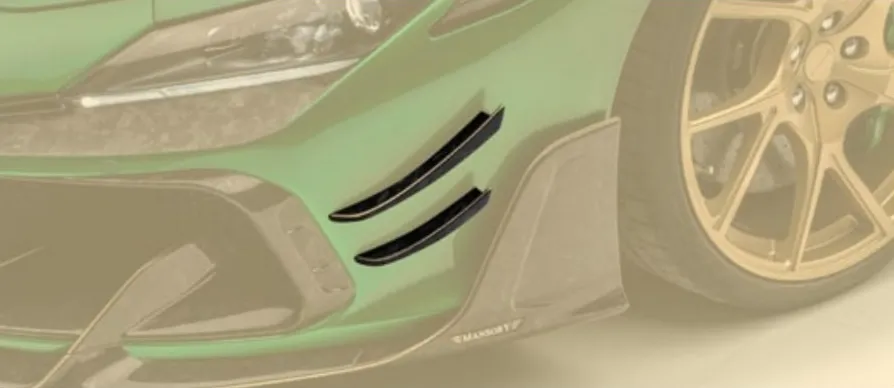
Race flaps front bumper Mansory Carbon for Ferrari F8 Tributo


Race Flaps Front Bumper — Mansory Carbon for Ferrari F8 Tributo
This is the most overtly motorsport-flavoured aero piece in the F8 roster — a pair of vertical carbon "race flap" blades that bolt onto the lower outer corners of the front bumper, just ahead of each front wheel. They are part of the Mansory Carbon Fiber Body kit set for Ferrari F8 Tributo and they translate Ferrari Challenge cup-car body language onto the road-going F154 V8 BiTurbo Tributo. The function is straightforward and honest: at high speed, the blades trip the freestream and generate localised downforce ahead of the front contact patch while turning a portion of the airflow outboard around the wheel arch. The visual cue is equally direct — these are the blades that announce, from any angle, that the car has been built up rather than just trimmed.
Construction & Materials
Race flaps live in a punishing zone. They sit low, ahead of the front axle, where every kerb, every speed-bump and every gravel-strewn pit lane meets the underside of the bumper. Mansory's part is built to load that abuse without delaminating, while staying light enough that you are not adding nose-end mass to a car whose front end was already engineered to be light.
The blades are dry-prepreg, autoclave-cured and finished to body standard, with a structural laminate that resists flex under aero load. Edges are rolled and lacquered so that the lamination does not fray when a stone clips the tip.
- 3K twill carbon weave on the outer face, weave aligned to the leading edge for visual flow
- Autoclave dry-prepreg cure for void-free laminate and consistent stiffness
- Wall thickness ~2.4–3.0 mm with localised reinforcement in the mounting flange
- Pair weight ~1.0–1.3 kg, marginal vs. OEM bumper trim — net mass impact at the nose is effectively neutral
- Stainless threaded inserts moulded into the flange so the blades cannot tear out under aero load
- Closed-cell EPDM gasket between flap flange and bumper paint to prevent witness marks
- Deep-gloss UV-stable lacquer standard; matte-clear or exposed-weave-with-UV-clear by request
- Optional internal stiffener rib for circuit-day customers who run the car at sustained 280+ km/h
Design & Visual Function
Aerodynamically the race flap is a dive-plane — a vertical/lightly-canted carbon blade that, in undisturbed flow, generates a pressure differential between its upper and lower face, producing downforce. On the F8 the blade is positioned so that it complements rather than fights the S-Duct philosophy of the standard car: the S-Duct collects air through the central front intake and routes it up and out through the bonnet vent to scrub front-end lift, while the race flap operates at the outer corners, loading the front axle locally and outboard. The two systems work in harmony — the flaps do not block S-Duct intake flow, and they do not interfere with the brake-cooling ducts that feed the carbon-ceramic discs behind the wheel.
There is a drag penalty. Any blade in clean airflow generates drag as well as downforce, and the F8's race flaps are no exception — top speed will be marginally trimmed at the very top of the rev band in seventh. For owners who care about lap time, balance, and turn-in feel, that trade is fundamentally favourable; for owners who only ever drive the F8 at autostrada cruise, the blades are primarily a visual statement and the drag is a small entry fee.
Visually the flap reads as a Ferrari Challenge nod. The leading edge is sharp, the trailing edge is finished cleanly, and the weave is aligned along the chord line so that the blade looks intentional under raking light. Combined with the front-kit and the front-fender-air-intake the F8's nose acquires a track-day silhouette without losing the OEM proportions.
Compatibility & Fitment
Engineered for the Ferrari F8 Tributo Coupé and F8 Spider, model years 2019–2024, against Ferrari's published bumper geometry. They mount to the OEM lower outer corners of the front bumper and use OEM hardpoints reinforced with structural adhesive. They are not compatible with the 488 GTB or 488 Pista (predecessor bodywork — different bumper corner geometry, different parent kit), nor with the 296 GTB (hybrid V6 successor — entirely different aero programme). The S-Duct front aperture and bonnet exit vent remain fully OEM, the parking sensors continue to function, and the brake-cooling ducts are not occluded.
One important note on type-approval. In several markets, externally-protruding aero appendages on a road-registered car require homologation paperwork, sometimes a TÜV-style technical certificate, and in some cases a body-kit declaration on the registration document. We can supply the underlying Mansory documentation; the owner's local registration regime governs how that documentation is processed.
Installation & Reversibility
Allow 2–4 hours for a careful installation by a Ferrari-aware body shop. The work is not exotic, but it is unforgiving: the flaps must be mounted in a precisely mirrored geometry left-to-right, otherwise the car will read as visually crooked from any front three-quarter angle, and at speed the aero loading will be asymmetric. The bumper corner is wiped down, the gasket is dry-fitted, the threaded inserts are torqued to spec, and the structural adhesive is allowed to cure for 24 hours before the car is driven hard.
Reversibility is a slight asterisk. Removing the flaps and refitting OEM trim will return the car to factory aesthetics, but the small mounting holes will remain in the lower bumper corner and a future paint touch-up may be needed if the original paint is matched against a non-standard colour. For circuit-day owners who alternate between road trim and track trim, that is a minor inconvenience; for owners who view this as a one-way upgrade, it is irrelevant.
Low-speed scrape risk is real. Steep ramps, painted speed-bumps, and unmarked driveway lips will all interact with the leading edge. The flaps are tougher than they look — the laminate is structural, not cosmetic — but a hard scrape on a kerb will mark the lacquer and potentially craze the leading edge. Owners who use the F8 daily in dense urban environments should mentally route around the worst geometry; track-focused owners will not notice.
Ferrari warranty considerations apply as with any non-OEM exterior part. The dealer service relationship is a personal one — many Ferrari main dealers will continue to service a tastefully Mansory-equipped F8 without issue, but the conversation is worth having with your service advisor before installation.
Pairing within the Mansory F8 programme
Race flaps belong with the front-end carbon set. The natural pairings are front-kit Mansory carbon for the F8 Tributo, which gives the bumper assembly itself a unified Mansory geometry, and front-fender-air-intake Mansory carbon, which carries the same aero-derived language onto the fender and continues the front-axle airflow story. For owners completing the front-end visual package, front-bonnet Mansory carbon closes the loop by carrying the carbon weave up over the S-Duct exit vent on the bonnet itself.
Maintenance & Durability
The lacquer is the part that needs care, not the laminate. A hand wash with pH-neutral shampoo, two-bucket method, and a soft microfibre will keep the lacquer optically clean. Avoid alkaline traffic-film removers, ammonia-based glass cleaners, and abrasive sponges — all three will dull the lacquer in a way that is hard to recover without a polish. A ceramic coating layered over the lacquer adds chemical resistance and makes road grime release in the wash; carnauba is acceptable but needs more frequent topping up.
Because the flaps sit ahead of the front wheels, they collect tar, brake dust and gravel pickup. After a track day, inspect the leading edges for stone chips, the underside flange for adhesive integrity, and the lacquer for crazing. Stone chips can be touched in by a competent paint technician; the underlying laminate is robust. PPF (paint-protection film) over the leading edge is a sensible upgrade for owners who run the car hard in mixed conditions — clear, near-invisible, and dramatically reduces chip incidence.
Carbon-ceramic brake dust is hot and chemically aggressive. Wash the lower bumper region after every spirited drive rather than letting iron deposits sit on the lacquer overnight.
Lead Time & Warranty
Lead time runs 4–8 weeks from confirmed order, in line with Mansory's bespoke production cadence. Each pair is finished and quality-checked individually rather than pulled from a stock shelf. Warranty is 12 months against manufacturing defects (delamination, lacquer failure under normal use, hardware failure); kerb damage, track contact, and chemical damage from inappropriate cleaners are excluded as you would expect.
FAQ
Q: Will the race flaps fit a 488 GTB or 296 GTB?
A: No. The 488 has different bumper-corner geometry, and the 296 GTB is the hybrid V6 successor on a different aero programme. This part is engineered specifically for the F8 Tributo Coupé and F8 Spider, 2019–2024.
Q: How much actual downforce do they generate?
A: Numerical figures vary with speed, ride height and the configuration of the rest of the kit. Practically, on a road F8 you will feel sharper turn-in confidence above 200 km/h and steadier front-end feel under braking from high speed. The blades are useful aero, not a wind-tunnel toy.
Q: Will my country accept them on a road-registered F8?
A: Many markets will, some markets will require homologation paperwork, and a small minority will not. We can provide the Mansory documentation; please confirm with your local technical inspectorate before installing if you are uncertain.
Q: What is the low-speed scrape risk?
A: Real but manageable. The flaps sit at the lowest outer corner of the front bumper. Steep driveways and painted speed-bumps want a careful approach angle. Owners use front-axle lift if equipped, or simply approach known obstacles diagonally.
Q: Does the Spider variant fit identically?
A: Yes — the F8 Spider shares front bumper geometry with the Coupé, so the race flaps install identically. Fitment is a function of the front bumper, not the roof system.
Q: Can I drive the car hard with these on, or are they cosmetic?
A: They are functional aero parts built with a structural laminate. Track-day use is well within design intent — many F8 owners specify race flaps precisely because they intend to run circuit days.
Pair the race flaps with the front-kit and front-fender-air-intake to lock in the F8's track-day front-end signature. Order or specify finish: WhatsApp +44 7488 818 747 or [email protected].