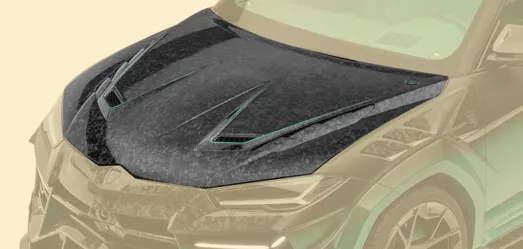
Front bonnet V - primed Mansory for Lamborghini Urus Venatus


Front Bonnet V (Primed) Mansory for Lamborghini Urus Venatus
The front bonnet V (primed) is the newer, generation-V evolution of the Mansory Venatus bonnet for the Lamborghini Urus, Urus S and Urus Performante. Within the wider Mansory Body Kit for Lamborghini Urus Venatus S, the bonnet is the largest single carbon panel forward of the windshield, and the V geometry was drawn specifically around the Venatus EVO-era front mask: the wider grille aperture, the redrawn Y-DRL signature of the post-2022 Urus S / Performante, and the more aggressive shoulder break that mates with the EVO front lip and the EVO race-flaps. Supplied primed for paint, the V bonnet is intended for owners who want the latest Mansory Urus aesthetic in body colour, harmonised with the OEM-painted fenders and roof rather than presented as raw weave.
Construction & Materials
The V bonnet is laid up as a full carbon-fibre composite shell with internal reinforcement ribs that mirror the OEM steel inner structure, then cured under autoclave heat-and-pressure to lock the resin matrix. Once cured, the panel receives a 2K epoxy primer surface applied by Mansory's bodywork facility, levelled and block-sanded so it leaves the workshop ready for a paint-shop colour coat — no raw weave is visible in service.
- 3K twill carbon-fibre substrate with internal woven ribs for torsional stiffness over the V8 engine bay
- Autoclave cure at controlled temperature and pressure for void-free lamination and dimensional stability
- Wall thickness approximately 1.6–2.2 mm across the main shell, thicker around the latch and hinge bosses
- Finished mass roughly 6–8 kg in primer, depending on final paint build (steel OEM bonnet is materially heavier)
- 2K epoxy high-build primer, block-sanded P400 → P600, ready for body-shop sealer + base + clear
- OEM-spec hinge mounts, latch striker, gas-strut tabs and underhood insulation pads pre-fitted
- Compatible with OEM under-bonnet wiring, washer jets and acoustic damping mat
- Supplied with installation hardware, alignment shims and a bodywork-prep technical sheet
Design & Visual Function
The V geometry is a deliberate redraw of the original generation-II Venatus bonnet. Where the gen-II shell was sculpted around the pre-facelift Urus front mask — narrower upper grille, earlier Y-DRL signature, softer shoulder line — the gen-V shell follows the Venatus EVO design language: a wider centre power-bulge, repositioned air-extraction louvres set further back over the intercooler stacks, and a sharper shoulder crease that runs cleanly into the EVO front lip and the EVO race-flap canards. The hot-air extraction vents are larger and more rearward on V, which improves visual continuity with the redrawn Urus S / Performante grille and gives the bonnet a longer, lower silhouette from a three-quarter angle.
Functionally, the relocated louvres sit more directly above the twin-turbo V8's charge-air paths, so under sustained load — Sport or Corsa, full boost on a long pull — hot air vents up and back rather than being trapped at the front. This is the same logic Mansory used on the EVO front-lip race-flaps and on the high-performance roof spoiler: keep the air moving rearwards, keep the front mask cool, keep the front-axle aero balanced.
Where the V bonnet really earns its place is in the four-way bonnet matrix Mansory offers for the Urus Venatus programme, and choosing correctly is the single most consequential decision an owner makes for the front of the car. The matrix is: front bonnet II carbon (gen-II geometry, lacquered raw weave on display), front bonnet II primed (gen-II geometry, painted in body colour), front bonnet II visible carbon (gen-II geometry, alternative visible-weave finish presentation), and front bonnet V primed — this part — gen-V geometry, painted in body colour. Owners who want the latest, most aggressive Mansory Urus aesthetic, harmonised with EVO front-lip and EVO race-flaps, specify V primed. Owners who want the classic Venatus look, with the carbon weave on theatrical display over the engine bay, specify II carbon or II visible carbon. Owners who want the classic gen-II silhouette but in body colour pick II primed. The V bonnet, by definition, is offered in primed form only — the gen-V geometry is intended for paint, not for raw-weave display.
Compatibility & Fitment
The V bonnet fits the Lamborghini Urus, Urus S and Urus Performante, with one important nuance owners should understand. Pre-2022 Urus cars — those built around the original Venatus front mask — accept the gen-II bonnet more naturally; the gen-II shoulder line and louvre placement was drawn around that earlier face. Post-2022 Urus S and Urus Performante cars — those running the facelift front mask, the redrawn Y-DRL and the wider lower aperture — pair more naturally with the gen-V geometry; the V bonnet's louvre position, shoulder break and rear-edge profile were specifically drawn around the facelift face. The V bonnet will physically mount to a pre-2022 Urus, but the visual harmony is best on Urus S and Performante. Mansory's recommendation, and ours, is to match generation: gen-II car → gen-II bonnet, facelift car → gen-V bonnet.
OEM hinge geometry, latch position, gas-strut travel, washer-jet placement and the pedestrian-impact zone are all preserved. Adaptive air-suspension self-levelling, the front parking-radar array, the night-vision feed (where fitted) and rear-wheel-steering response curves are unaffected, since none of these systems live in the bonnet. There is no active-aero constraint to consider on the front of the car.
Installation & Reversibility
Fitment of the bare bonnet is a 4–6 hour body-shop job — remove OEM bonnet, transfer hinges, latch striker, gas struts and underhood pads to the V shell, refit, align gaps to fenders and headlamps, verify latch travel and safety catch, refit washer plumbing and acoustic mat. Because the panel is supplied primed, it must then go to paint: full body-shop colour-match (typically a further 8–10 hours of prep, sealer, base coat, clear coat and bake). End-to-end, allow 12–16 hours total, plus the paint-shop drying schedule. The original OEM bonnet stores cleanly and the swap is fully reversible — wise owners keep the steel bonnet for resale or for converting back to factory specification before sale.
Pairing within the Mansory Urus Venatus programme
The four-way bonnet matrix is the most important cross-link to understand. The direct sibling in body-colour is front bonnet II primed — same primed-for-paint logic, gen-II geometry, for owners running the pre-facelift face. The lacquered-weave gen-II option is front bonnet II carbon, which presents the carbon weave on the bonnet's centre panel for owners who want the engine bay framed in visible carbon rather than body colour. The natural aero pair for the V bonnet is the EVO race flaps for front lip, drawn from the same Venatus EVO design generation and intended to mate visually with the gen-V shoulder line and louvre placement.
Maintenance & Durability
Once colour-matched and clear-coated, the V bonnet behaves like any high-quality painted body panel: pH-neutral shampoo, two-bucket wash method, soft microfibre, dedicated drying towel. A modern ceramic coating extends gloss life and hydrophobic behaviour, and is strongly recommended on a painted carbon bonnet. Avoid alkaline traffic-film removers, ammonia-based glass cleaners migrating onto the bonnet and any abrasive sponge or brush. The Urus is a school-run-and-long-distance super-SUV that will see motorway stone-chip exposure on the leading edge — paint protection film over the front 30–40 cm of the V bonnet, plus the headlight and front fender leading edges, is the single best investment for preserving paintwork. If a chip ever cuts through to the carbon substrate, a competent body shop can fill, prime, blend and clear-coat back to invisibility.
Lead Time & Warranty
Lead time runs four to eight weeks from order to release of the primed shell, reflecting Mansory's bespoke production cadence — laminate schedule, autoclave cycle, primer surface and final QA. Paint-shop time is additional and depends on the body shop. Warranty is twelve months from delivery against manufacturing defects in lamination, primer adhesion and hardware. Paint warranty is held by the body shop that applies the colour coat.
FAQ
Q: V vs II — which generation should I pick?
A: Match the generation to your car's face. Pre-2022 Urus pairs best with gen-II geometry; post-2022 Urus S and Urus Performante pair best with gen-V. The V bonnet's louvre position and shoulder line were drawn around the facelift Y-DRL mask.
Q: Does the V bonnet fit the original Urus, or only Urus S / Performante?
A: It fits all three cars at the hinge and latch level. Visually, V is happiest on Urus S and Performante. On a pre-2022 Urus the gen-V louvre placement reads as a slightly forward-of-its-time choice — some owners actually like that, but most match generation to face.
Q: How much weight does the V bonnet save versus OEM?
A: The OEM steel bonnet is materially heavier than the carbon V shell. The carbon panel sits roughly 6–8 kg in primer, with painted weight a fraction higher. Weight saved over OEM is meaningful, helping front-axle response in steering transitions and braking.
Q: Why is the V bonnet only sold primed?
A: The gen-V geometry was drawn for body colour, to integrate with painted fenders, painted EVO race-flaps and the roof. Mansory does not present V as a raw-weave display panel; if you want visible weave on the bonnet, the gen-II carbon and visible-carbon variants are the correct choices.
Q: How long is fitment plus paint?
A: Roughly 12–16 hours total — 4–6 hours to fit the bare shell and align gaps, then a further 8–10 hours of paint-shop prep, base, clear and bake, plus the paint-shop drying schedule. Lead time on the panel itself is four to eight weeks.
Pair the V bonnet with EVO race-flaps and the body-colour rear-decklid spoiler for a fully harmonised Venatus EVO-era Urus front-to-rear silhouette. To order, configure colour code, or discuss matching to an existing Mansory build, talk to us: WhatsApp +44 7488 818 747 or [email protected].