
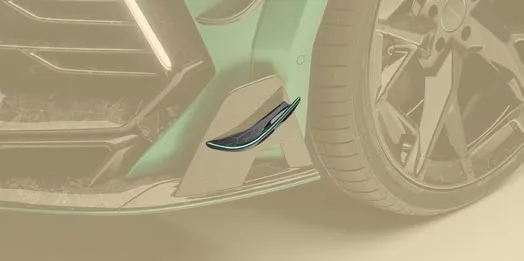
EVO Race flaps for front lip Mansory for Lamborghini Urus Venatus


EVO Race Flaps for Front Lip — Mansory for Lamborghini Urus Venatus
The EVO race flaps are the third leg of the Mansory Venatus front-canard matrix and the most recent revision in the programme — a pair of carbon flaps engineered to bolt to the Mansory front-lip extension rather than directly into the Urus bumper. They are the natural choice for owners running the full Mansory Body Kit for Lamborghini Urus Venatus S, where the lip extension is already part of the front-end architecture. The geometry is newer than the original race-flaps, the shoulder line is cleaner, and the EVO-era aesthetic ties the front mask, the Y-shaped LED DRL signature and the hexagonal Lambo intake DNA into a single, deliberate aero statement. With 4.0 twin-turbo V8, eight-speed ZF, rear-wheel-steering and adaptive air suspension underneath, the Urus deserves canards that look engineered into the car, not stuck onto it.
Construction & Materials
EVO race flaps are supplied as a left-and-right pair, autoclave-cured at elevated temperature and pressure for full prepreg consolidation. Compared to the bumper-mount race-flaps and the front-assistant variant, the EVO geometry is sculpted around the lip extension's leading edge, so the flap blends rather than steps off the panel.
- Pre-impregnated 3K twill carbon laminate, autoclave-cured for void-free density and structural rigidity at speed.
- Pair weight approximately 1–2 kg, balanced left-and-right with mirrored profiles to maintain symmetric vortex output.
- Wall thickness in the 2.0–2.6 mm range across the canard body, locally thicker at the lip-extension mounting tabs for fastener pull-out resistance.
- Mounts to the Mansory front-lip extension via concealed bolts and structural adhesive; can also be fitted to a compatible OEM Urus S / Performante apron with adapter hardware on confirmation.
- Finish supplied in Mansory deep-gloss UV-stable lacquer over visible weave; satin and primed finishes available on bespoke order.
- Edge geometry refined relative to the original race-flap — the EVO trailing edge runs cleaner along the lip's shoulder, with no visible step where the flap meets the extension.
- Stainless and zinc-plated fasteners as supplied; thread-lock recommended on torque-down.
- Each pair carries a Mansory part identifier and is matched to the Venatus EVO front-lip programme.
Design & Visual Function
The headline difference between the EVO race flaps and the two earlier canards in the matrix is where they live on the car. Standard race-flaps anchor directly into the Urus bumper, biting clean air at the apron's outermost shoulder. The front-assistant variant does the same job with a notch carved out for the parking-sensor cone, sacrificing a little vortex tuning to keep ADAS happy. The EVO flap takes a different route: it sits on the front-lip extension, lower in the air mass, working a flow path that has already been shaped by the lip itself. The result is a different vortex character — tighter, lower, and tied into the air the lip is already redirecting toward the wheel arch and intercooler intakes.
Visually, the EVO flap is the most contemporary of the three. Mansory's later Venatus EVO programme refined the front-end language — flatter shoulders on the lip, cleaner intersections between the apron, the lip and the canards, less of a stuck-on aftermarket impression. If you compare a Venatus running standard race-flaps directly into the bumper with one running EVO flaps on the lip, the EVO car reads as one continuous front-end sculpture; the standard car reads as a bumper with canards bolted on. Neither is wrong — they are different aesthetic registers within the same programme.
The matrix decision is straightforward. Pick the standard race-flaps if you want the original, most aggressive bumper-mount canard and your car has no front-assistant sensor in the way. Pick the front-assistant variant if your Urus has the front-assistant ADAS package and you need the sensor cut-out to retain the parking-aid function. Pick the EVO race flaps — these — if you are already running the Mansory front-lip extension or you are building a Venatus EVO-spec front end and want the latest, cleanest visual integration. Owners who plan to run the Mansory front lip almost always end up here, because mounting earlier-generation flaps onto a lip-equipped car involves compromise on either side of the panel.
Compatibility & Fitment
EVO race flaps are designed for the Lamborghini Urus, Urus S and Urus Performante (2018–present). The intended host is the Mansory front-lip extension; if your Urus is already wearing the Mansory lip — as it would be on a complete Venatus or Venatus S kit — the EVO flaps drop in directly. For facelift Urus S and Performante aprons without the Mansory lip, fitment is conditional on confirmation; we ask for VIN, build year and front-end photographs before quoting, because the EVO flap's mounting geometry is optimised for the lip extension and will not blend correctly on every OEM apron. Adaptive air suspension self-levelling, rear-wheel-steering geometry and the six driving-mode aero state are unaffected. OEM parking sensors can be retained where the host apron carries them; sensor cut-outs are confirmed during fitment.
Installation & Reversibility
Plan on roughly 1.5–2.5 hours of body-shop time per pair, ideally with the front of the car on stands and the lip extension already fitted and torqued to its final position. Installers dry-fit each flap, mark the bolt path, drill or open the supplied lip mounting points if not pre-prepared, apply structural adhesive bead, set the flap, fasten the concealed hardware and finish with sealant clean-up. EVO flaps are fully reversible — fasteners back out, adhesive releases under heat, and any pilot holes sit inside the lip extension's own footprint, so a future repaint or panel swap recovers a clean apron. We recommend a Lamborghini-certified body shop or a Mansory-trained installer for first fitment, particularly when the lip extension itself is part of the same install session.
Pairing within the Mansory Urus Venatus programme
The EVO race flaps live inside the front-canard matrix but also pair naturally with EVO-era body parts. Within the canard matrix, sister parts are the bumper-mount Race Flaps Carbon Mansory for Lamborghini Urus Venatus and the ADAS-friendly Race Flaps for Cars with Front Assistant Mansory for Lamborghini Urus Venatus — pick exactly one, depending on whether you are running the Mansory lip and whether your car carries front-assistant. For a coherent EVO-era front end, pair the EVO flaps with the Front Bonnet V Primed Mansory for Lamborghini Urus Venatus, whose generation-V geometry sits visually closer to the Venatus EVO language than the earlier generation-II hood. Owners building the full programme often add the rear high-performance roof-spoiler or performance wing to balance front and rear downforce visually.
Maintenance & Durability
The EVO flap leads the air at the front of the car and sits below the headlight line, in exactly the zone where stone-chip exposure peaks on a super-SUV used for school-run, motorway miles and the occasional gravel approach. Apply paint protection film over the leading edge of each flap as part of the install — this is the highest-value PPF spend on the front end, sparing the lacquer and the weave underneath. Wash with pH-neutral shampoo and a clean wash mitt, dry with plush microfibre and avoid alkaline cleaners, ammonia, traffic-film removers and abrasive sponges, which all attack lacquered carbon. A dedicated carbon-safe ceramic coating extends gloss life and makes road grime release on a rinse. If a stone strike scuffs the lacquer, a clear-coat refresh recovers the finish; deeper damage into the weave is repairable through a Mansory-trained carbon specialist with no need to swap the panel.
Lead Time & Warranty
Mansory builds Venatus EVO carbon to order. Lead time on EVO race flaps runs four to eight weeks from order confirmation, sometimes longer when paired with a full front-end refresh or with the lip extension itself. Each pair is inspected before despatch and carries Mansory's twelve-month warranty against manufacturing defects in the laminate, lacquer and hardware. Impact damage, abrasion, stone strikes and chemical attack from incorrect cleaners are not covered, which is exactly why PPF on the leading edge is a strong recommendation.
FAQ
Q: How are the EVO race flaps different from the standard race-flaps?
A: The EVO flaps mount on the Mansory front-lip extension rather than directly on the bumper. The geometry is newer, the integration is cleaner, and the visual register matches the Venatus EVO front-end language. Standard race-flaps bite air at the apron shoulder; EVO flaps work a flow path the lip has already shaped.
Q: Do I have to be running the Mansory front lip to fit the EVO flaps?
A: That is the intended host and gives the cleanest result. They can fit some OEM Urus S and Performante aprons with confirmation, but the lip is where the EVO geometry was designed to live. If you are not running the lip, the standard race-flaps or front-assistant variant are usually the better call.
Q: Will they work on my Urus / Urus S / Performante?
A: Yes across the line in principle. We ask for VIN, build year and front-end photographs before confirming, especially on cars without the Mansory lip extension. Air suspension self-levelling, rear-wheel-steering geometry and driving-mode behaviour are unaffected.
Q: What if a flap is damaged by a stone strike or kerb hit?
A: Surface chips refresh through clear-coat repair. Deeper damage is repairable through a Mansory-trained carbon specialist; a full panel swap is rarely required. PPF on the leading edge is the cheapest insurance.
Q: How long until I get them?
A: Four to eight weeks from order confirmation in most cases, sometimes longer if the build is paired with the lip extension or a complete front-end refresh.
Pair the EVO race flaps with the Mansory front lip extension and a generation-V bonnet for a coherent Venatus EVO front end. Talk to us before you order: WhatsApp +44 7488 818 747 or [email protected].