
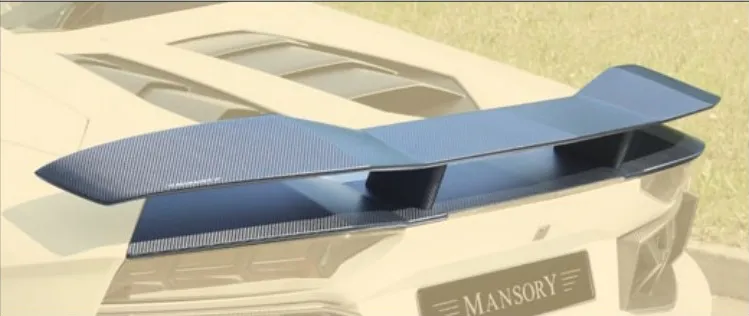
Biplane performance wing Mansory Carbon for Lamborghini Aventador Competition


Mansory Carbon Biplane Performance Wing for Lamborghini Aventador Competition
The biplane performance wing is the most theatrical aerodynamic statement in the Mansory Carbon Body Kit for Lamborghini Aventador Competition programme — two stacked carbon aerofoil planes mounted on twin swan-neck pylons, the upper element sitting roughly a chord-and-a-half above the lower. Where the single-plane rear-performance wing chases efficiency, the biplane chases peak downforce and visual drama in equal measure. It suits owners who want their LP-series, SVJ or Ultimae Aventador to read like a GT-class race-car from twenty paces, and who accept a measured drag tax in return for the layered, working-pair aesthetic. The design respects ALA 2.0 on SVJ donor cars by keeping the central rear-wing channel unobstructed, mirrors the V12 NA airbox feed behind the scissor-door cuts, and bolts to the same OEM hard-points as the rest of the Competition wing line.
Construction & Materials
Twin elements demand twin layup discipline. Mansory builds each plane around a closed-section CFRP torsion box — two skins bonded over an internal rib lattice — so the wing can shoulder peak loads at 300+ km/h without the chord flexing into harmonic chatter. The pylons and endplates are co-cured rather than bonded post-cure, eliminating a stress riser at the wing-to-mount interface. The slot gap between the upper and lower aerofoils is geometrically calibrated, not eyeballed, and the endplates seal the gap from spilling into a tip vortex.
- 3K twill prepreg outer skins on both aerofoils; 12K unidirectional spar caps along the chord neutral axis
- Autoclave cure at 6 bar / 125 C for the load-bearing planes; pylons and endplates RTM-prepreg co-cure
- Skin wall thickness 1.6–2.0 mm on the upper plane, 2.0–2.4 mm on the lower; pylons 4–5 mm in the bend zone
- Combined dry weight 7.4–8.6 kg depending on lacquer pack — the lower plane carries the bulk
- Stainless A4 mounting hardware, captive titanium-grade washers under the swan-neck feet
- Slot-gap spacer tube CNC-machined from 7075 aluminium, anodised black, hidden inside the endplate sandwich
- Lacquer options: high-gloss UV-stable 2K clear, satin matte, or factory-grade visible-weave gloss with anti-yellowing topcoat
- Optional forged-carbon endplate inserts for the marbled chip aesthetic against the orderly twill of the planes
Design & Visual Function
Twin-plane aerodynamics are not single-plane aerodynamics scaled by two. The upper aerofoil sits in the partially deflected wake of the lower, which means each element runs at a slightly different effective angle of attack. Mansory exploits this — the lower plane is set at a milder geometric incidence to manage the freestream, while the upper plane is steeper, biting into already-turned air. The slot gap between them works as a fluidic bypass: high-pressure flow from beneath the upper plane bleeds through the gap and re-energises the boundary layer over the lower plane's suction surface, delaying separation past the angles a solo wing would survive. The net effect is a downforce shelf that climbs steeper with speed than a single-plane reference of equivalent span.
Vortex management is where the biplane earns its keep visually as well as functionally. The endplates are tall, scalloped along the leading edge and rolled outward at the trailing edge, which forces the wingtip vortex to shed cleanly outboard rather than rolling up between the two planes and choking the slot. From three-quarter rear, the silhouette reads as an interlocked pair of carbon blades floating over the engine cover — a deliberate echo of GT3-class race aero that Mansory codified into its Carbonado design vocabulary years ago.
The drag penalty versus the single-plane rear-performance wing is real and worth being explicit about. Twin elements double the wetted surface and add interference drag at the slot, so peak speed on a long straight will trail the single-plane sibling by a few km/h at unrestricted V12 power. In return the biplane plants the rear axle harder during high-speed direction changes, complements the SVJ's rear-wheel-steering authority, and lifts mid-corner stability on long sweepers. ALA 2.0 on SVJ is preserved — the central channel mast routes between the lower plane's pylon feet, never blocked by either aerofoil — so the active aero strategy still has its idle-drag and stall-balance modes.
Compatibility & Fitment
Fitment covers the full Lamborghini Aventador Competition donor matrix: LP700-4, LP750-4 SV, S, SVJ (coupé and Roadster) and Ultimae. Pre-SVJ cars receive a passive variant — bolt-through pylons land on the reinforced rear deck hard-points behind the engine bonnet. SVJ donors get the ALA-aware variant: the lower plane's pylon spacing widens by approximately 80 mm to clear the active aero mast, and the wing is supplied with a profiled pass-through cap so the central channel remains uninterrupted. Roadster owners can specify the wing — pylon feet anchor forward of the targa stowage well, with no interference with the soft-top mechanism. OEM rear parking sensors stay live; high-mount central twin-exhaust on SVJ retains its full thermal halo, and the lower plane's trailing edge is set above the exhaust plume column to avoid soot deposition on the underside.
Installation & Reversibility
Plan 5–7 hours for a clean fit including alignment, torque verification and slot-gap geometric check. Tooling list: torque wrench (10–60 Nm range), drill with carbide pilot for the SVJ ALA bypass collar if upgrading from a passive deck, alignment laser or string-line for symmetry, fish-eye tape during initial mock-up. Pylon feet land on reinforced OEM mount points already engineered for the donor's factory wing or its LP series rear-deck inserts; no structural cutting of the CFRP monocoque is required. Methacrylate adhesive is not used on this part — the biplane is mechanically fastened, so reversibility is total. Removal restores the deck to OEM appearance once the captive collars are unscrewed and the tap-point covers reseated. Lamborghini-certified bodyshop or Mansory-trained installer is recommended for first-time fitters because slot-gap geometry is the variable that determines whether the wing performs as designed.
Pairing within the Mansory Aventador Competition programme
The Competition catalogue offers three rear-aero strategies, and choosing the right one is a matter of intent rather than hierarchy. The rear-performance-wing is the efficiency-first option — single-plane, lowest drag, best top-speed bias, suited to owners who value V12 freewheel composure and clean wake signature. The biplane covered here is the middle-weight in downforce-per-frontal-area terms but the heavyweight in visual signature. If the twin-tier silhouette matches the brief but more peak grip is needed still, the rear-high-performance-wing answers that — taller endplates, longer chord, the fullest grip envelope of the line. Owners who reject all three winged silhouettes for a stealthier rear deck pick the rear-spoiler ducktail instead — passive lip, no pylons, trim-level downforce. Pick by intent: stealth, balanced theatre, or maximum grip.
Maintenance & Durability
Lacquered twill on a twin-plane wing weathers harder than a single-plane reference because the slot gap traps wash water and accelerates UV-induced amber drift if neglected. Treat the planes to a quarterly ceramic-coat refresh on the upper surfaces, and rinse the slot gap end-to-end whenever the car returns from rain or trackday duty so iron-rich brake dust does not microscore the lacquer. Avoid alkaline wheel cleaners on the endplates entirely — overspray attacks the 2K clear and dulls the weave within a season. Soft microfibre only; no abrasive sponges, no ammonia glass cleaner near the planes. The V12 hot zone sits ahead of and below the wing, so heat soak from the mid-mounted naturally aspirated engine reaches the lower plane's underside indirectly via convective wash; the laminate is qualified to that thermal envelope but acoustic test cycles still suggest annual visual inspection of the pylon-foot bond line. Stone chips on the lower plane's leading edge, if they occur, are repaired with an in-shop scarf-and-laminate workflow rather than spot-fill.
Lead Time & Warranty
Lead time runs 4–8 weeks because Mansory builds each biplane to order — the slot-gap geometry and endplate scallop pack are configured per donor variant and lacquer choice rather than pulled from a finished-stock pool. A 12-month manufacturing-defect warranty covers laminate delamination, pylon-foot bond integrity and lacquer adhesion. UV drift, stone-chip damage and improper-cleaner attack are out of scope.
FAQ
Q: How much extra downforce versus the single-plane rear-performance wing?
A: At 200 km/h the biplane delivers roughly 35–45% more rear downforce than the single-plane reference of equivalent span, scaling steeper with speed. The trade is a few km/h of top-speed potential and modestly higher fuel burn at sustained cruise.
Q: Is the biplane SVJ ALA-compatible?
A: Yes. The ALA-aware variant widens pylon spacing to clear the active aero mast and includes a profiled pass-through cap so the central channel remains uninterrupted. ALA 2.0 retains its idle-drag and stall-balance modes.
Q: Will the slot-gap geometry shift over time?
A: No. The CNC-machined 7075 spacer tube inside the endplate sandwich is dimensionally stable, and the swan-neck pylons are co-cured rather than bonded — the gap stays where it was set during the autoclave cure for the laminate's lifetime.
Q: Coupé only or Roadster as well?
A: Both. Roadster fitment anchors pylons forward of the targa stowage well and does not interfere with soft-top operation. Confirm donor variant at order so the correct fastener pack ships with the wing.
Q: Can I keep raw weave instead of lacquer?
A: Raw weave is offered but not recommended on a load-bearing twin-plane assembly — UV exposure on bare epoxy yellows the resin within months and reduces matrix performance. Factory-grade visible-weave gloss with anti-yellowing topcoat is the visual-purist choice.
Q: Will the lower plane scorch over the central twin-exhaust on SVJ?
A: No. The lower plane's trailing edge sits above the exhaust plume column so the laminate stays outside the direct thermal halo. Convective wash reaches the underside but the autoclave-cured prepreg is qualified to that envelope.
Pair the biplane with a sculpted lower deck — the designed-diffuser closes the rear visual statement, while a finished engine bay reads cleaner with the engine-bonnet coupé panel above it. Configure the wing pack via WhatsApp +44 7488 818 747 or [email protected] and we will quote your exact donor variant, lacquer pack and lead-time slot.