
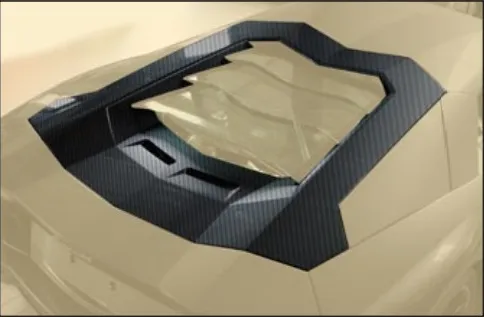
Engine bonnet Mansory Carbon for Lamborghini Aventador Competition


Mansory Carbon Engine Bonnet for Lamborghini Aventador Competition
The engine bonnet is the most theatrical surface on a mid-engine Lamborghini Aventador — a glass-and-carbon canopy that frames the 6.5-litre naturally aspirated V12 like a museum vitrine over a working sculpture. This Mansory carbon piece replaces the factory cover on the coupe variant of the Aventador Competition programme, sitting within the wider Mansory Carbon Body Kit for Lamborghini Aventador Competition. Crucially, this part is for the closed-roof car only — the Roadster uses a separate piece with a different rear-deck topology and soft-top stowage geometry. Owners specify the bonnet for three reasons at once: thermal management of the V12 hot zone, visual continuity with the rear quarters and rear bridge, and the acoustic signature that travels through a vented engine cover when the dual-clutch ISR slams a gear above 7,000 rpm.
Construction & Materials
Mansory builds this bonnet as a hybrid lay-up: a structural carbon shell carries the load, large tempered-glass apertures preserve the showcase function, and dedicated extraction louvres are cut and capped with carbon vanes to channel the V12's thermal plume up and away from the rear glass. The glass is bonded with high-temperature urethane rated for the engine-bay soak that follows a track session. The carbon perimeter and centre spine are autoclave-cured prepreg; vane sets and vent surrounds are RTM-pressed for closer tolerances on visible edges. Weave alignment is hand-mapped before cure so the twill direction follows the natural taper from the cabin shoulders towards the tail, joining the rear bridge and rear bumper outtake covers in one continuous visual line.
- Outer skin: 3K twill prepreg, 0/45/0 lay-up, autoclave cured at 120 C and 6 bar.
- Inner sub-frame: 2x2 twill biaxial with localised unidirectional reinforcement around glass mounts and louvre cut-outs.
- Wall thickness 1.6–2.4 mm shell; 3.2 mm at louvre flanges and hinge pad zones.
- Tempered glass louvres bonded with high-temp urethane, edge-polished and ceramic-printed.
- Mass saving versus OEM coupe bonnet: approximately 3.4–4.1 kg, depending on glass spec.
- Mounting: factory hinge pad pattern, OEM gas struts, factory latch and pop-up safety catch retained.
- Finishes: gloss lacquer, matte 2K satin, soft-touch satin, raw weave with UV-stable seal, optional forged-look insert in the centre spine.
- Hardware: stainless A4 fasteners, anti-rattle isolators on louvre vanes, EPDM perimeter seal.
Design & Visual Function
The Aventador's rear deck is dominated by hot air. A naturally aspirated V12 with dry-sump lubrication dumps roughly the same heat load as a small house furnace into the engine bay during a hard run, and the OEM cover already concedes a big slot for it. Mansory amplifies that gesture: the louvre count goes up, the louvre pitch tightens over the cylinder banks, and the carbon vanes between glass panes become functional flow guides rather than decorative crossbars. The exposed weave reads as raw rather than dressed because it sits next to glass — there is no body colour to soften the contrast, so the carbon orientation has to be perfect on every car. Mansory hand-orients the twill so the diagonal threads bisect the centre spine at exactly 45 degrees and continue that bias into the rear-quarter intake covers when those parts are specified together.
Acoustic behaviour shifts noticeably. The OEM bonnet acts as a partial acoustic ceiling above the V12; the Mansory cover, with a higher open area through louvres and vents, lets more of the intake roar and exhaust resonance escape upward and rearward. Owners with high-mount central twin-exhaust SVJs report a sharper top-end edge to the note above 6,500 rpm, where the V12 stops being a baritone and turns into something operatic. The visual function pairs that with theatre: at night, with the engine running, the louvre slots glow faintly amber from the manifold heat, and the engine-bay LED bar (factory option) reads through the glass with a depth that the painted OEM cover cannot deliver.
On SVJ chassis, the bonnet's central spine is profiled to clear the ALA 2.0 rear-wing mast and never intrudes into the central rear-wing channel, so active aero behaviour at the wing remains exactly as Sant'Agata intended. The piece complements the rear bridge and the biplane wing rather than replacing any aerodynamic role they perform.
Compatibility & Fitment
This part fits Lamborghini Aventador coupe variants only — LP700-4, LP750-4 SV, S, SVJ and Ultimae closed-roof cars. The Roadster uses a different deck assembly with soft-top stowage geometry; for that car please reference the cabrio engine bonnet listed in the same programme. The bonnet retains all OEM Lamborghini hinge pads, gas struts, latch, pop-up safety catch and harness routing for the engine-bay courtesy lights and any factory engine-bay LED option. SVJ-specific clearances are honoured: the centre spine is recessed under the ALA mast path, and the louvre array sits clear of the central rear-wing pylon footprint. Pre-SVJ LP and S cars use the same hinge geometry, so fitment is identical; the only difference is louvre orientation tuning to match the lower exhaust outlet path on side-exhaust cars rather than the central twin-exhaust on SVJ. Rear-wheel-steering hardware sits well below the engine cover and is not affected. The factory parking-sensor harness is unchanged; the bonnet itself carries no sensors.
Installation & Reversibility
Budget 4–6 hours for a clean install at a Lamborghini-certified body shop. The job is fully bolt-on at the hinge pads — no monocoque drilling, no methacrylate adhesive bonding to the CFRP tub, no harness cutting. Workflow: chock the car on a flat lift, support the OEM cover, disconnect the gas struts at the upper ball studs, unbolt the four hinge fasteners, lift the OEM bonnet clear, transfer the latch striker plate and the rear-deck weather seal to the Mansory shell, drop the new piece onto the hinges, reconnect struts, set the latch, and shim the perimeter for an even gap to the rear-quarter weave. Glass louvres ship pre-bonded; do not attempt to remove or reseat the glass. After fit, run a hot soak — engine to operating temperature, twenty minutes idle, then a short blast — and re-check louvre temperature distribution with a non-contact thermometer to confirm there are no cold pockets indicating an obstructed vent. Reversibility is full: the OEM cover bolts straight back on with no surface trace.
Pairing within the Mansory Aventador Competition programme
The engine bonnet is rarely specified alone. The natural pairing is with the smaller Mansory carbon bonnet air outtake, which handles the secondary hot-air slot just inboard of the rear-quarter shoulder and visually echoes the louvre rhythm of the main cover. For owners who run a Roadster as a second car or who want catalogue-level cross-reference, the cabrio engine bonnet is the open-top sibling — a useful comparison for anyone undecided between coupe and Roadster spec. The third frequent pairing is the Mansory rear bridge, which closes off the rear of the engine deck and continues the twill bias through to the tail-light line, giving the rear quarter a single uninterrupted weave plane from hinge to bumper.
Maintenance & Durability
Carbon bonnets that sit directly above a V12 hot zone live a harder life than carbon panels on the doors or sides. The lacquer cycles through bigger temperature swings, the surface picks up more airborne oil mist around the louvres, and UV exposure on the centre spine is essentially unshielded. Two practical rules. First, ceramic-coat the lacquered weave on day one and refresh annually — a high-SiO2 ceramic outperforms carnauba for thermal cycling and is far easier to wipe clean of louvre soot. Second, never use alkaline wheel cleaner, ammonia-based glass cleaner or abrasive sponges anywhere on the bonnet; the lacquer is harder than paint but the gloss layer above it is not, and a single pass with a yellow scrub pad will haze the weave permanently. Glass apertures take standard automotive glass cleaner; just keep the cleaner away from the urethane bond line. For chip repairs, Mansory supplies matched lacquer kits keyed to the original cure batch, and a competent detailer can spot-repair stone strikes near the leading edge of the louvre array without re-cooking the whole panel. Lifespan with reasonable care exceeds the chassis life of the car.
Lead Time & Warranty
Mansory builds these bonnets to order; lead time runs 4–8 weeks from confirmed spec to dispatch, depending on finish complexity and whether forged-look inserts are added at the centre spine. A 12-month manufacturing warranty applies against delamination, glass-bond failure and lacquer defects under normal use. The warranty does not cover stone strikes, track-day damage or cosmetic wear from incorrect cleaning chemistry.
FAQ
Q: Will this fit my Roadster?
A: No. This is the coupe-only version. The Roadster uses a different rear deck because of the soft-top stowage geometry, and Mansory builds a separate cabrio engine bonnet for that car.
Q: Does it block ALA on the SVJ?
A: No. The centre spine is profiled to sit clear of the ALA 2.0 rear-wing mast, and the louvre array stops short of the central rear-wing channel footprint. Active aero behaviour at the wing is unchanged.
Q: Does it really change the V12 sound?
A: Subtly but audibly above 6,500 rpm. The higher open area through louvres lets more high-frequency content escape upward, sharpening the top end. Below 4,000 rpm the difference is barely there.
Q: How much weight does it save versus OEM?
A: Around 3.4–4.1 kg depending on glass spec. The saving sits high and rearward, so it has a measurable effect on rear-axle yaw response, more than a same-mass saving on a door panel would.
Q: Lacquered or raw weave for an engine cover?
A: Lacquered, almost without exception. The bonnet is the dirtiest carbon surface on the car — louvre soot, oil mist and bug strikes — and lacquer makes cleaning realistic. Raw weave looks beautiful for a month, then needs constant babying.
Q: Will the louvres cool the V12 enough on track?
A: They help. The bonnet is not a substitute for a proper oil cooler or radiator strategy, but the additional vented area meaningfully reduces engine-bay soak temperatures on long sessions, which is good for the dry-sump system and for nearby harnessing.
Pair the engine bonnet with the bonnet air outtake and rear bridge for a continuous carbon plane across the rear deck, or quote it on its own as a single-piece upgrade. Order or quote via WhatsApp +44 7488 818 747 or [email protected].